00197187-01_AI_LBO_SX12_ab_09-2011_FS02_de_en.pdf - 第60页
Annex Calibrating the Lifting Table Motors in SX1/2 Conveyors 60 Long Board Option 4.2 Calibrating the Lifting Tab le Motors in SX1/2 Conveyors Due to the higher wei ght of the lif ting tab le plates for the LBO, you nee…
Annex
Setting the Parallelism and Height of the Lifting Table Plate
Long Board Option 59
4 Annex
4.1 Setting the Parallelism and Height of the Lifting Table Plate
Parts, equipment and tools
▪ Depth measuring gauge (200 mm) [03079617-xx]
Setting
► Initialize or move the lifting table before performing measurement. This is important as the bottom
position is not automatically the mechanical end position. Move the lifting table to the bottom stopper:
Check sensors and functions --> Check sensors and functions of specific
components --> Conveyor – inputs/outputs --> Lane --> Lifting table down.
To achieve a position which can be reproduced, it may be advisable to move the lifting table once
from the central position downwards. (Not multiple times downwards when it is already in the bottom
position.)
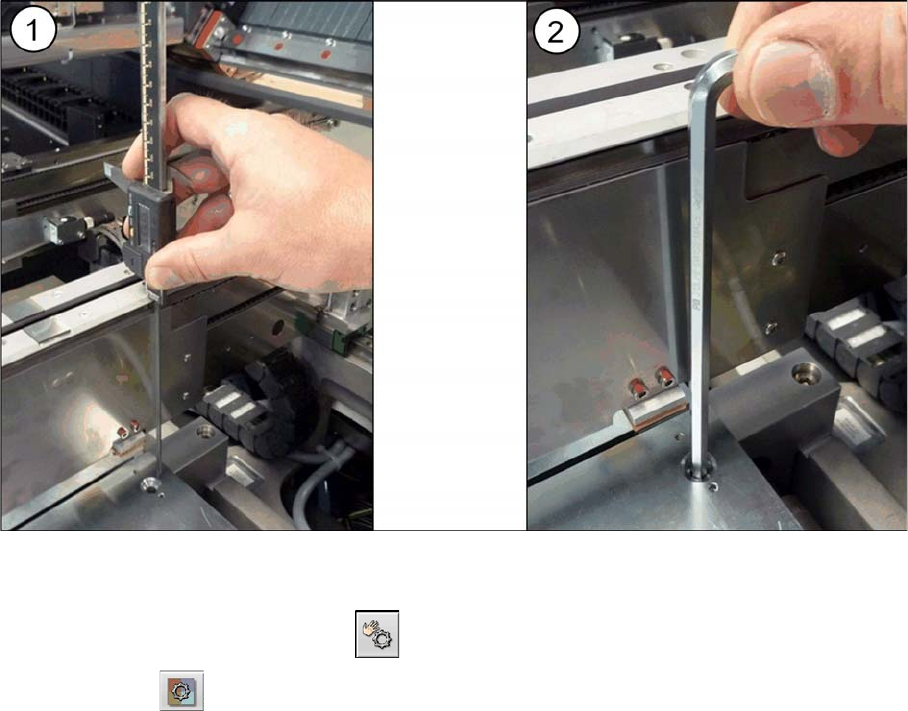
► (1) Use the measuring gauge to measure the distance from the top edge of the conveyor to the top
edge of the lifting table plate.
► (2) Set the height of the lifting table plate with the help of the plate guides to 145 -0.2 mm. You do
not need to remove the lifting table plate for this as the hexagon socket-head screws on the plate
guides can be reached with an Allen key size 6, through the holes provided in the lifting table plate.
However, the lifting table plate will need to be screwed tight again before you perform measurement.
► Perform this measurement procedure at all four screws fastening each lifting table plate. This is es-
sential for guaranteeing the parallelism of the lifting table plates. The four measurements may not
deviate from one another by more than 0.1 mm.
► Calibrate the zero position of the lifting table motor.
Annex
Calibrating the Lifting Table Motors in SX1/2 Conveyors
60 Long Board Option
4.2 Calibrating the Lifting Table Motors in SX1/2 Conveyors
Due to the higher weight of the lifting table plates for the LBO, you need to recalibrate the lifting table
motor.
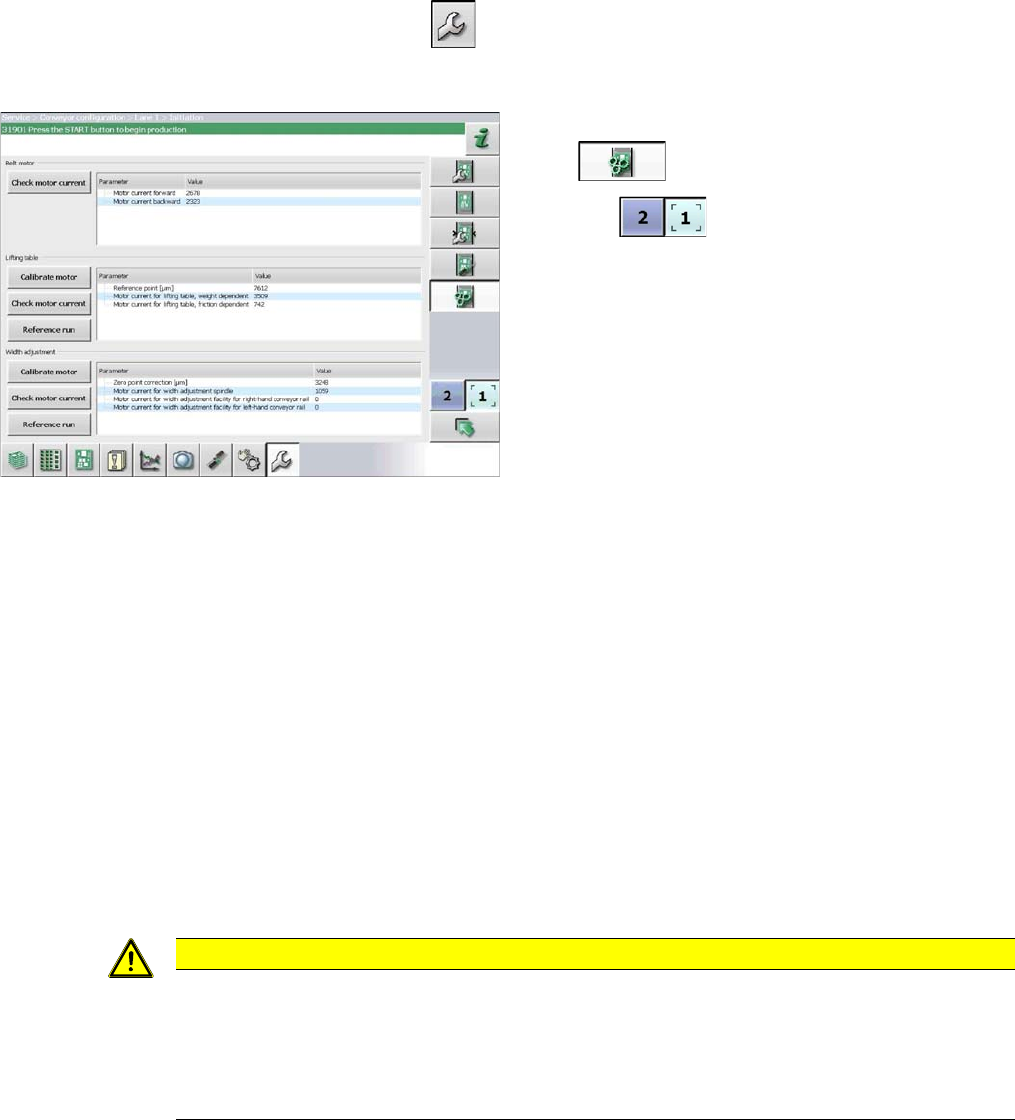
► Start up the station.
► Switch over to the activity level Machine Service (or better still)
► Switch over to the service menu .
► Select the Conveyor configuration button.
4.3 Loosening the Conveyor Side Clamps (DT only)
Many tasks performed on the conveyor require that the conveyor sides are moved when the machine is
switched off. The conveyor side clamps on the dual/quad conveyor can be released for this purpose.
Parts, equipment and tools
▪ Per side:
3x ISO4762-M3x35-A2-70 [03043114-xx] or
3x ISO8734-3x30-A-ST [03015760-xx]
Procedure
► Move the conveyor sides to a position which gives you good access to the clamps.
► Switch off the machine, disconnect it from the power supply and secure it to prevent unauthorized
reactivation. Observe the instructions in section "1.2 Preparatory Work..." [ ➙ 37].
Select the applicable version of the clamp:
► Select the Initiate conveyor parameters but-
ton .
► Use the button to select the required con-
veyor lane.
► Calibrate the lifting table motor in the Lifting ta-
ble section, by selecting the Motor calibration
button.
CAUTION
Marking the starting positions
After completing this task, move the conveyor sides back to their approximate starting posi-
tions.
► To enable you to find the starting positions later on, you may want to mark the current po-
sitions of the conveyor sides.
Annex
Loosening the Conveyor Side Clamps (DT only)
Long Board Option 61
Restoring the clamp
► Follow the removal instructions in reverse order for installation. Also observe the following instruc-
tions:
Version 1
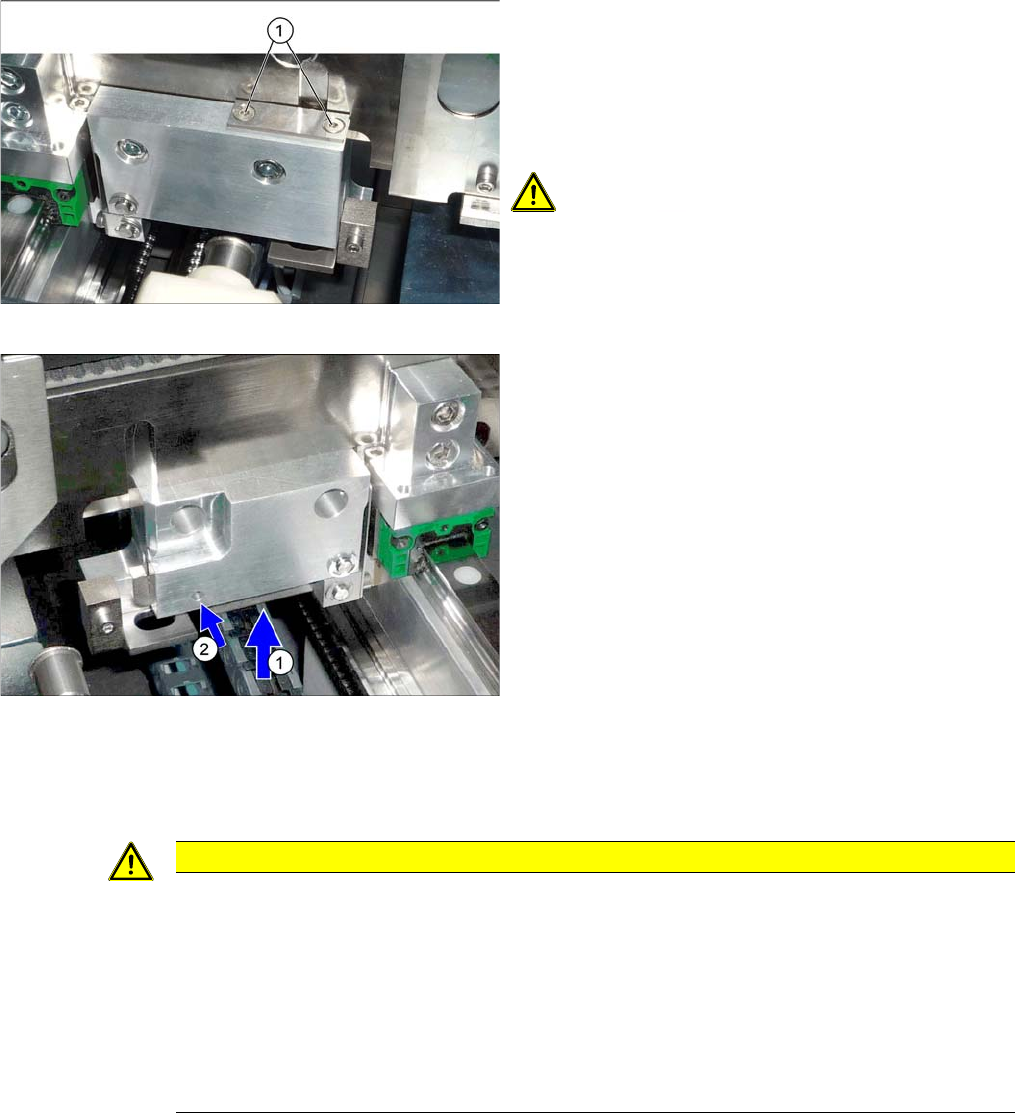
► Loosen the clamps on the conveyor sides.
To do this, remove the disks above the clamp com-
pression springs (2 screws for each disk). To do this,
loosen both screws (1) on the clamps (2 x for each
conveyor side).
CAUTION!
Compression springs
The compression springs are tensioned.
Make sure that you do not lose these.
You can now move the sides.
Version 2
► Loosen the conveyor side clamps. To do this, press
the lever (1) upwards and push a suitable pin into the
hole (2).
► Repeat these steps for all clamps on the sides con-
cerned.
You can now move the sides.
CAUTION
Installation instructions
► Make sure that the conveyor sides are aligned parallel again. You may need to push these
up to the stop on one side to check.
► Use a board to test the parallelism. This board must be transported evenly through the en-
tire conveyor.
► Make sure that the conveyor sides are back in their original positions after switching on.
Perform a complete reference run to check this. (This is performed automatically when you
start up the machine again.)