VDA_6.3_EN_Yellow_Volume_.pdf.pdf - 第13页
11 product charac teristics, thi s should be documented and taken into account in the evaluation. Table 2-1: Diffe rentiation between aud it standard s
10
2 Instructions for use
2.1 Scope of the volume
A process audit is a method for impartial analysis and evaluation of product
development and implementation processes as well as their effectiveness.
Process audits can be used internally as well as externally throughout the en-
tire product life cycle and fulfill the requirements specified in IATF 16949. Pro-
cess audits are suitable for small or medium-sized companies as well as
large corporations.
In general, this volume can be used throughout the entire product life cycle. In
this regard, a distinction is made between:
- Potential analysis
- Product and production process development
- Product and production process implementation
- series production
When conducting process audits, the selection of process elements and the
implementation period may vary.
During series production, the process audit serves to ensure regular monitor-
ing of the series production processes and can also be used on an event-ori-
ented basis.
The aim of the process audit is to determine whether the processes/process
steps fulfill the process and product requirements and specifications. Any dis-
crepancies detected are evaluated in accordance with a points system with
regard to the process/product risk and are documented as audit findings. The
objective is to determine to what extent potentially non-compliant products
are to be expected based on the audit findings, as well as to identify the asso-
ciated risks.
If any questions are added or deleted, or if any changes are made to the eval-
uation method, an audit cannot be considered a VDA 6.3 audit anymore, as
the evaluation systems are not comparable any more.
Specific evaluation questions relating to sustainability, compliance with social
standards, environmental protection, the conservation of resources, etc. are
not included in the questionnaire. There are special audit standards as well
as statutory and normative specifications for this. However, should the auditor
identify obvious aspects which are not in compliance with the requirements of
this process audit standard and/or which have a lasting negative effect on the
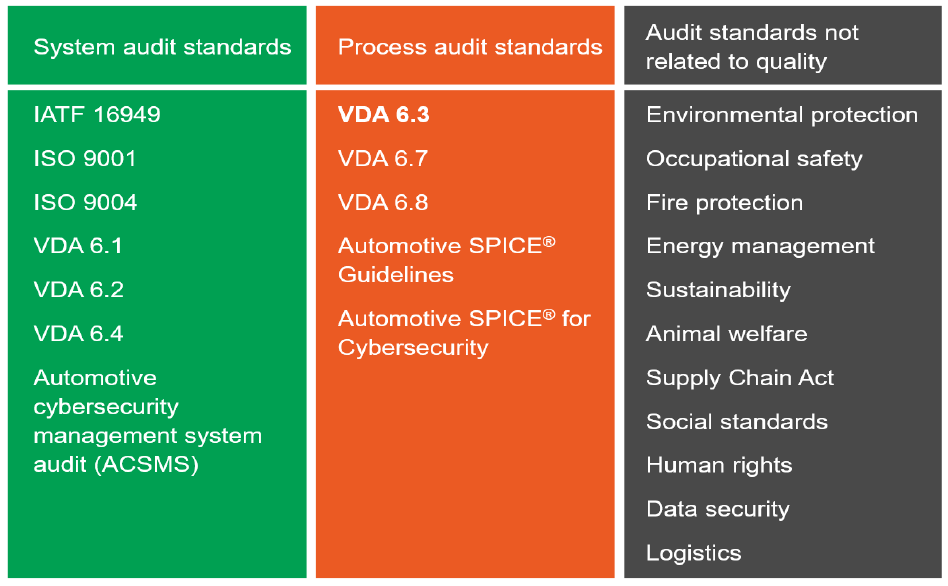
11
product characteristics, this should be documented and taken into account in
the evaluation.
Table 2-1: Differentiation between audit standards
12
2.2 Integration into the product life cycle
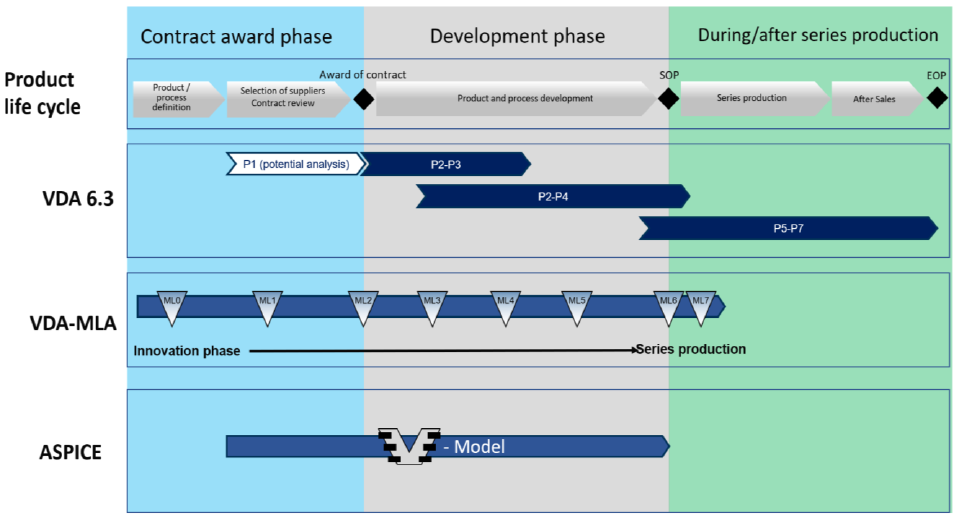
The VDA 6.3 audit standard can be used throughout the entire product life cy-
cle, from the selection of potential suppliers (P1 potential analysis) and the
product and production process development (P2-P4) up to support during
series production and follow-up support after production (P5-P7). Thanks to
the modular structure of the volume, individual process elements can also be
audited depending on the scope to be considered.
Figure 2-1 shows the possible use of the individual process elements accord-
ing to VDA 6.3 and how they relate to VDA MLA and Automotive SPICE
®
standards.
Figure 2-1: Possible use of the individual process elements
P1: Potential analysis
P2: Project management
P3: Product and production process development planning
P4: Implementation of product and production process development
P5: Supplier management
P6: Production process analysis
P7: Customer care, customer satisfaction, service
For explanations regarding the potential analysis, see chapter 5.
The use of process elements P2 to P4 focuses on the phase of the product
and production process development. Ideally, both process element P2 and
process element P3 are used after contract award to analyze the planning ac-
tivities.