VDA_6.3_EN_Yellow_Volume_.pdf.pdf - 第8页
6 Contents Foreword 5 Contents 6 1 Notes on the revisi on 8 2 Instructions for use 10 2.1 Scop e of the volum e 10 2.2 Integration into the product lif e cycle 12 2.3 Differentiation betwe en a potential ana lysis and a …
5
Foreword
The VDA 6.3 process audit has been established for almost three decades as
an important method for identifying strengths and weaknesses.
It involves analyzing and evaluating process capability during the product de-
velopment and product implementation phase.
The characteristics of VDA 6.3 are:
- a structured approach to analyzing processes
- an evaluation and points system
- clear downgrading rules
- identification of specific product and process risks (questions marked
with an asterisk, i. e. *-questions)
- a clear presentation of the results of the process evaluation (A, B or C)
- worldwide comparability of the results for similar products and pro-
cesses
- potential analysis for evaluating the suitability of new suppliers, loca-
tions, and technologies prior to awarding a contract
- a focus on the process and the product rather than on the system
The VDA 6.3 process audit is integrated into a company’s QM system and
contributes to the fulfillment of the requirements according to IATF 16949.
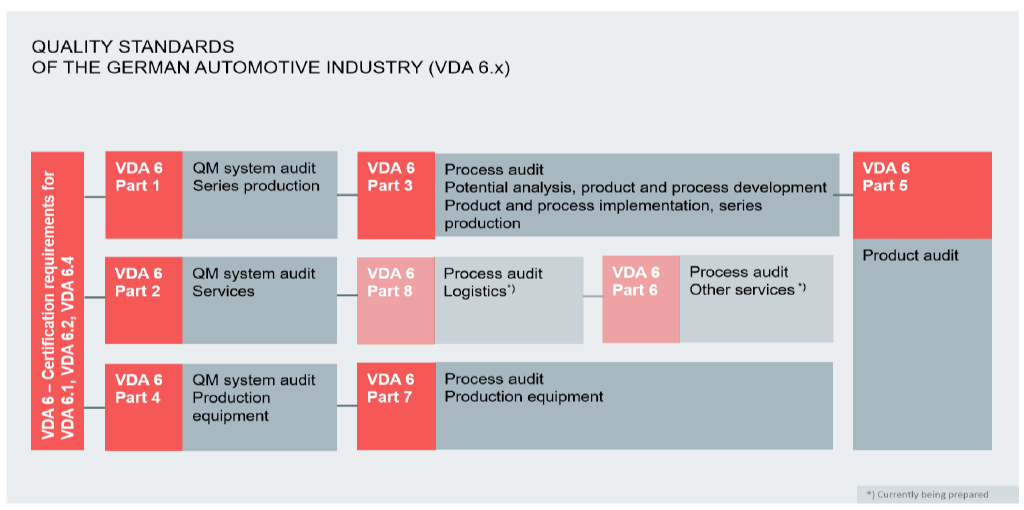
The VDA 6.3 process audit is part of the VDA 6.x family:
Figure 0-1: Overview of the volumes of the VDA 6.x family
6
Contents
Foreword 5
Contents 6
1 Notes on the revision 8
2 Instructions for use 10
2.1 Scope of the volume 10
2.2 Integration into the product life cycle 12
2.3 Differentiation between a potential analysis and a process audit 14
2.4 Identification of process risks (risk analysis) 14
3 Requirements for process auditors 16
3.1 Auditor qualification 16
3.1.1 Internal process auditors 16
3.1.2 Supplier auditors 17
3.1.3 Process auditors as external service providers 18
3.2 Product/process-related knowledge of the auditors 19
3.3 Code of conduct for auditors 19
4 Notes on conducting remote audits 21
4.1 Definition of a remote audit 21
4.2 Definition of a hybrid audit 21
4.3 Instructions for use 21
4.4 Classification of the audit methods based on existing risk factors / influencing
factors 22
4.5 Suitability of individual process elements/questions for conducting remote
audits within the scope of the potential analysis (P1) 24
4.6 Suitability of individual process elements/questions for conducting remote
audits (process elements P2-P7) 25
5 Potential analysis (P1) 26
5.1 Definition of a potential analysis 26
5.2 Prerequisites 26
5.3 Preparation 26
5.4 The process of conducting a potential analysis 27
7
5.5 Evaluation of a potential analysis 27
5.6 Follow-up activities after contract award 30
6 Evaluating a process audit for material products 31
6.1 Evaluation of the individual questions 31
6.2 Detailed evaluation and downgrading rules 33
6.3 Overall level of compliance and downgrading rules 35
6.4 Evaluation of product groups 37
6.5 Using the questionnaire (process elements P2 to P7) 39
6.6 Rules on conducting an audit 41
6.7 Repeat audit 41
7 Questionnaire 42
7.1 Overview of questionnaire 42
7.2 Project management (P2) 47
7.3 Product and process development planning (P3) 52
7.4 Implementation of product and process development (P4) 60
7.5 Supplier management (P5) 69
7.6 Production process analysis (P6) 74
7.7 Customer satisfaction/customer care/service (P7) 96
8 Glossary and list of abbreviations 101
9 Downloads 103