VDA_6.3_EN_Yellow_Volume_.pdf.pdf - 第43页
41 6.6 Rules on conductin g an audit An audit can be stopped at the auditor’s dis cretion, for exa mple in the follo w- ing cases: • Refusal to dis close necessary information during the audit • Obvious violation s of th…
40
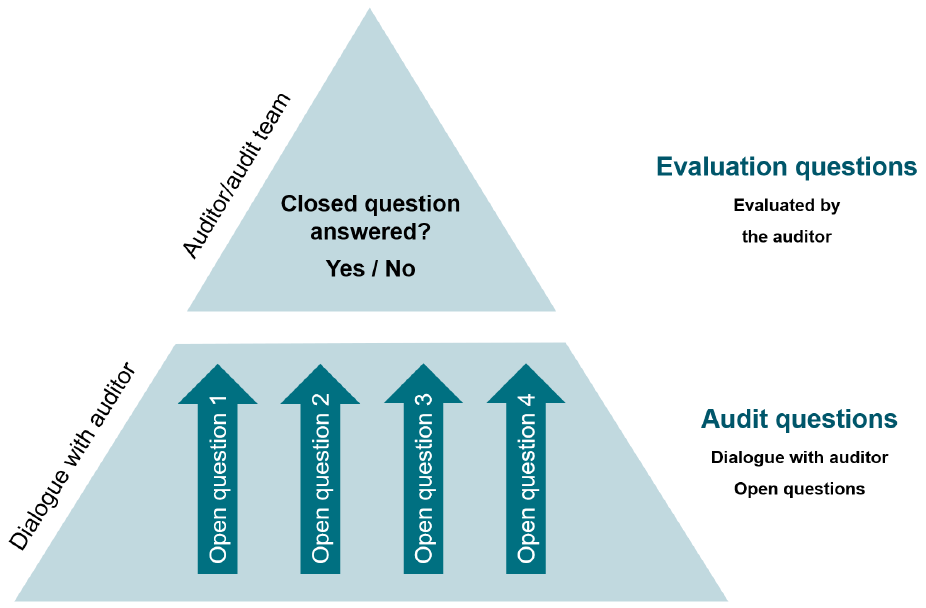
Figure 6-1: Audit pyramid
Process elements P3 and P4 can be audited either together or separately
when evaluating the product planning/implementation and process plan-
ning/process implementation. This depends on the audited organization.
If process element P6 (“series production”) requires a breakdown into pro-
cess steps, each step must be specified and evaluated separately.
In addition to the VDA 6.3 questions listed in this volume, it is recommended
that a knowledge database be created to store information about the risks as-
sociated with individual products and processes. The experience stored in the
knowledge databases can be used in addition to the requirements relevant for
the evaluation.
Based on the risk analysis described in section 2.4, identified risks must be
checked against the questionnaire and integrated into the applicable ques-
tions.
41
6.6 Rules on conducting an audit
An audit can be stopped at the auditor’s discretion, for example in the follow-
ing cases:
• Refusal to disclose necessary information during the audit
• Obvious violations of the law
• Actively interfering with the auditor’s work or putting the auditor in
danger
• Refusal to grant access to areas that are relevant for the audit, de-
spite prior agreement
• Insufficient preparation of the audit on the part of the organization
• Providing evidently false statements
The reason for stopping the audit must be stated. Audit findings obtained up
to the point the audit was interrupted must be documented.
The organization conducting the audit decides whether a new audit should be
carried out.
6.7 Repeat audit
It must be specified in which cases a repeat audit is necessary. Reasons for
conducting a repeat audit can include, for example:
• A specified level of compliance is not reached
• Critical process that is associated with risks
• The requirements according to one or more *-questions are not met
(0 points)
• Potential analysis results in “red light”
The repeat audit must be carried out within a specified time frame. Within this
period of time, the audited organization must initiate measures to effectively
rectify the shortcomings.
The scope of the repeat audit must be the same as for the previous audit. Re-
ducing the scope of the audit to a mere test of the effectiveness of the imple-
mented measures is not permissible.

42
7 Questionnaire
7.1 Overview of questionnaire
Potential analysis**
P2
Project management
2.1
Has a project management strategy (including a project
organization) been established?
X
2.2*
Are all resources required for project implementation
planned and available, and are changes reported?
X
2.3
Is there a project plan that has been agreed upon with the
customer?
X
2.4
Are the quality-related project activities being imple-
mented and monitored for compliance?
X
2.5
Are the procurement activities of the project implemented
and monitored for compliance?
2.6*
Is change management within the project ensured by the
project organization?
X
P3
Planning product and process development
3.1
Are the specific product and process requirements availa-
ble?
X
3.2*
Has the feasibility been comprehensively evaluated ac-
cording to the identified product and process require-
ments?
X
3.3
Are the activities for product and process development
planned in detail?
3.4*
Have the procurement activities been planned, and are
they monitored for compliance?
X
3.5
Have the necessary resources been taken into account for
product and process development planning?
3.6
Have the activities related to customer care/customer sat-
isfaction/customer service and field failure analysis been
planned?