IPC-TM-650 EN 2022 试验方法1.pdf - 第419页
IPC-TM-650 Number Subject Da te Revision Page 7 of 7 2.4.54 TestMethodforThermalTransmissionPropertiesof 09/2022 MetalBasedPrintedBoards(MBPB) N/A 6Notes 6.1 The following information should be giv…
IPC-TM-650
Number Subject Date
Revision
Page 6 of 7
2.4.54
TestMethodforThermalTransmissionPropertiesof
09/2022
MetalBasedPrintedBoards(MBPB)
N/A
Equation 14). With the thickness from the microsection it is possible
to calculate the apparent thermal conductivity of the dielectric
layer (Table 1 Equation 16). This calculated value must be shown
in the measurement report including the dimensions (mm²K/W)
(Table 1 Equation 15) as well as the apparent thermal conductivity
in W/(mK) (Table 1 Equation 16) and the thicknesses in µm.
5.10
Measure three identical samples across the board and list
all results in the measurement report. In addition, the mean value
and the standard deviation must be listed as well in the report.
5.11
To measure the DIE thickness a cross section according to
IPC-TM-650 Test Method 2.1.1 should to be made.
5.12
To embed the sample, the specimen is first cut in half using
a e.g., metal saw. Afterwards the specimen gets embedded,
grinded and polished.
5.13
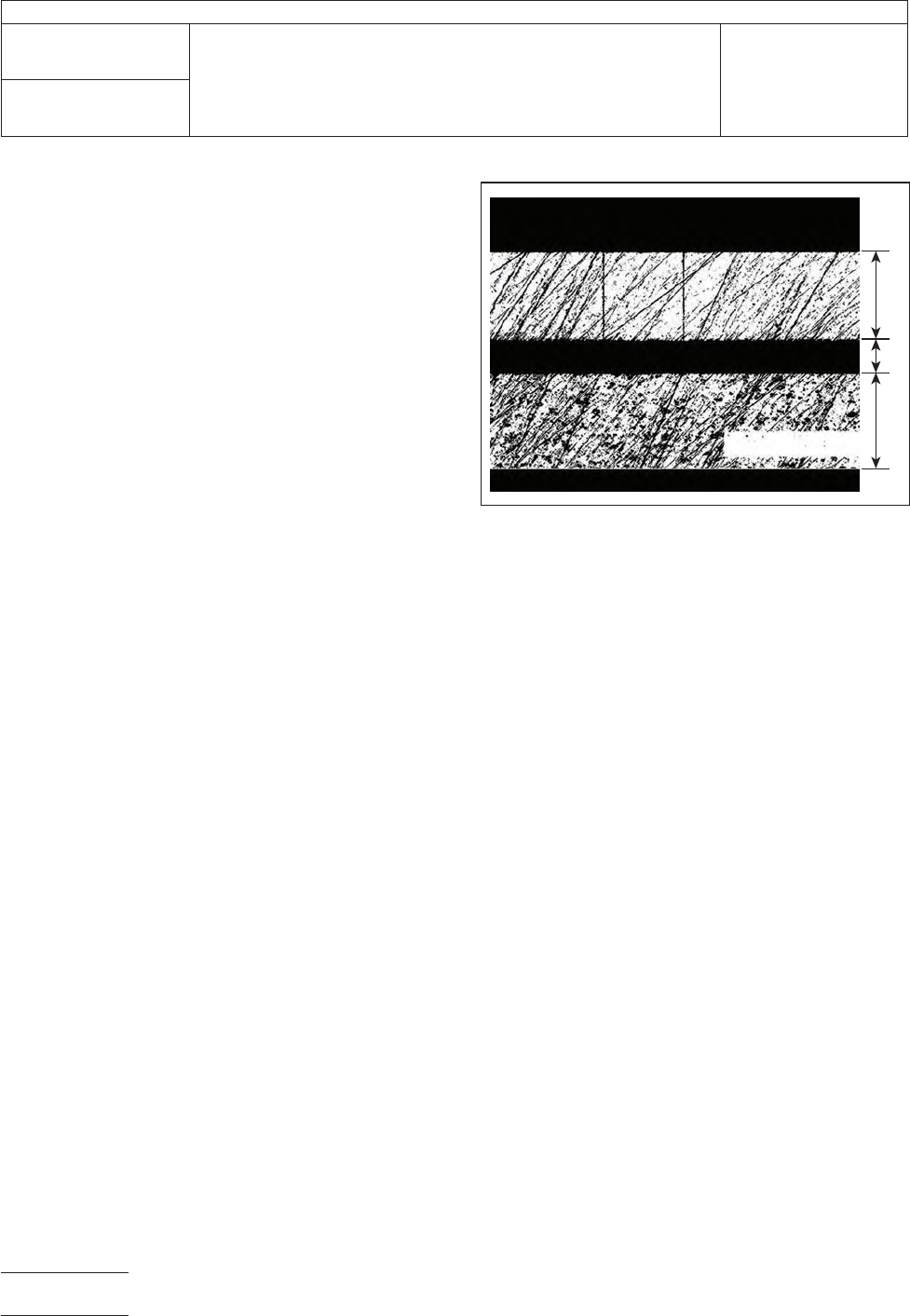
The thicknesses of the top and dielectric layer are measured
in the microsection on five different points using a microscope.
Calculate the middle value of the five measured values for each
layer. From the total thickness of the sample, the thickness of
the base layer can be determined by subtraction (see Table 1
Equation 17).
1
2
3
Figure5LayerStructureofaMetal-BasedBoard
Note1: Top layer: d
top,
see 1.3.1
Note2: Dielectric layer: d
die
Note3: Base layer: d
base

IPC-TM-650
Number Subject Date
Revision
Page 7 of 7
2.4.54
TestMethodforThermalTransmissionPropertiesof
09/2022
MetalBasedPrintedBoards(MBPB)
N/A
6Notes
6.1
The following information should be given in the measurement report associated with the measurement. Show all measured
values and the mean value for all parameters:
6.2
General information:
6.2.1
Measurement institution
6.2.2
Testing apparatus (identification)
6.2.3
Date
6.2.4
Contact person
6.3
Specimen identification:
6.3.1
Name of the manufacturer
6.3.2
Batch or lot number
6.3.3
Grade designation
6.3.4
Nominal thickness
6.3.5
Any other information pertinent to the identification of the material
6.4
Results and thermal properties
6.4.1
Number of layers used in the test
6.4.2
Average temperature of the specimen (@ max pressure)
6.4.3
Temperature difference over the specimen (@ max pressure)
6.4.4
Pressure used during testing
6.4.5
Apparent thermal conductivity (@ max pressure)
6.4.6
Thermal resistance (@ max pressure)
6.4.7
Uncertainty of the thermal measurement (@ max pressure)
6.4.8
Layer thicknesses of top, base and dielectric layer
6.4.9
Microscopic images of the layer thicknesses
6.4.10
Used material to reduce contact resistances between meter bars and specimen
6.4.11
Assumptions of the thermal conductivity of the top and base plate to determine the thermal properties of the dielectric
layer
6.4.12
Determined thermal conductivity of the dielectric layer (@ max pressure)
6.5
The following information show how to use the values from this method for CFD simulation.
Build up a three-layer system in your simulation tool according to Figure 5. Use for upper and lower metal layer the mean value
of the thickness from microsection and the thermal conductivity of each metal layer. Use the mean value of apparent thermal
conductivity (Table 1 Equation 16) and thickness of the dielectric material.
ASTM D495
Page 1 of 2