CP43维护手册.pdf.pdf - 第18页
Introduction T o meet the challenge of diversification in the field of surface mount technology , the FCP IV -3 offers parts location via an advanced vision processing system, a split device table, a pr oduction support …

About This Manual
The version number starts at Version 1.0 for a newly published manual. When
minor corrections are made for misprints and omissions, the decimal part of the
version number increases. When the actual content of the manual is revised, the
integer part of the version number increases.
Because the version number on each page is changed only if that page is
revised, it should be clear which pages have been altered from the previous
manual.
Example:
Version 1.0 (A new manual)
Version 1.1 (Minor correction of misprints and omissions)
Version 2.0 (Major revision of contents)
Note: The above described version numbers are not related to the software version
numbers.
Version 1.0
Chapter 1 Setting Up
1 – 3
Setting Up
This chapter explains the steps to follow when
setting up prior to operation.
1.1
1.
Connecting the Power Supply
•
Power Consumption
The power consumption of the machine
is approximately 6.5 KVA. Connect the
the machine to a power supply with at
least this capacity.
Power Supply Cable
Connect the power supply to a machine
power supply cable having a cross
section of at least 5.5 mm2. Thin cables
may overheat or cause a drop in the
supply voltage.
•
Version number
Page number
Chapter number and title
Body
??? Maintenance
Manual name

Introduction
To meet the challenge of diversification in the field of surface mount
technology, the FCP IV-3 offers parts location via an advanced vision
processing system, a split device table, a production support system (HELPS)
and many other advantages to produce a highly accurate, reliable placing
machine.
The FCP IV-3 has achieved, for a wide variety of parts, a placement rate of 0.15
sec/part. How to achieve precision placements at such high speeds has been
investigated from all angles. Based on the results of our investigations, we
have incorporated the following features into the FCP IV-3.
• The part rotation function has been divided into pre-theta and fine theta.
Pre-theta rotates the part 90° towards the correct angle, thereby reducing
the overall time required for placement.
• In the FCP-III the vision processing control and the control system for the
entire machine operated from the same CPU. In the FCP-IV (FCP-IV, FCP
IV-2, and FCP IV-3) series, the vision processing system operates
independently, using a dedicated CPU, enabling faster vision processing.
• The new gray scale vision system, which can see shades between black and
white, enables the machine to discern with much greater accuracy the
position of the part, which enables greater placement accuracy.
• When light is shone directly onto a part, there is no shadow and the body
will not hide things like J leads, which will be clearly seen and thus enable
greater placing accuracy (optional).
• The machine takes into account the height of the part in question and
automatically adjust the height of the XY table to reduce stress on the
placed part. Part heights are entered into Part data, which then feeds this
information to servo motors to adjust the XY table. Therefore, despite
simplicity of the nozzle structure the parts will always have a “soft
landing.”
• There are three types of nozzles (S, M and L) on one head. This means that
the FCP IV-3 can pick parts with a flat picking surface from sizes as small as
1005 to as large as 20 mm X 20 mm.
Version 7.0
xvi
CP IV-3 Maintenance
Chapter 1 Safety Guidelines
1. Safety Guidelines
Fuji made the safety of the operator one of the foremost priorities in the
designing of the FCP IV-3.
However, to ensure safety, the operator must follow the safety guidelines
described in this chapter.
1.1 Electrical Safety Guidelines
This section describes safety guidelines when working with the electric
power supply and transformers.
1.1.1 High Voltage Electricity Supply
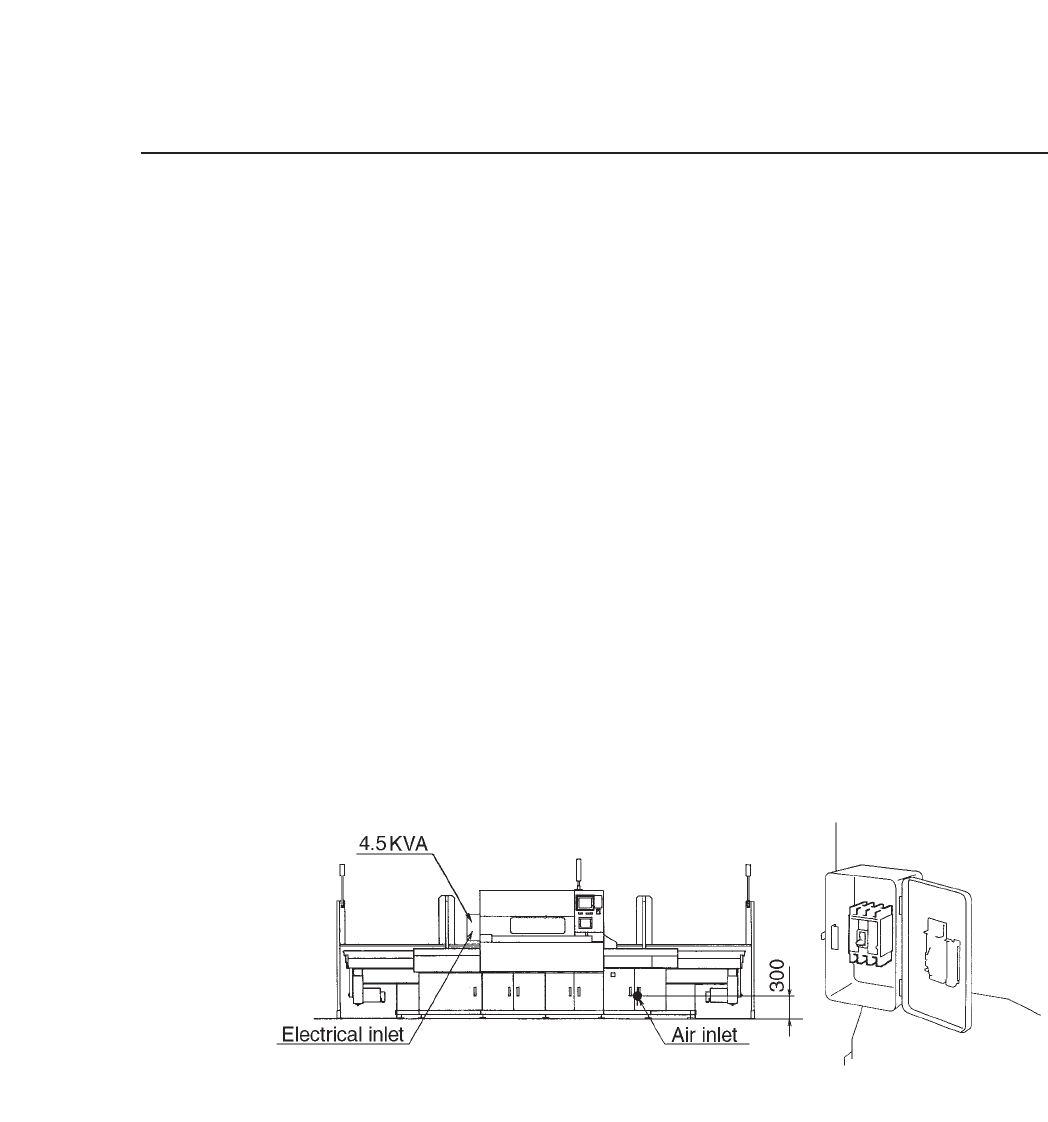
Run the power supply cable through the opening at the bottom of
the machine on the left-hand side (when viewing from the front) as
shown in figure 1-1. Connect the three phase cables and the earth
cable to the primary side of the main breaker.
Fig. 1-1 Position of the Three Phase and Earth Cables
Before performing machine inspection, always disengage the main
power source. Even if the main breaker is off, the primary voltage
is still active, so operators should be very careful.
Also, the machine should never be operated with the door open as
shown in figure 1-1.
1 – 1
Version 8.0