MIL- STD-883F 2004 TEST METHOD STANDARD MICROCIRCUITS.pdf - 第430页
MIL-STD-883F METHOD 2032.2 18 June 2004 24 C lass H Class K 3.1. 6 f . Contact over lap between t he meta llization and 3.1. 6 f. Same as Class H. the res ist or in whic h the widt h dimensi on "y" is l ess t h…
MIL-STD-883F
METHOD 2032.2
18 June 2004
23
Class H Class K
3.1.6 c. Any sharp (clearly defined) color change 3.1.6 c. Same as class H.
within 0.1 mil of the terminal.
NOTE: A sharp color change close to the
terminal usually indicates an abrupt
reduction of resistor film thickness.
This color change usually occurs in a
straight line parallel to the terminal.
A gradual color change, or a nonuniform
or mottled color anywhere in the resistor,
is not cause for rejection.
d. Any resistor film lifting, peeling or d. Same as class H.
blistering.
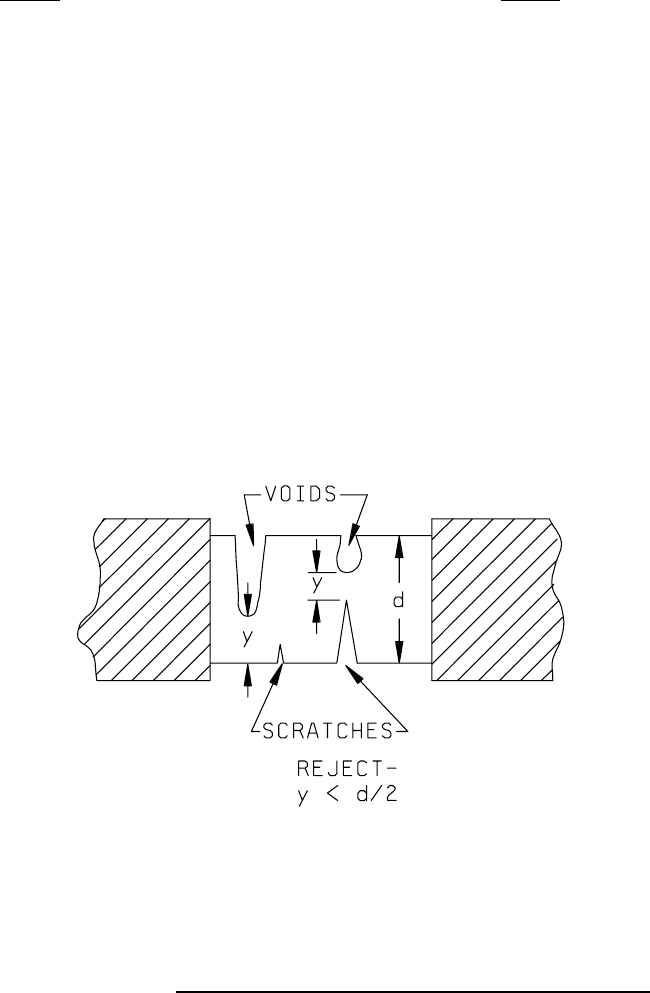
e. Reduction of resistor width, resulting from e. Same as class H.
voids, scratches, or a laser trim kerf or a
combination of these, that leaves less than
50 percent of the narrowest resistor width
(see figure 2032-15h).
PRECAUTIONARY NOTE: The maximum allowable
current density requirement shall not be exceeded.
FIGURE 2032-15h. Class H resistor width reduction by voids and scratches criteria
.
MIL-STD-883F
METHOD 2032.2
18 June 2004
24
Class H Class K
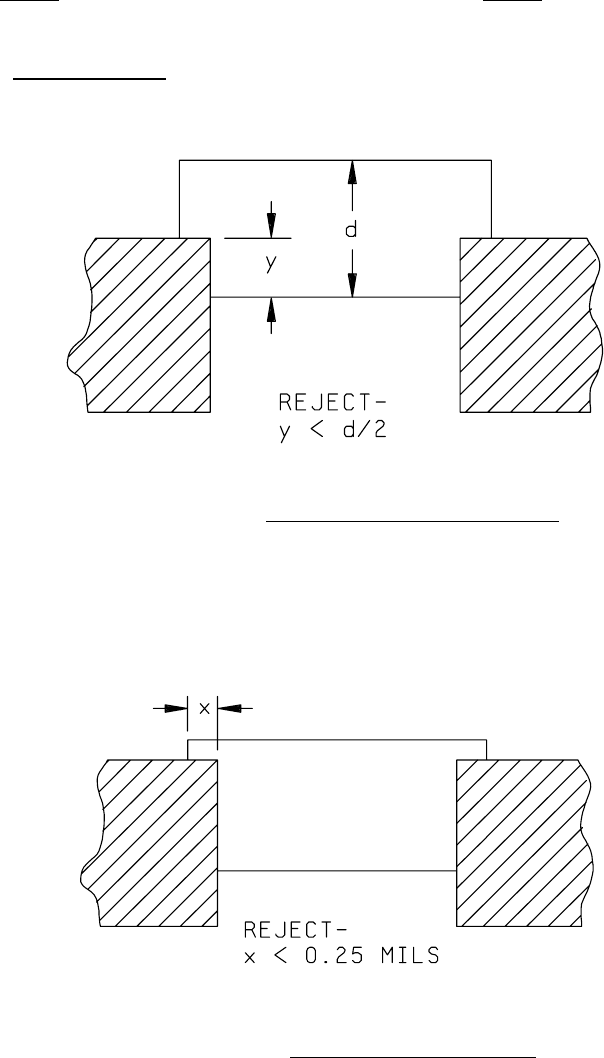
3.1.6 f. Contact overlap between the metallization and 3.1.6 f. Same as Class H.
the resistor in which the width dimension "y"
is less than 50 percent
of the original resistor
width (see figure 2032-16h).
FIGURE 2032-16h. Class H metal/resistor overlap criterion
.
g. Contact overlap between the metallization g. Same as class H.
and the resistor in which the length
dimension "x" is less than 0.25 mil
(see figure 2032-17h).
FIGURE 2032-17h. Class H contact overlap criterion
.
MIL-STD-883F
METHOD 2032.2
18 June 2004
25
Class H Class K
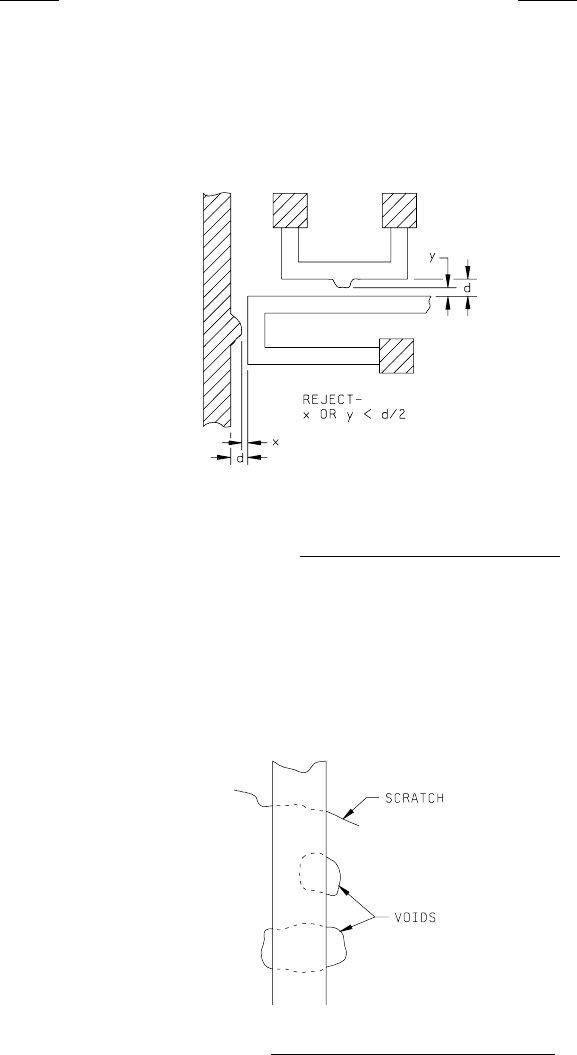
3.1.6 h. More than a 50 percent reduction 3.1.6 h. Same as class H.
of the original separation,
between any two different resistors,
or a resistor and metallization
not associated with it
(see figure 2032-18h).
FIGURE 2032-18h. Class H resistor separation criteria
.
i. Any resistor that crosses a substrate i. Same as class H.
irregularity (such as a void or scratch)
(see figure 2032-19h).
NOTE: This criterion is applicable to
conductive substrates only.
FIGURE 2032-19h. Class H substrate irregularity criterion
.