MIL- STD-883F 2004 TEST METHOD STANDARD MICROCIRCUITS.pdf - 第520页
MIL-STD-883F METHOD 3015.7 22 March 1989 6 NOTES: 1. The c urrent waveforms shown s hall be meas ured as des cri bed in the wavef orm veri fic ation pr ocedure of 3.2, using equi pment meeting t he requir ements of 2. 2.…
MIL-STD-883F
METHOD 3015.7
22 March 1989
5
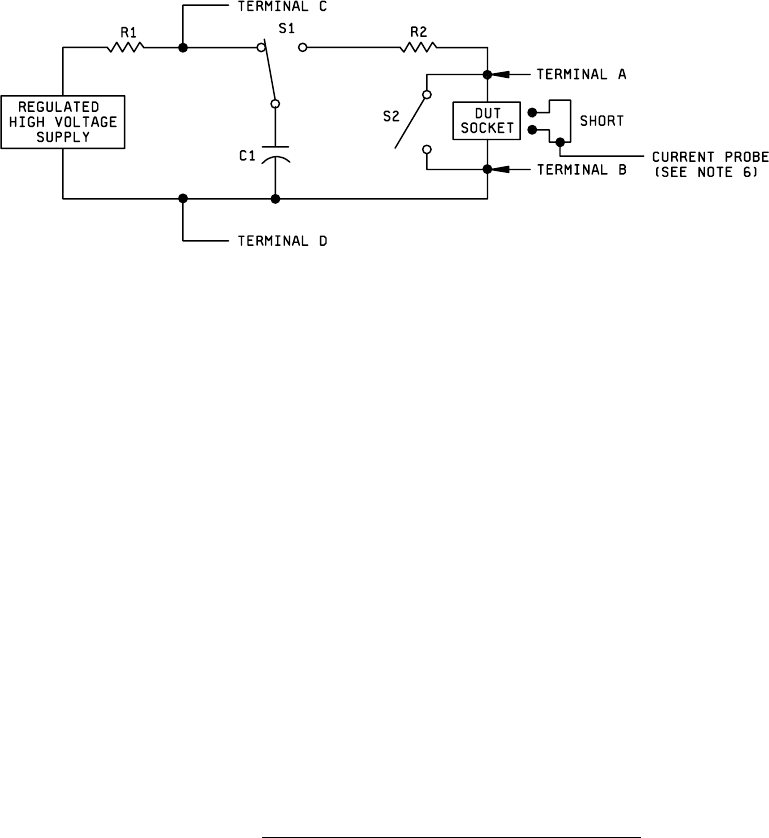
R1 = 10
6
ohms to 10
7
ohms
C1 = 100 picofarads ±10 percent (Insulation resistance 10
12
ohms minimum)
R2 = 1,500 ohms ±1 percent
S1 = High voltage relay (Bounceless, mercury wetted, or equivalent)
S2 = Normally closed switch (Open during discharge pulse and capacitance measurement)
NOTES:
1. The performance of this simulator circuit is strongly influenced by parasitics. Capacitances across relays and
resistor terminals, and series inductance in wiring and in all components shall be minimized.
2. As a precaution against transients upon recharge of C1, the supply voltage V
S
may be reduced before switch
S1 is returned to the charging position.
3. Piggybacking DUT sockets is not permitted during verification or classification testing.
4. Switching terminals A and B internal to the simulator to obtain opposite polarity is not recommended.
5. C1 represents the effective capacitance (see 2.3.2).
6. The current probe connection shall be made with double shielded cable into a 50-ohm termination at the
oscilloscope. The cable length shall not exceed 3 feet.
FIGURE 3015-1. EDS classification test circuit (human body model)
.
MIL-STD-883F
METHOD 3015.7
22 March 1989
6
NOTES:
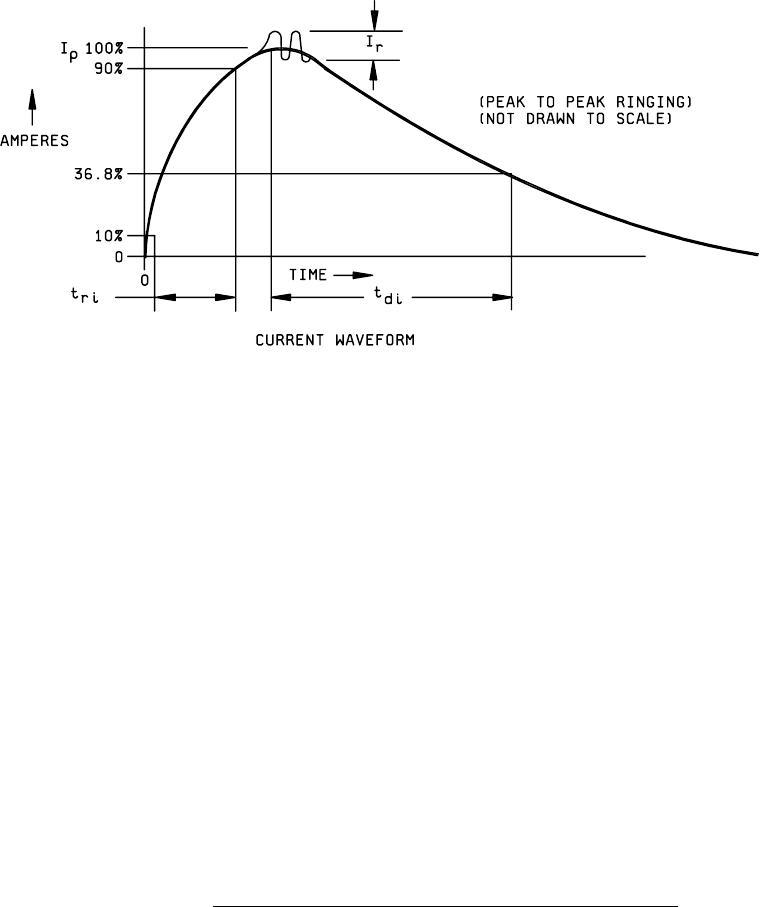
1. The current waveforms shown shall be measured as described in the waveform verification procedure of 3.2,
using equipment meeting the requirements of 2.
2. The current pulse shall have the following characteristics:
Tri (rise time) ---------------Less than 10 nanoseconds.
Tdi (delay time) ------------150 ±20 nanoseconds.
I
p
(peak current) -----------Within ±10 percent of the I
p
value shown in table II for the voltage step selected.
I
r
(ringing) -------------------The decay shall be smooth, with ringing, break points, double time constants or
discontinuities less than 15 percent I
p
maximum, but not observable 100
nanoseconds after start of the pulse.
FIGURE 3015-2. EDS classification test circuit waveforms (human body model)
.

MIL-STD-883F
METHOD 3016
29 November 1985
1
METHOD 3016
ACTIVATION TIME VERIFICATION
1. PURPOSE
. This method establishes a means for assuring circuit performance during cold temperature start up. It
defines an activation time for digital microelectronic devices such as TTL, DTL, RTL, ECL, and MOS and establishes the
procedure necessary to accomplish the required testing. This method will ensure that a specified capability is available a
known time interval after application of power.
1.1 Definitions
. The following definitions shall apply for the purposes of this test method:
a. Activation time. Activation time is defined as the time required for a device to become functionally operable after
initial power is applied at the operating temperature extremes as specified by the applicable acquisition document.
Note that activation time may be due to device and test system limitations, or both.
b. Maximum and minimum. Maximum and minimum refer to an algebraic system where "max" represents the most
positive value of the range and "min" represents the least positive value of the range. This is consistent with
MIL-STD-1331, 30.1 and 30.2 for logic levels only.
c. Maximum operating frequency. Maximum operating frequency is defined as the frequency of operation resulting
from use of the minimum clock period for devices requiring a clock, or the frequency of operation resulting from the
use of the minimum cycle time for devices not requiring a clock (such as memory devices) as specified in the
applicable acquisition document.
1.2 Symbols
. The following symbols and definitions shall apply for the purposes of this method.
1.2.1 Logic levels
.
a. V
LW
= worst case nominal low level logic input. The maximum allowable V
IL
specified in the applicable acquisition
document minus 100 millivolts to allow for uncertainty in the drive level capability of high speed functional test
equipment. (V
LW
= V
IL
(max) - 100 mV).
b. V
HW
= worst case nominal high level logic input. The minimum allowable V
IH
as specified by the applicable
acquisition document plus 100 millivolts (V
HW
= V
IH
(min) + 100 mV).
c. V
OH
(min) = minimum output high level specified for a digital microelectronic device.
d. V
OL
(max) = maximum output low level specified for a digital microelectronic device.
1.2.2 Activation times
.
a. t
AH
= maximum allowable activation time requirement, measured at V
CC
(max).
b. t
AL
= maximum allowable activation time requirement, measured at V
CC
(min).
2. APPARATUS
. An instrument shall be provided which has the capability of applying sequential logic patterns to the
device under test in accordance with the applicable acquisition document. The test instrument shall also be capable of
applying nominal power supply voltage(s) and monitoring the output for the specified logic levels. The output monitoring
circuit shall be of the double comparator type. The threshold voltage (trip point) for a comparator shall be V
OL
(max) and V
OH
(min) as specified in the applicable acquisition document. The test chamber shall be capable of maintaining the device
under test at any specified test temperature.
3. PROCEDURE.
The device shall be thermally stabilized at the minimum specified test temperature with no power
applied to the device. The specified power supply voltage and the specified input logic patterns using V
LW
and V
HW
input
voltage levels shall then be applied to the device under test and the outputs shall be monitored as described in section 2.
This functional test shall be performed at a speed of at least 75 percent of F(max) using a test vector pattern as called out in
the applicable acquisition document that has been designed for maximum fault coverage with no more than 4 K vectors.