00191657-0102_UM_Luftkissentransportsystem_DE EN.pdf - 第54页
Operating Instruct ions Air cushion transporting system for SIPLACE 3.3 Connecting the module to the load 10/99 edition 12
Air cushion transporting system for SIPLACE Operating Instructions
10/99 edition 3.3 Connecting the module to the load
11
The unladen weight of the module is very small compared to its load-bearing capacity. 3
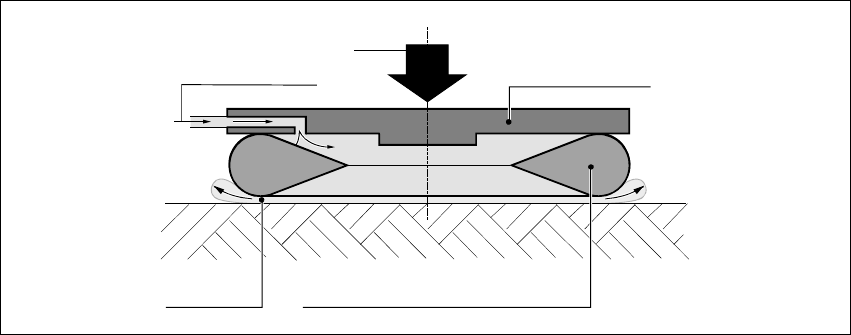
Air flows through the hose connecting nozzle (6) on the load supporting plate, via the entry holes
(7), and into the bellows and inner space of the air cushion. 3
3.3 Connecting the module to the load
The air cushion modules are generally inserted loosely beneath the load to be transported, e.g.
when moving machines (see figure 16 on page - 30), although they can also be used in holders
or fixed. 3
Operating Instructions Air cushion transporting system for SIPLACE
3.3 Connecting the module to the load 10/99 edition
12
Air cushion transporting system for SIPLACE Operating Instructions
10/99 edition 4.1 Strength
13
4 Optimum surface finish for using the
air cushion
The air cushion transporting system works best on a smooth, flat and airtight surface. Most floor
surfaces in modern production halls meet these requirements, e.g. polished concrete floors, with
plastic sealant to protect against metal swarf and dust. The expansion joints are filled with a
flexible compound. 4
The floor or surface must be airtight to enable the rubber bellows between the load supporting
plate and the floor to inflate and form the air cushion. 4
The surface must be smooth so that a film of air is created between the rubber bellows and floor
with a minimal air consumption. The load to be transported is pushed over this film with practically
no friction. 4
The surface must be horizontal, i.e. without a slope, so that the transported load does not slide
away of its own accord due to the low friction. 4
Fig. 4 - 1 Cross-section through the air cushion module while in use
4.1 Strength
The specific load on the surface is very small compared to wheeled or tracked vehicles. This is
due to the air cushion’s large surface area, flexibility and low unladen weight. Heavy loads can be
carried on air cushions without damaging sensitive surfaces, such as parquet, linoleum, vitrified
tiles or surfaces with underfloor heating. Of course, the admissible floor load must be taken into
account, but air cushions still offer many advantages. 4
Compressed air
Load
Supporting plate
Rubber bellows seals and raises
Film of air