00191657-0102_UM_Luftkissentransportsystem_DE EN.pdf - 第59页
Air cushion t ransporting system for SIPLACE Operating Instructions 10/99 edition 4.5 New floors 17 4.5 New floors The fla tness tolera nces de fined in DIN 18202 part 5, line 4 apply when b uilding a flo or sui table fo…
Operating Instructions Air cushion transporting system for SIPLACE
4.4 Undulating and sloping surfaces 10/99 edition
16
4.4 Undulating and sloping surfaces
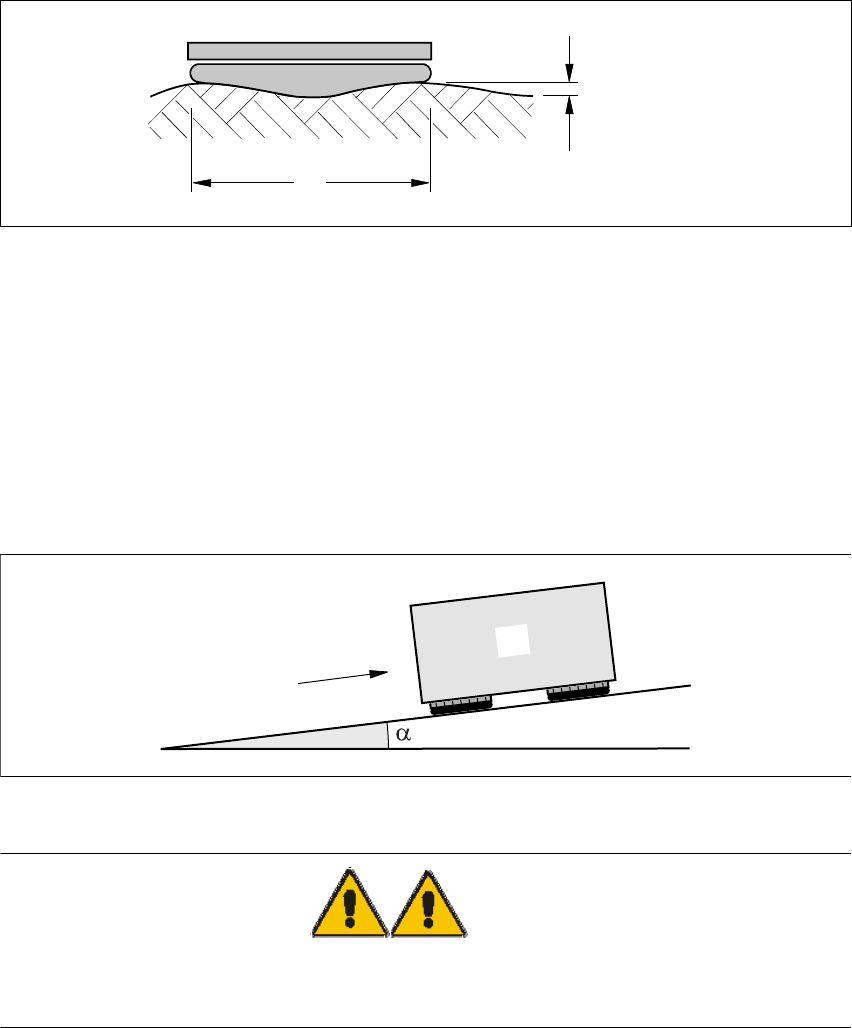
Fig. 4.4 - 1 Undulating surface
The air cushion modules are sufficiently flexible to be able to adapt to a gently undulating surface
to a limited extent. The difference in height must not exceed 2% of the diameter of the rubber
bellows, however. 4
Long undulations can be regarded as slopes. A load on the film of air will tend to slide to the lowest
point of its own accord on account of the low friction. The force required to hold the load in place
on a slope can be calculated as follows: 4
F = tg α · G (Dynamic forces must be added as well). 4
Fig. 4.4 - 2 Sloping surface
WARNING RISK OF CRUSHING 4
: In these situations, the load must be secured by means of drives, grippers, etc.
4
A ramp may be built in order to pass over door sills or steps, provided that the above values are
taken into account. 4
D
< 2% of D
F
G
Air cushion transporting system for SIPLACE Operating Instructions
10/99 edition 4.5 New floors
17
4.5 New floors
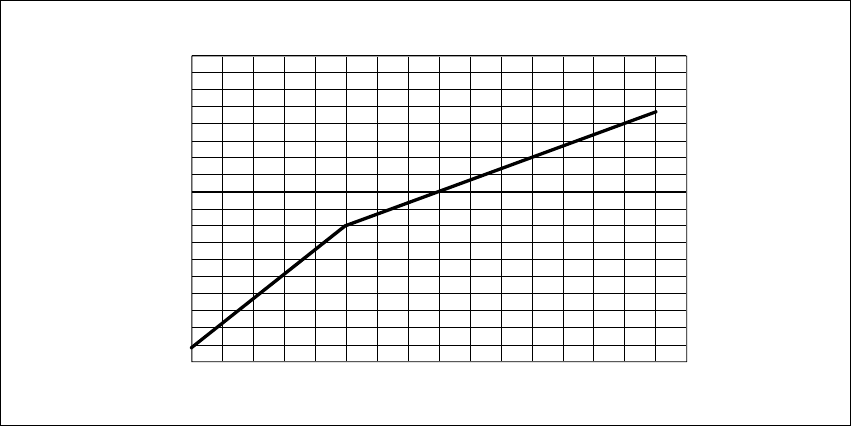
The flatness tolerances defined in DIN 18202 part 5, line 4 apply when building a floor suitable for
transporting loads with air cushions: 4
Fig. 4.5 - 1 Flatness tolerances for hall floors
The surface must be mechanically smoothed, sealed with varnish and given a plastic coating, if
necessary. 4
4.6 Old floors
The floor must conform to the flatness tolerances defined in DIN 18202. It is sometimes necessary
to add a screed layer in order to achieve this. It may also be necessary to burn off, grind or mill
the floor before laying the screed to ensure that the screed adheres well to the substrate. This also
applies if the floor is coated directly. 4
Good adhesion and an airtight surface coating is particularly important with screed floors and
other floor coverings such as plastic tiles, parquet, linoleum, vitrified tiles, etc. Even tiny cracks will
allow air to penetrate and then lift the coating away from the substrate. 4
1
5
1
0
5
0
123456789101112131415
Room length / width [m]
Unevenness [mm]
Operating Instructions Air cushion transporting system for SIPLACE
4.7 Air-permeable floors 10/99 edition
18
4.7 Air-permeable floors
If the surface is not airtight, so much air can escape through the floor that the resulting pressure
is not enough to raise the load. Alternatively, the volume of air will be too small to form a film of air. 4
A conventional (unsealed) concrete floor is porous and allows some air to seep through. Even
coated surfaces are not always totally airtight, i.e. they may have cracks, gaps, holes or joints.
Such non-airtight points can easily be patched, covered with adhesive tape or a thin sheet of metal
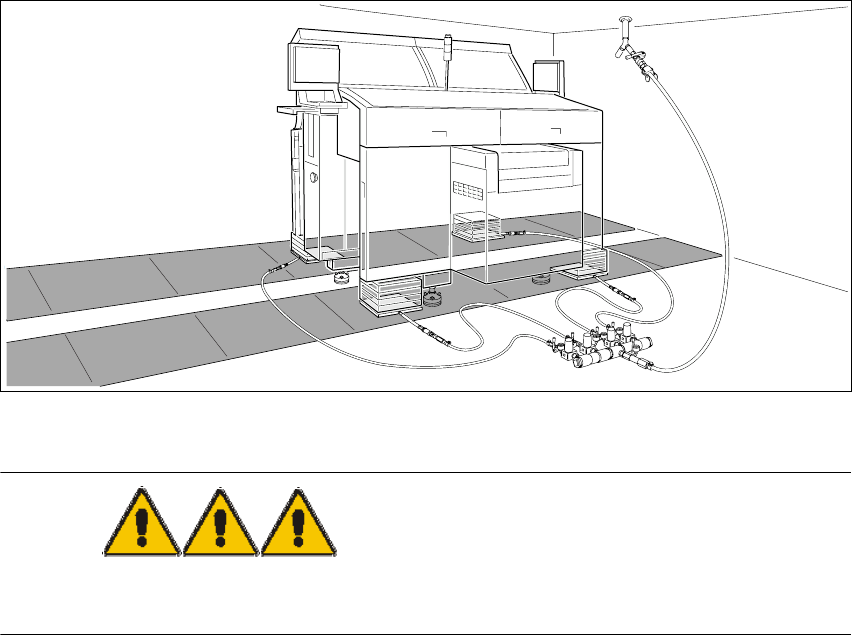
(see Fig. 4.8 - 1 and 5.1 - 1). 4
4.8 One-off transportation on an unsuitable surface
If a machine only has to be moved once, for example, the air cushion can be used on practically
any surface, provided that the route is covered with sheets of metal, etc. (see also Fig. 5.1 - 1).4
Fig. 4.8 - 1 Covering an unsuitable surface with sheets of metal
DANGER
Do not exceed the load-bearing capacity of the floor. 4
4