00191657-0102_UM_Luftkissentransportsystem_DE EN.pdf - 第60页
Operating Instruct ions Air cushion transporting system for SIPLACE 4.7 Air-permeable floo rs 10/99 edition 18 4.7 Air -perme able fl oors If the sur face is not a irtight, so mu ch air c an esca pe thr ough the fl oor t…
Air cushion transporting system for SIPLACE Operating Instructions
10/99 edition 4.5 New floors
17
4.5 New floors
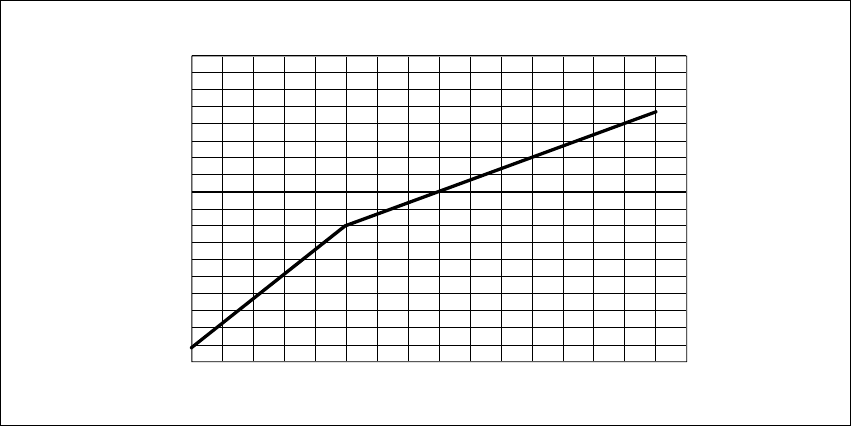
The flatness tolerances defined in DIN 18202 part 5, line 4 apply when building a floor suitable for
transporting loads with air cushions: 4
Fig. 4.5 - 1 Flatness tolerances for hall floors
The surface must be mechanically smoothed, sealed with varnish and given a plastic coating, if
necessary. 4
4.6 Old floors
The floor must conform to the flatness tolerances defined in DIN 18202. It is sometimes necessary
to add a screed layer in order to achieve this. It may also be necessary to burn off, grind or mill
the floor before laying the screed to ensure that the screed adheres well to the substrate. This also
applies if the floor is coated directly. 4
Good adhesion and an airtight surface coating is particularly important with screed floors and
other floor coverings such as plastic tiles, parquet, linoleum, vitrified tiles, etc. Even tiny cracks will
allow air to penetrate and then lift the coating away from the substrate. 4
1
5
1
0
5
0
123456789101112131415
Room length / width [m]
Unevenness [mm]
Operating Instructions Air cushion transporting system for SIPLACE
4.7 Air-permeable floors 10/99 edition
18
4.7 Air-permeable floors
If the surface is not airtight, so much air can escape through the floor that the resulting pressure
is not enough to raise the load. Alternatively, the volume of air will be too small to form a film of air. 4
A conventional (unsealed) concrete floor is porous and allows some air to seep through. Even
coated surfaces are not always totally airtight, i.e. they may have cracks, gaps, holes or joints.
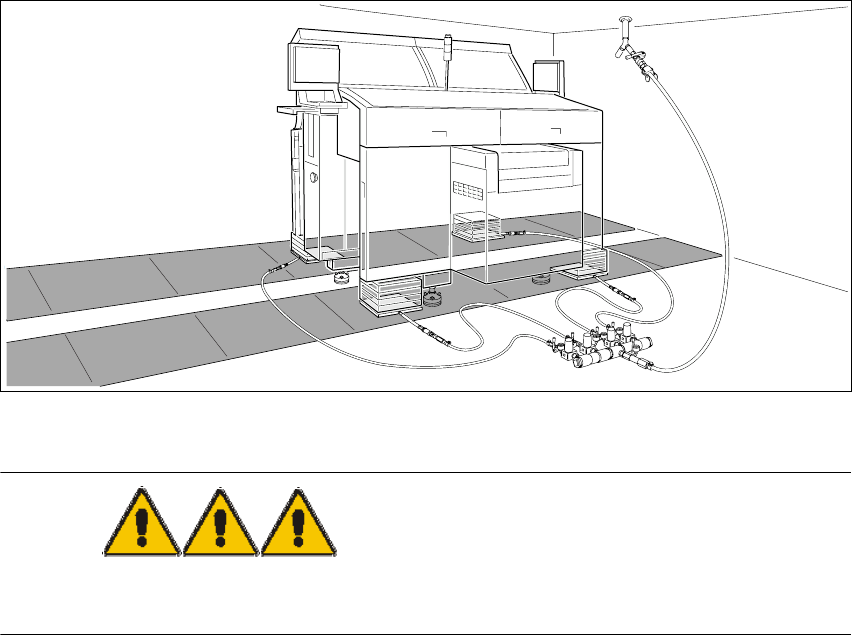
Such non-airtight points can easily be patched, covered with adhesive tape or a thin sheet of metal
(see Fig. 4.8 - 1 and 5.1 - 1). 4
4.8 One-off transportation on an unsuitable surface
If a machine only has to be moved once, for example, the air cushion can be used on practically
any surface, provided that the route is covered with sheets of metal, etc. (see also Fig. 5.1 - 1).4
Fig. 4.8 - 1 Covering an unsuitable surface with sheets of metal
DANGER
Do not exceed the load-bearing capacity of the floor. 4
4

Air cushion transporting system for SIPLACE Operating Instructions
10/99 edition 4.9 Cleanliness
19
4.9 Cleanliness
For the air cushion module to work perfectly over long periods, the floor surface must be clean.
Wear can be almost totally eliminated by preparing the floor well. 4
Small, light objects, such as fine sand, sawdust, cigarette ends, etc, are blown away by the flow
of air. Stuck-on dirt, such as spots of ink or oil, tire dust from fork-lift trucks, etc, reduce the surface
quality and can cause the rubber bellows to wear, which in turn increases air consumption. 4
CAUTION 4
: Large, sharp objects, such as nails, screws or embedded steel swarf can damage the air
cushion bellows.
4