00191657-0102_UM_Luftkissentransportsystem_DE EN.pdf - 第62页
Operating Instruct ions Air cushion transporting system for SIPLACE 4.9 Cleanliness 10/99 edition 20

Air cushion transporting system for SIPLACE Operating Instructions
10/99 edition 4.9 Cleanliness
19
4.9 Cleanliness
For the air cushion module to work perfectly over long periods, the floor surface must be clean.
Wear can be almost totally eliminated by preparing the floor well. 4
Small, light objects, such as fine sand, sawdust, cigarette ends, etc, are blown away by the flow
of air. Stuck-on dirt, such as spots of ink or oil, tire dust from fork-lift trucks, etc, reduce the surface
quality and can cause the rubber bellows to wear, which in turn increases air consumption. 4
CAUTION 4
: Large, sharp objects, such as nails, screws or embedded steel swarf can damage the air
cushion bellows.
4
Operating Instructions Air cushion transporting system for SIPLACE
4.9 Cleanliness 10/99 edition
20
Air cushion transporting system for SIPLACE Operating Instructions
10/99 edition 5.1 Prepare the route to be taken
21
5 Operating instructions
Air cushion transporting systems are designed to prevent almost all serious errors during use,
provided that the above points such as working load, compressed air supply and surface finish
are observed. 5
The following points will make them even easier to use: 5
5.1 Prepare the route to be taken
DANGER
Do not exceed the load-bearing capacity of the floor. 5
5
: Remove all metal swarf, dirt, etc, from the ground to prevent increased wear of or damage to
the air cushion.
: Check the floor surface:
It should be airtight and smooth (see Tab. 4.3 - 1).
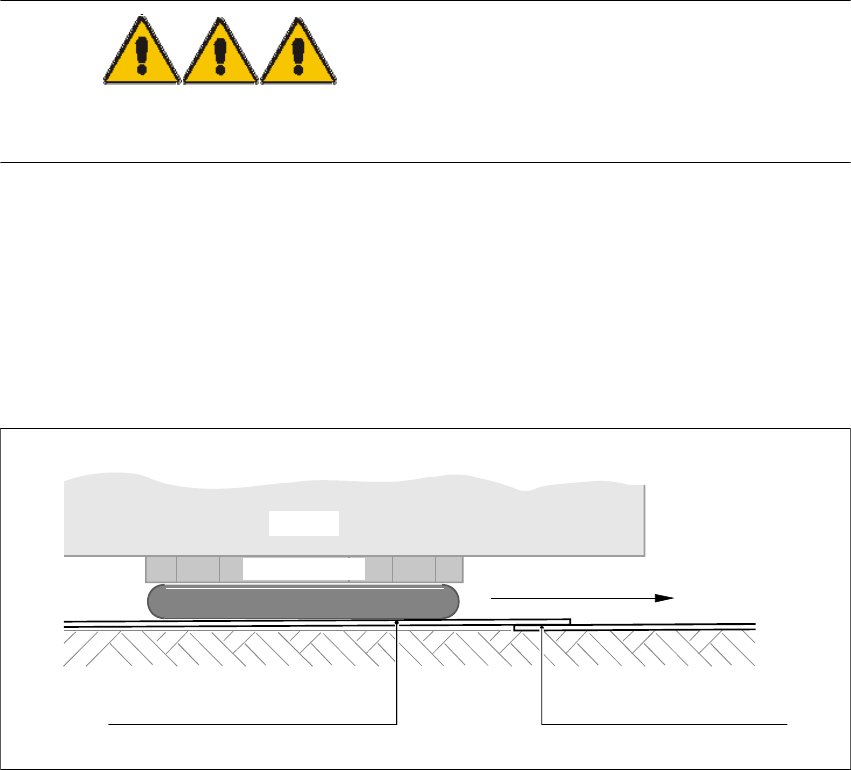
: Cover any cracks with adhesive tape or use metal sheets (no more than 0.5 to 1 mm thick).
5
Fig. 5.1 - 1 Covering the floor with overlapping metal sheets
: Make sure that the sheets always overlap in the transport direction.
Metal sheet 0.5 - 1.0 mm thick
Air cushion
Load
Overlap sheets and attac
h
adhesive tape, if necessa
ry
Transport direction