Specification SIPLACE X-Series规格说明书1.pdf - 第37页
37 Vision Sensor Technology PCB Position Recognition Description Different fiducial shapes prove to be optim al depend- ing on the condition of the surface. Particularly advisable for bare copper surfaces wi th lit- tle …
36
Digital Vision System
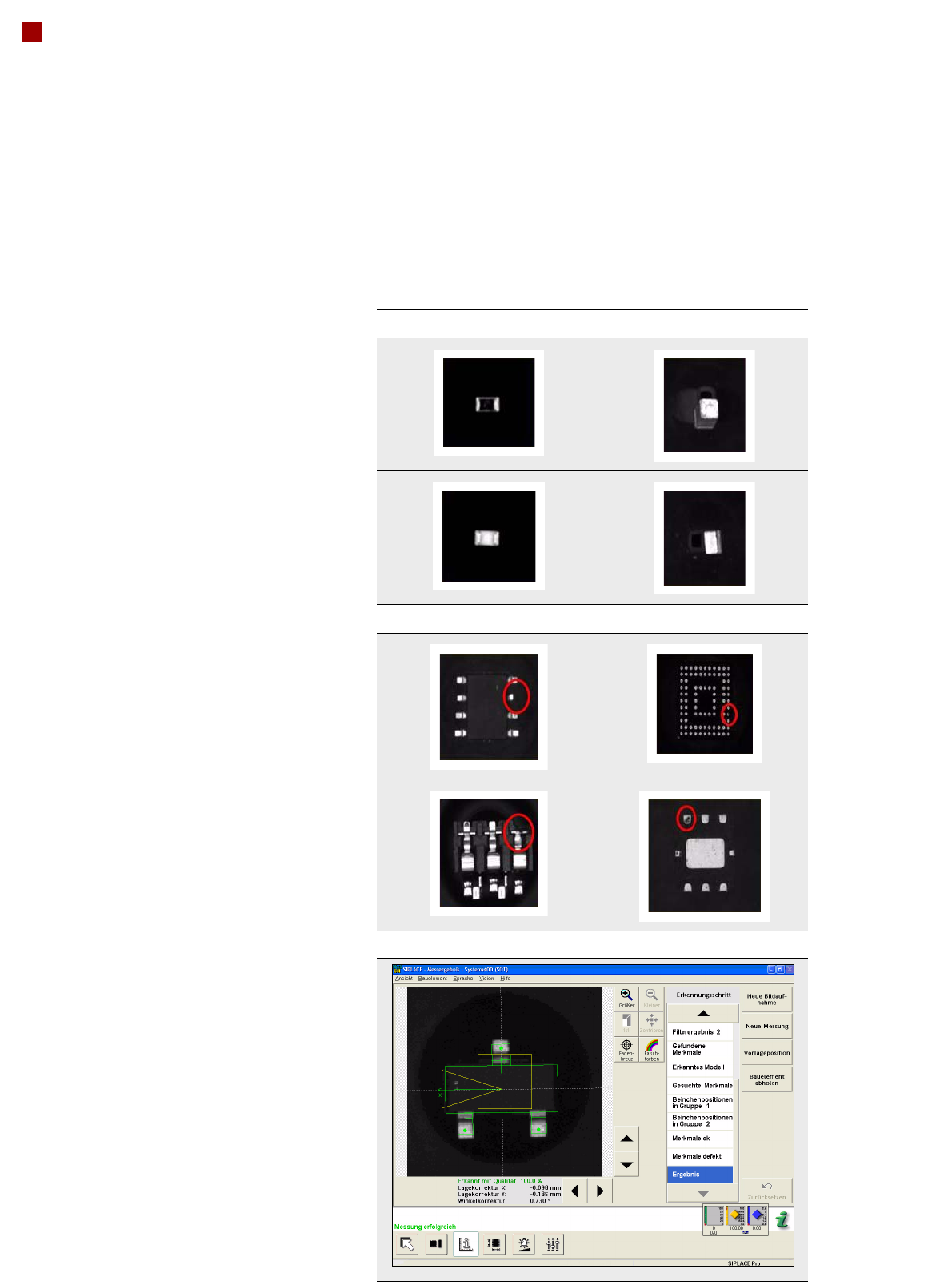
Checking the Component Quality
SIPLACE vision algorithms
help with the recognition of
• flipped components,
• upright components,
• poor component quality.
The digital vision system
automatically saves the last
500 images of components
that were identified as “bad”.
SIPLACE users can then
easily demonstrate poor
component quality.
The benefits at a glance:
• Maximum placement qual-
ity
• High first pass yield
• Reduced operating costs
Flipped components Upright components
Poor component quality
Vision Teach menu at the station

37
Vision Sensor Technology
PCB Position Recognition
Description
Different fiducial shapes
prove to be optimal depend-
ing on the condition of the
surface.
Particularly advisable for
bare copper surfaces with lit-
tle oxidation is the single
cross. Maximum accuracy is
achieved due to the high
information content.
Rectangle, square and circle
are less “informative” but
save space and can even be
used when oxidation is at an
advanced stage. Advisable
for tinned structures are cir-
cle or square because in this
case the ratio of the fiducial
dimensions to the presolder
thickness is particularly
favorable.
Fiducial criteria
Locate 2 fiducials
Locate 3 fiducials
X-/Y-position, rotation angle, mean PCB distortion
in addition: shear, distortion in X- and Y-direction separately
Fiducial shapes Synthetic fiducials: circle, cross, square, rectangle, rhombus,
circular, square, and rectangular contours, double cross, any
pattern
Fiducial surface:
copper
tin
Without oxidation and solder resist
Fiducial warp 1/10 of structure width, both with good con-
trast to environment
Dimensions of synthetic fiducials
min. X/Y size for circle and rectangle: 0.25 mm
min. X/Y size for annulus and rectangle: 0.3 mm
min. X/Y size for cross: 0.3 mm
min. X/Y size for double-cross: 0.5 mm
min. X/Y size for lozenge: 0.35 mm
min. frame width for annulus and rectangle: 0.1 mm
min. bar width / bar distance for cross, double-cross: 0.1 mm
max. X/Y size for fiducial shapes: 3 mm
max. bar width for cross / double-cross: 1.5 mm
min. tolerances, general: 2% of nominal dimension
max. tolerances, general: 20% of nominal dimension
Dimensions of patterns
min. size
max. size
0.5 mm
3 mm
Fiducial environment Clearance around reference fiducial not necessary if there is
no similar fiducial structure in the search area

38
Vision Sensor Technology
PCB Position Recognition
Bad Board Recognition
Ink Spot Criteria
Methods • Synthetic fiducial recognition method
• Mean grayscale value
• Histogram method
• Template matching
Shapes and sizes of fiducials/structures for
synthetic fiducials
other methods
For dimensions of synthetic fiducials,
see page 37
min. 0.3 mm
max. 5 mm
Masking material good coverage
Recognition time depends on the method: 20 ms - 200ms
Description
In the cluster technology
each subpanel is assigned
an ink spot. If this is present
during the measurement via
the PCB vision module, the
corresponding subpanel is
populated.
With this function it is possi-
ble to eliminate costs due to
unnecessary population of
faulty subpanels.
Technical data for PCB position detection
PCB fiducials
Local fiducials
Library memory for recognition
of bad panels
up to 3 (subpanels and multiple panels)
up to 6 for the Long board option (Optional PCB fiducials
are output by the optimization.)
up to 2 per PCB (may be of different type)
up to 255 fiducial types per subpanel
Image analysis Edge detection method (Singular feature) based on gray-
scale values
Lighting method Front lighting
Fiducial recognition time 0.1 s
Field of vision 5.78 x 5.78 mm