KE2040Instruction Manual Ver2.01,REV04.2003.6.25.pdf - 第373页
5 − 10 5.2.1.2 Bal l components (1) BGA A l low able setting range/Descripti on Setting items Minimum Maximum Default value 1 Pitc h (lead pitc h) 1.00 mm 3.00 m m None 2 W d (lead width) 0.40 m m 1.00 m m None 3 Bot., R…
5 − 9
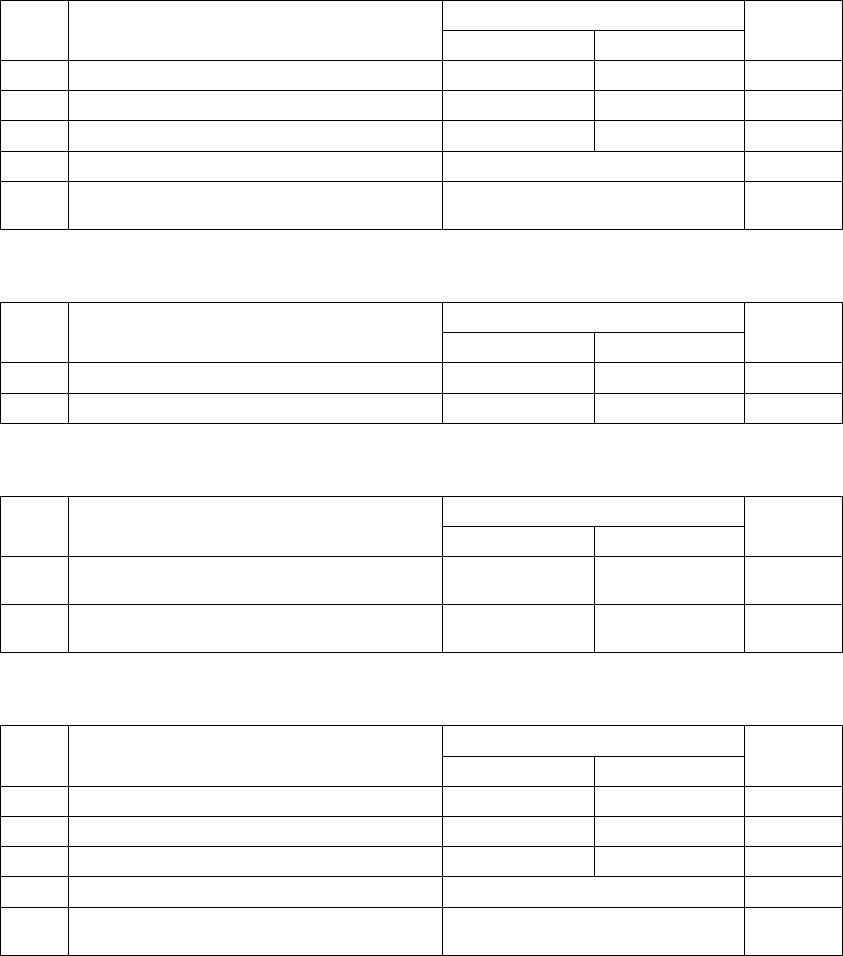
(4) SOJ
Components having J leads on two sides
Allowable setting range/Description
Setting items
Minimum Maximum
Default
value
1
Pitch (lead pitch) 1.27 mm 1.27 mm None
2
Len (lead length) 0.30 mm 3.00 mm None
3
Bot., R, Top, L (number of leads on each side) 7 (Note 4) 128 None
4
Bend (Bent lead detecting level) 15% 20% 25% 30% None (No check) 20%
5
Missing Start/No
(First missing lead/Number of missing leads)
Up to three blocks of missing leads
can be set.
0
(5) Aluminum electrolytic capacitor (See Note 6.)
Allowable setting range/Description
Setting items
Minimum Maximum
Default
value
1
Len (lead length) 1.50 mm 15.00 mm None
2
Wd (lead width) 0.50 mm 1.50 mm None
(6) GaAsFET (See Note 6.)
Allowable setting range/Description
Setting items
Minimum Maximum
Default
value
1
Len Bot, R
(length of a lead on the bottom and right sides)
1.00 mm 15.00 mm None
2
Wd Bot, R
(width of a lead on the bottom and right sides)
0.50 mm 1.50 mm None
(7) SOP (equipped with a heat sink)
Allowable setting range/Description
Setting items
Minimum Maximum
Default
value
1
Pitch (lead pitch) 0.4 mm 1.27 mm None
2
Len (lead length) 0.30 mm 3.00 mm None
3
Bot., R, Top, L (number of leads on each side) 7 128 None
4
Bend (Bent lead detecting level) 15% 20% 25% 30% None (No check) 20%
5
Missing Start/No
(First missing lead/Number of missing leads)
Up to three blocks of missing leads
can be set. (Note 7)
0
Note 1: The lead pitch less than 0.4 mm is optional. When the lead pitch is less than 0.4 mm, the
dimensions of a component should be 24 mm x 24 mm or less (for a 27-mm VCS).
Note 2: The recognition precision of a component whose number of leads is less than four cannot be
guaranteed.
Note 3: When image of a component is divided into two for recognition, the minimum number of
leads is 14. When it is divided into three, the minimum number of leads is 21.
Note 4: The machine cannot recognize divided images of a PLCC (GFJ) or SOJ component for
recognition.
Note 5: Only the standard VCS can divide and recognize image of a connector.
Note 6: The machine cannot recognize divided images of an aluminum electrolytic capacitor. Only
the standard VCS can recognize this type of component.
Note 7: For this component, enter the number of missing leads on a heat sink.
5 − 10
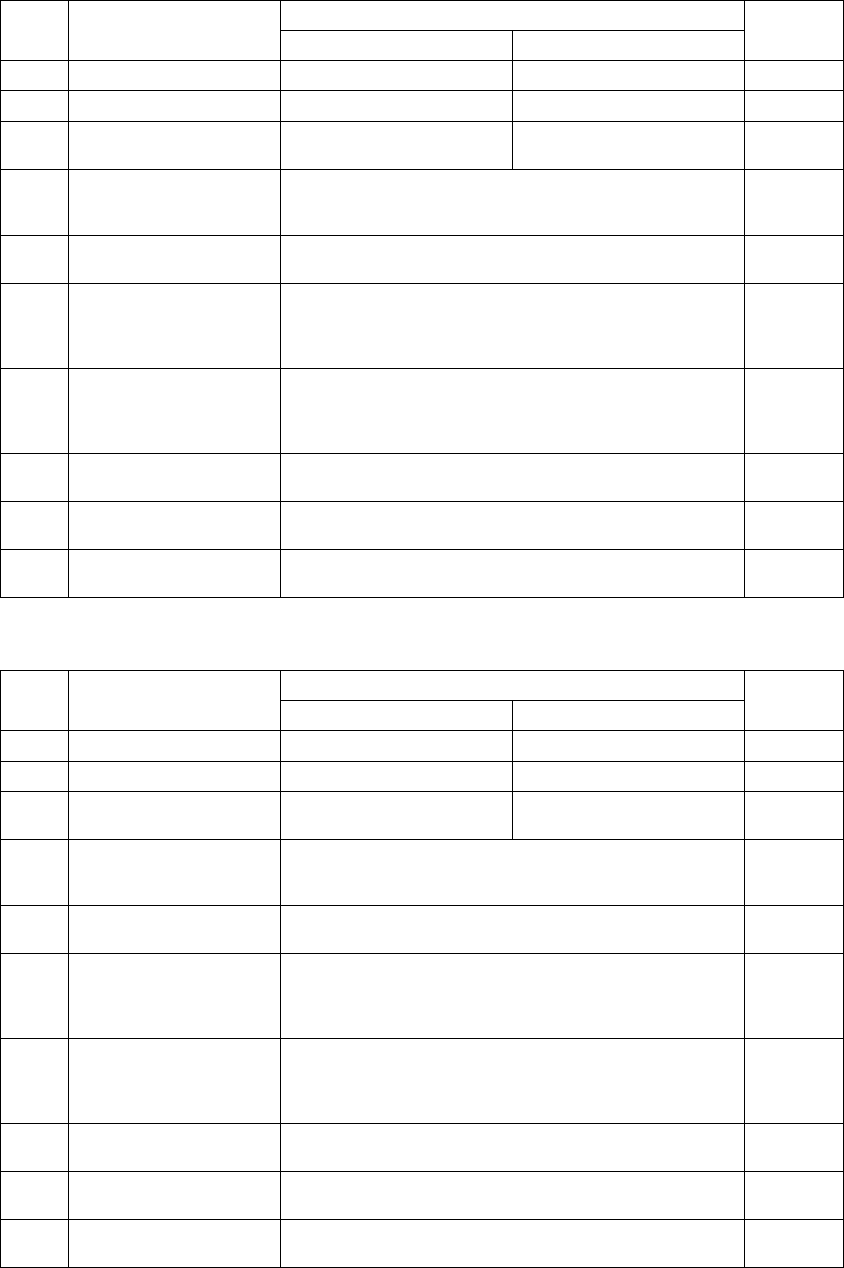
5.2.1.2 Ball components
(1) BGA
Allowable setting range/Description
Setting items
Minimum Maximum
Default
value
1
Pitch (lead pitch) 1.00 mm 3.00 mm None
2
Wd (lead width) 0.40 mm 1.00 mm None
3
Bot., R, Top, L (number of
leads on each side)
4 51 (Note 1) None
4
Missing Start/No (First
missing lead/Number of
missing leads)
Up to three blocks of missing leads can be set. 0
5
Contrast
Select one of the settings: “PWB”, “Ceramic”, “All balls” and
“All land”. (Notes 2 and 3)
All balls
6
Base Style
Select one of the settings: “Standard”, “Index mark 4
corner”, “Index mark 3 corner”, “Index mark 2 corner”, “Index
mark 1 corner”, “Outer belt type mark” and “Mark overspill
type”.
Standard
7
Ball Pattern
Select one of the settings: “Browse”, “Edit”, “Standard
BGA”, “Peripheral BGA”, “Staggered std. BGA (More out)”,
“Staggered per. BGA (More out)”, “Staggered std. BGA
(Fewer out)” and “Staggered per. BGA (Fewer out)” (*).
None
8
NumLn
For a peripheral ball pattern, set the number of lines on which
balls are located with being viewed from the outside.
None
9
Diameter/Level
Select “Yes” or “No” to check the diameter of a ball and set
the level for checking the diameter (1 to 100 %)
No (50%)
10
Variant/Level
Select “Yes” or “No” to check deformation of a ball and set
the level for checking deformation (1 to 100 %).
No (50%)
(2) FBGA
Allowable setting range/Description
Setting items
Minimum Maximum
Default
value
1
Pitch (lead pitch) 0.35 mm (Note 4) 2.00 mm None
2
Wd (lead width) 0.14 mm (Note 5) 0.63 mm None
3
Bot., R, Top, L (number of
leads on each side)
4 51 (Note 1) None
4
Missing Start/No (First
missing lead/Number of
missing leads)
Up to three blocks of missing leads can be set. 0
5
Contrast
Select one of the settings: “All balls” and “All land”. (Notes 2
and 3)
All balls
6
Base Style
Select one of the settings: “Standard”, “Index mark 4
corner”, “Index mark 3 corner”, “Index mark 2 corner”, “Index
mark 1 corner”, “Outer belt type mark” and “Mark overspill
type”.
Standard
7
Ball Pattern
Select one of the settings: “Browse”, “Edit”, “Standard
BGA”, “Peripheral BGA”, “Staggered std. BGA (More out)”,
“Staggered per. BGA (More out)”, “Staggered std. BGA
(Fewer out)” and “Staggered per. BGA (Fewer out)” (*).
None
8
NumLn
For a peripheral ball pattern, set the number of lines on which
balls are located with being viewed from the outside.
None
9
Diameter/Level
Select “Yes” or “No” to check the diameter of a ball and set
the level for checking the diameter (1 to 100 %)
No (50%)
10
Variant/Level
Select “Yes” or “No” to check deformation of a ball and set
the level for checking deformation (1 to 100 %).
No (50%)
Note: For a BGA, meaning of some setting items is changed: from “lead pitch” to “ball pitch”,
“lead width” to “ball width”, and “number of leads” to “number of balls on the outer frame”.

5 − 11
Note 1: For a staggered type of BGA (see
⑦
of Section 5.2), the maximum value is 25.
Note 2: The checking precision cannot be guaranteed when you select “ Ceramic”.
Note 3: When you select “PWB” or “Ceramic”, the machine cannot divide and recognize image of a
component. For an FBGA, “PWB” and “Ceramic” do not appear on the pop-up menu.
Note 4: The minimum ball pitch is 0.7 mm for an optional 37-mm VCS, 0.5 mm for an optional
27-mm VCS, and 0.35 mm for an optional 18-mm VCS.
Note 5: The minimum ball diameter is 0.28 mm for an optional 37-mm VCS, 0.2 mm for an optional
27-mm VCS, and 0.14 mm for an optional 18-mm VCS.
Notes:
The machine cannot recognize a component if:
①
the machine does not detect any clear contrast between a solder ball and a
board on which a solder ball is mounted,
②
the machine does not recognize a ball alone because a pattern whose
diameter is the same as that of a solder ball is connected to a solder ball, or
③
there is a through-hole whose diameter is the same as that of a solder ball on
a board on which a solder ball is mounted.