KE2040Instruction Manual Ver2.01,REV04.2003.6.25.pdf - 第451页
5 − 61 ⑥ Missing elements I n the example, ther e is no missing lead on the elem ent g roup. If there is/ are a missing element (s), specify this set ting it em also in the same m anner as that of a Q FP . Up to f our bl…
5 − 60
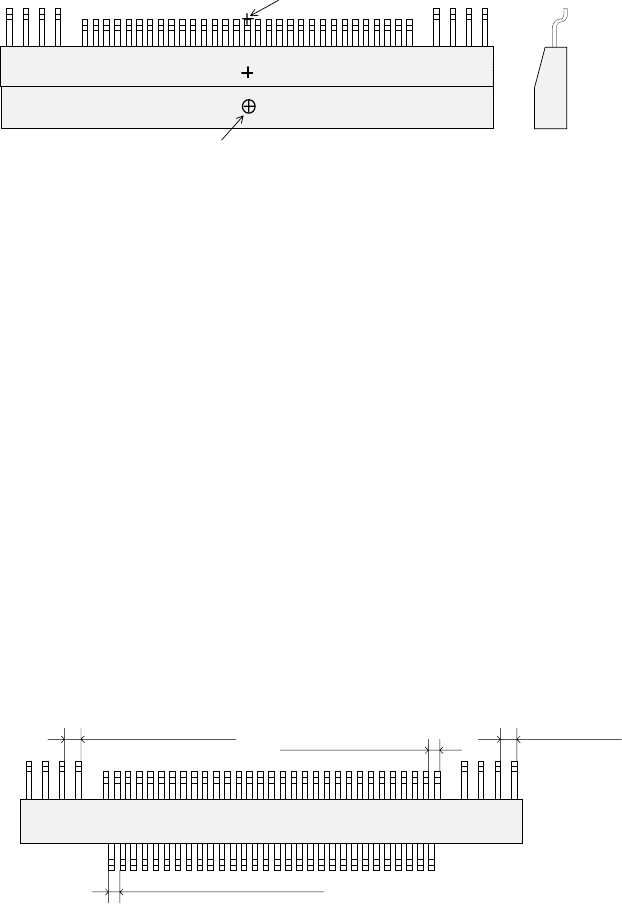
Figure 5.2.4.4.6
③ When the first lead end position is set to (- 20.0 mm, - 5.0 mm), set each value
in the “First element position” field as follows:
Offset X: - 20.0
Offset Y: - 5.0
Offset Z: 0 (not used)
Offset Theta: 0
Set “0” to each field of the setting item “Tolerance”.
* Next, set the element group arrangement.
To set the element group arrangement, the setting items “Dimension”, and
“Count” and “Pitch” of the “Column” and “Row” are provided.
④ Dimension
For a lead element, the dimension is one. Select “1D”.
In the example, the number of leads located in the first element group is 30.
Enter “30” to the “Count” field displayed under the setting item “Row”.
The pitch of each element group is shown in Figure 5.2.4.4.3.
- When the pitch is 0.5 mm, enter “0.5” in the “Pitch” field.
- Set “0” to the “Tolerance” field.
Figure 5.2.4.4.7
⑤ Layout inspection
Set the level used for checking the layout of an element group (checking a
bent lead of a lead component). If you are to check the layout, check the
“Layout inspection” check box. In the same manner as setting of a QFP, use
the ratio of a bent lead to the lead pitch to set the bent lead detection level.
- When you want to set the level to “20 %”, check the “Layout inspection”
check box, then check “20 %”.
Top View
Lead pitch of the first element
group
Lead pitch of the
second element group
Lead pitch of the third element
group
Lead pitch of the fourth
element group
Top View
Component center position (Xcenter, Ycenter)
(component outline center)
Component pick-up position (Xpick, Ypick)
Placement center point of a component
Cross
section
5 − 61
⑥ Missing elements
In the example, there is no missing lead on the element group. If there is/are
a missing element(s), specify this setting item also in the same manner as that
of a QFP.
Up to four blocks of missing leads can be specified per element group.
To specify a block, set the position of the first missing lead and the number of
missing leads located continuously in the same manner when you set those of
a QFP component.
- If three leads are not located from the fifth lead,
Enter “5” to the “Start” field of the “Row” setting item, “3” to the “Count” field.
• Here, you have finished setting an element group. Next, define a recognition
element of this element group.
Only one element can be defined per element group. Even though you define
two or more elements, they are handled as “invalid”.
Click the <Add> button in the “Element” setting field.
1) Element screen
① Type
The lead element types are mainly classified into two: inner leads and outer
leads.
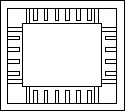
An inner lead refers to a lead whose end faces toward the inside of a
component. An outer lead refers to a lead whose end faces toward the
outside of a component.
- In the example, a component
consists of outer leads.
Select “Outer Lead” from the
“Type” combo box.
Figure 5.2.4.4.8
② Reference pos. (position)
The element origin of a lead element is the lead end as described earlier.
- Select “Center of the bottom” from the “Reference pos.” combo box.
③ Polarity (element polarity)
Specify how bright the image of an element should be.
- Select “Bright” from the “Polarity” combo box because a lead element looks
bright under the reflective light.
④ Offset
Normally, the offset is not used. Set “0” to the “Offset” fields.
Example of
inner leads (of
a socket)
5 − 62
⑤ Element size
Enter the element size. In the example, the lead length is 1.0 mm, and the
lead width is 0.2 mm. In this case, enter the following values:
Size Width: 0.2
Length: 1.0
Normally, the tolerance is not used. Enter “0” to the “Tolerance” fields.
⑥ Outer Lead/Inner Lead
□ Profile (lead shape)
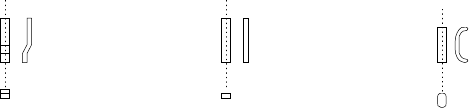
As shown in Figure 5.2.4.4.9, a lead whose shape is flat entirely is called a
“flat lead”, a stepped lead is called a “gullwing lead”, and a J-shaped lead is
called “J-Bend lead”.
* A flat lead is often used for a unidirectional connector.
* A gullwing lead is often used for a QFP and SOP.
* A J-Bend lead is used for a PLCC (QFJ) and SOJ.
Figure 5.2.4.4.9
- In the example, a gullwing lead is shown.
Select “Gullwing” from the “Profile” combo box.
⑦ Cut shape
Specify the shape of a lead end.
All of the settings other than “Flat” are handled in the same manner. When
you select a setting other than “Flat”, set the “Cut width” and “Cut length”
fields.
- In the example, the shape of a lead end is flat.
Select “Flat” from the “Cut shape” combo box.
⑧ Coating
This item is not to be used. Select “Bare” from this combo box.
⑨ Cut width
This item is not to be used. Enter “0” to this field.
⑩ Cut length
Set this item if you select a setting other than “Flat” from the “Cut shape”
combo box.
Enter the length of a not-flat portion measured from the lead end.
- In the example, the shape of a lead end is flat.
Enter “0” to the “Cut length” field.
Gullwing lead
Flat lead
J-Bend lead