fx3r.pdf - 第136页
FX-3R Maintenance Guide 12-7 2) Set the floppy disk drive. Select the “ Main ” menu screen with the [ ← ] or [ → ] key. Move the cursor (highlighted portion) to “ Legacy Diskette A: ” with the [ ↑ ] or [ ↓ ] key, and pr …
FX-3R Maintenance Guide
12-6
12-2-2. Setting Up the BIOS
After the SSD has been replaced, check the BIOS. If the settings are different from those described
in <Setting Method>, change the settings appropriately. In addition, if the CPU board is replaced, it
is absolutely necessary to change the BIOS.
Note: BIOS (Basic Input Output System)
The BIOS is an important program necessary to control the data input and output.
Therefore, always carefully operate the BIOS
. Normally, the programs are saved
into the flash memory on the CPU board and the setup data is saved into the SRAM
backed up by the battery.
Caution
12-2-2-1. Checking the Recognition of the SSD
You may check whether or not the BIOS recognizes the SSD correctly. If no automatic startable
SSD or FDD is found after memory check, the following message will appear.
Operating system not found
You can switch to the BIOS setting screen by pressing the <S> key. (Pressing the <R> key will
reset the unit.)
<Setting Method>
1) Display the BIOS screen.
Press the <F2> key while the “Phoenix Technologies” screen is displayed immediately
after the power has been turned ON.
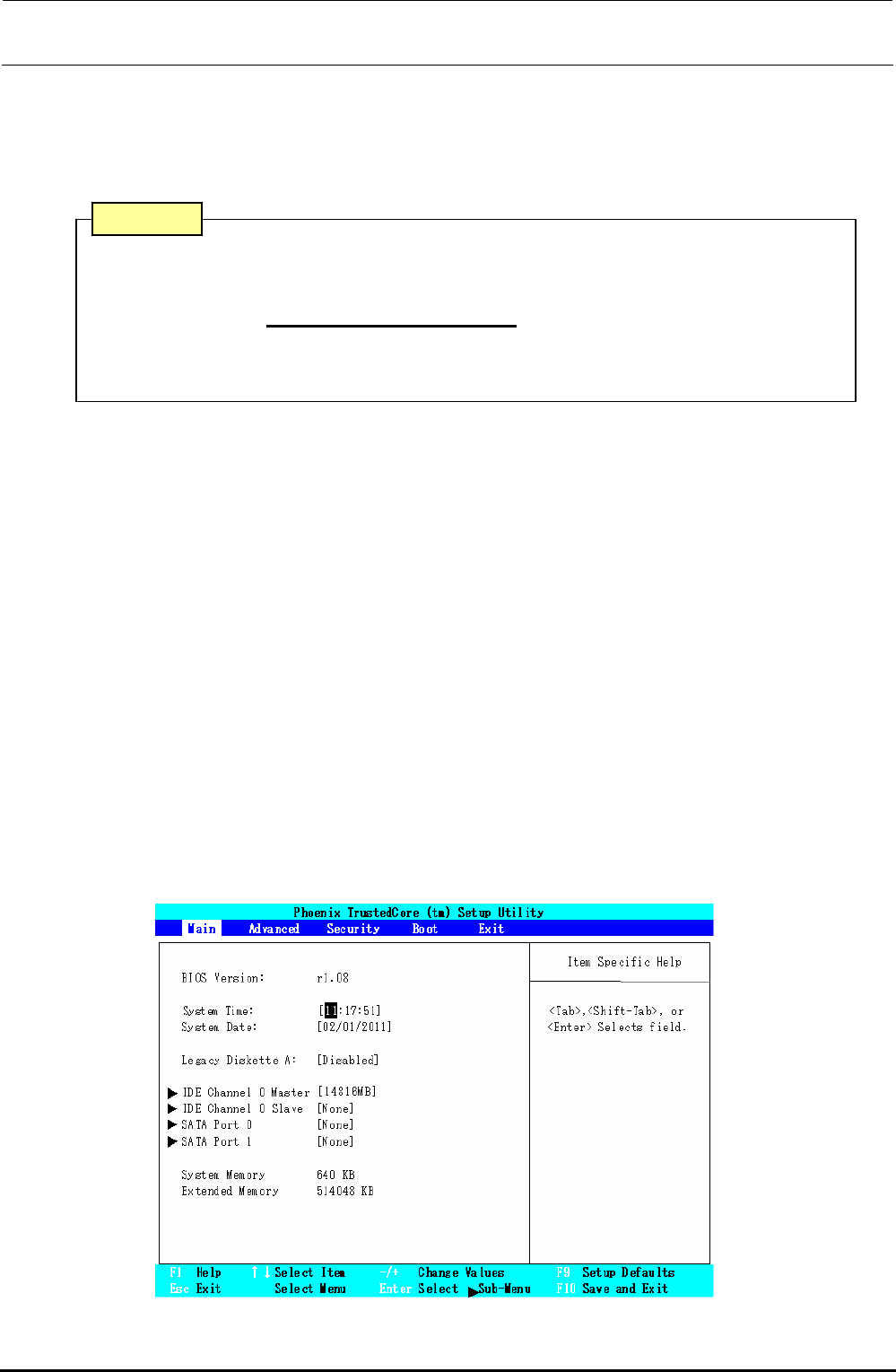
After the operation step has moved to the BIOS setting, the following screen will appear.
Select a menu screen (Main, Advance, Security, Boot, Exit) with the [←] or [→] key, move
the cursor (highlighted portion) with the [↑] or [↓] key, and then press the <Enter> key to run
the item you have selected.
Figure 12-2-2-1-1 Screen Displayed after Moving to BIOS Setting
Rev. 1.00
FX-3R Maintenance Guide
12-7
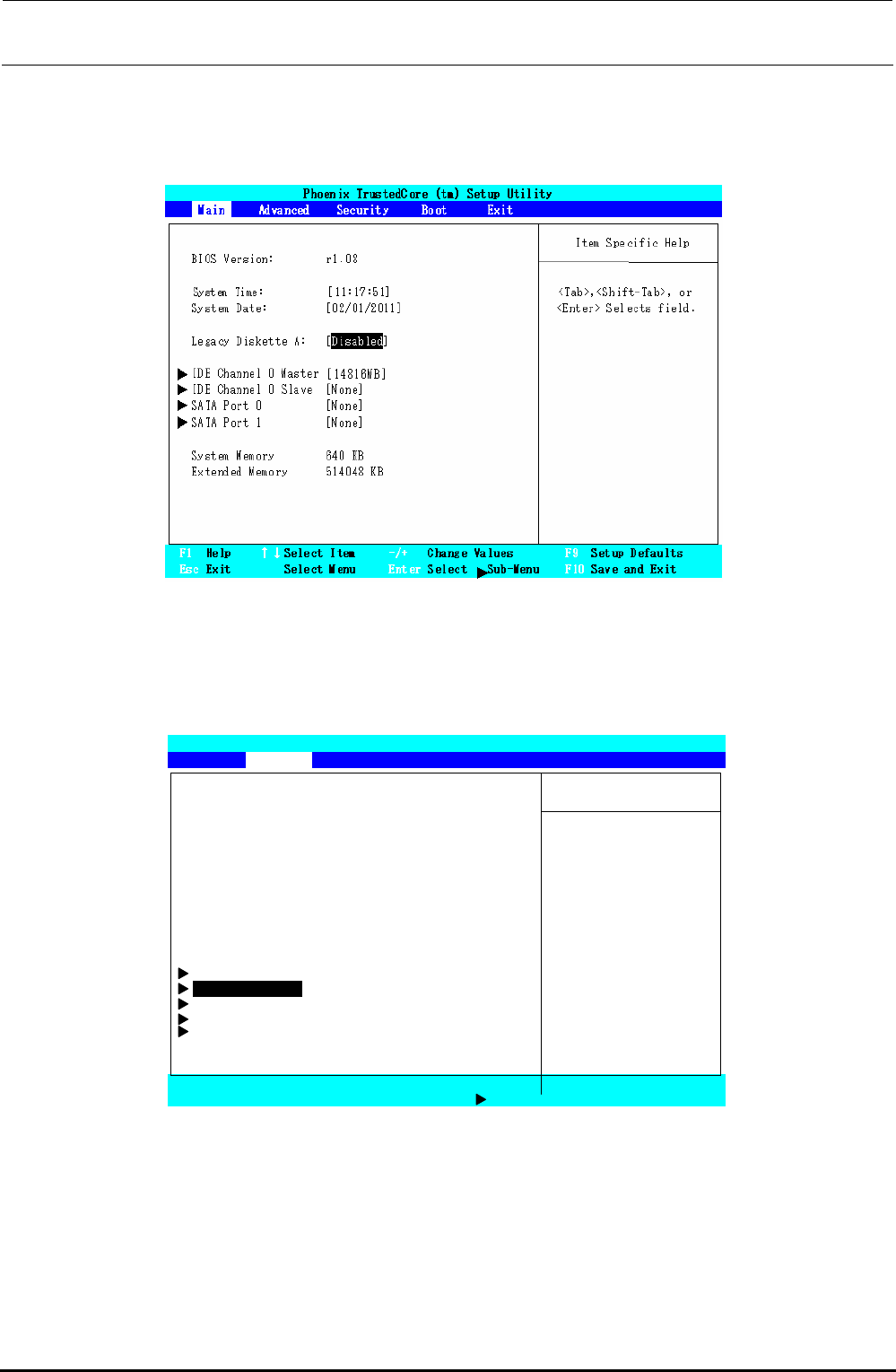
2) Set the floppy disk drive.
Select the “Main” menu screen with the [←] or [→] key. Move the cursor (highlighted
portion) to “Legacy Diskette A:” with the [↑] or [↓] key, and press the <ENTER> key. Select
“Disabled”, and press the <ENTER> key.
Figure 12-2-2-1-2 BIOS Screen (Main Screen)
3) Select the “PnP Configuration” screen.
Select the “Advanced” menu screen with the [←] or [→] key. Move the cursor (highlighted
portion) to “PnP Configuration” with the [↑] or [↓] key, and press the <ENTER> key.
Phoenix TrustedCore (tm) Setup Utility
Main Advanced Security Boot Exit
Item Specific Help
Reset Configuration Data: [No]
Large Disk Access Mode: [DOS]
Local Bus IDE adapter: [Primary] Select
‘
Yes
’
if you
Legacy USB Support: [Enabled] Want to clear the
Summary Screen: [Disabled] Extended System
Boot-time Diagnostic Screen: [Disabled] Configuration
QuickBoot Mode: [Enabled] Data (ESCD) area.
Extended Memory Testing: [Just Zero it]
PXE OPROM: [Disabled]
Keyboard Features
PnP Configuration
CPU Control Sub-Menu
ICH Control Sub-Menu
SIO Control Sub-Menu
F1 Help ↑↓Select Item -/+ Change Values F9 Setup Defaults
Esc Exit Select Menu Enter Select Sub-Menu F10 Save and Exit
Figure 12-2-2-1-3 BIOS Screen (Advanced Screen)
Rev. 1.00
FX-3R Maintenance Guide
12-8
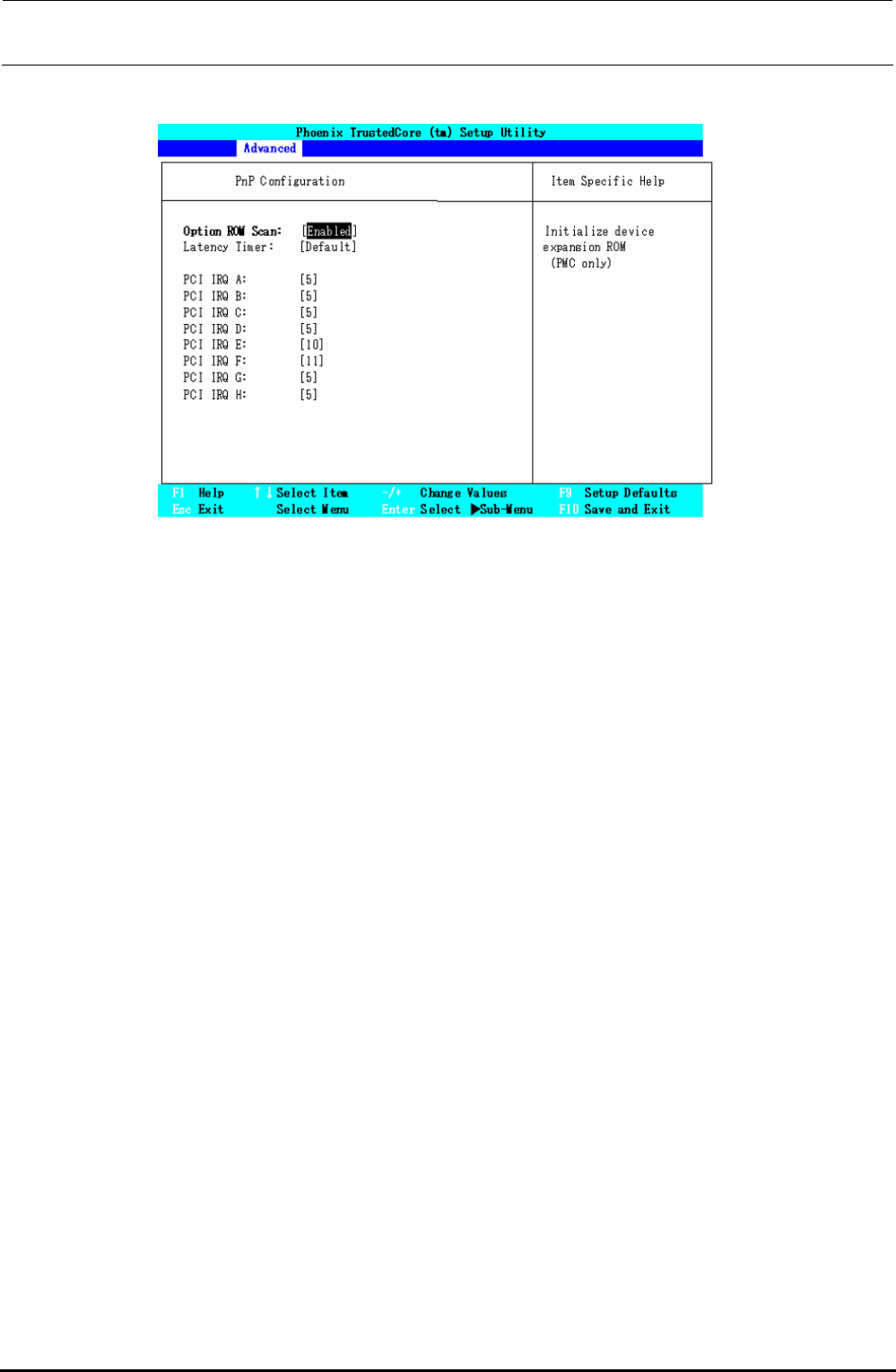
4) Set “PnP Configuration”.
Set “PCI IRQ” on this screen.
Figure 12-2-2-1-4 BIOS Screen (PnP Configuration Screen)
Move the cursor with the [↑] or [↓] key and press the <+> or <−> key, or the <ENTER> key.
Change the setting with the [↑] or [↓] key. So, change the following items.
・ Change “PCI IRQ A:”.
Move the cursor to “PCI IRQ A:” and set “5”.
・ Change “PCI IRQ B:”.
Move the cursor to “PCI IRQ B:” and set “5”.
・ Change “PCI IRQ C:”.
Move the cursor to “PCI IRQ C:” and set “5”.
・ Change “PCI IRQ D:”.
Move the cursor to “PCI IRQ D:” and set “5”.
・ Change “PCI IRQ E:”.
Move the cursor to “PCI IRQ E:” and set “10”.
・ Change “PCI IRQ F:”.
Move the cursor to “PCI IRQ F:” and set “11”.
・ Change “PCI IRQ G:”.
Move the cursor to “PCI IRQ G:” and set “5”.
・ Change “PCI IRQ H:”.
Move the cursor to “PCI IRQ H:” and set “5”.
After the setting has been completed, press the <ESC> key to return to the screen, on which
you can select a desired menu.
Rev. 1.00