YSI_Prog_E.pdf - 第109页
2-38 2 Creating inspection pr ograms 2.7 Step settings A "step" is the minimum inspection unit, and inspection details and judgment conditions are set for each step. Combinations of steps used to inspect each p…
2-37
2
Creating inspection programs
4
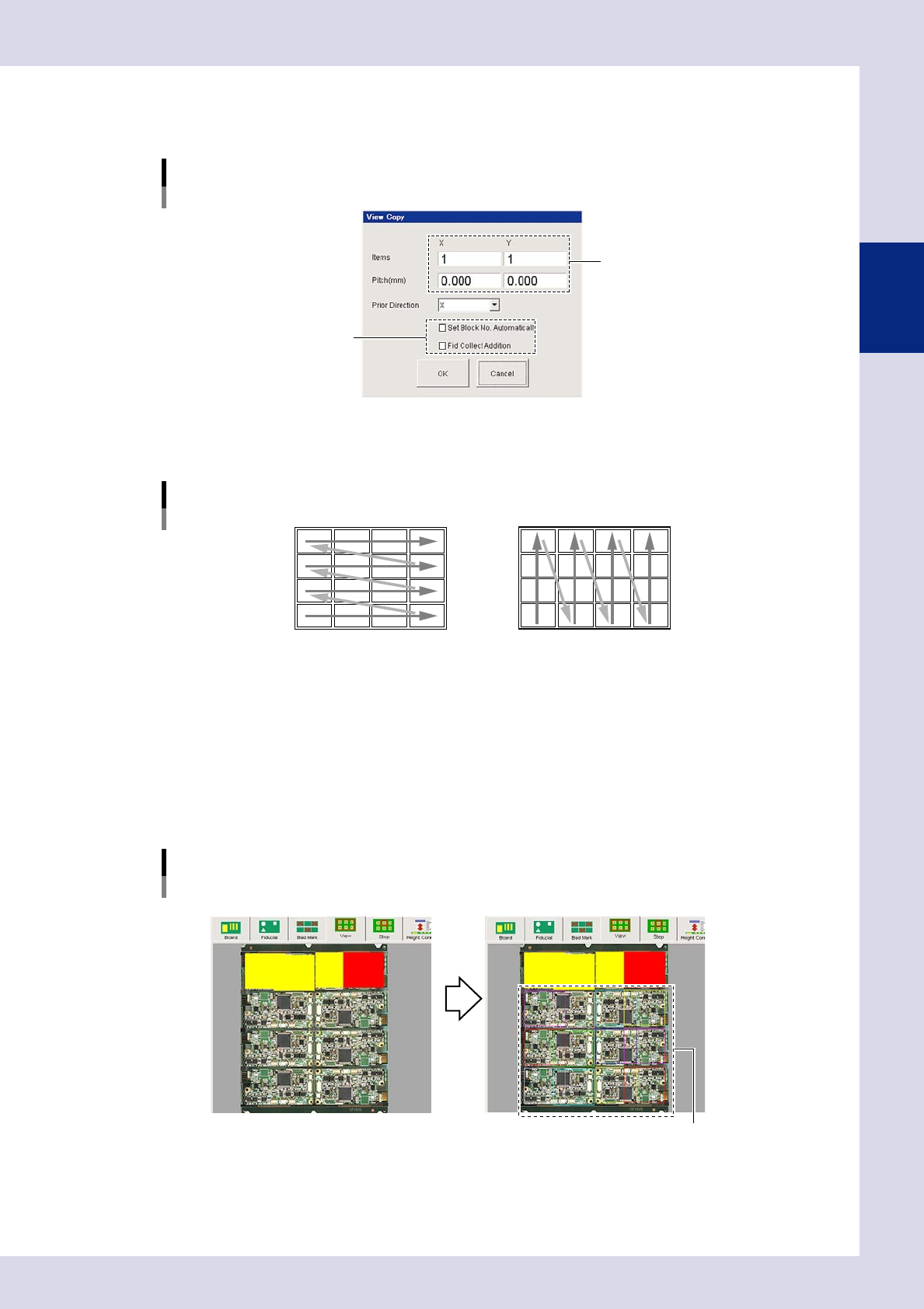
Set the deployment conditions.
Select the direction to be copied from the "Prior Direction" drop-down list. Select the condition check
boxes as required.
[View Copy] screen
Set the deployment conditions.
Step 3
24236-P6-00
Prior direction
Select the prior direction to be copied.
Prior direction
X direction Y direction
23216-P6-00
Set Block No. Automatically
Select this check box to add a block No. to the deployed view.
Fid Collect Addition
By selecting this check box, fiducials recognized when deploying the view are corrected.
5
Press the [OK] button to perform copy.
6
Click on the view list and view radar.
The copied views are displayed on the screen.
Screen example after pitch input and copy
Before pitch input and copy After pitch input and copy
Views are copied in
the specified positions
24237-P6-00
2-38
2
Creating inspection programs
2.7 Step settings
A "step" is the minimum inspection unit, and inspection details and judgment conditions are set for each step.
Combinations of steps used to inspect each parts are used as parts libraries. With inspection programs
converted from YAMAHA mounter data (YGX), parts libraries stored in the inspection machine are deployed to
mounter mounting positions. For parts to which no libraries have been deployed, it is necessary to paste the
relevant libraries from the parts library, create and register new libraries, and then deploy them.
n
NOTE
A parts library is a database to which a combination of inspection steps for each parts has been saved.
2.7.1 Pasting libraries
Paste standard libraries to parts for which libraries have not been deployed.
1
Press the [Data Edit] button and open the "Step" tab.
2
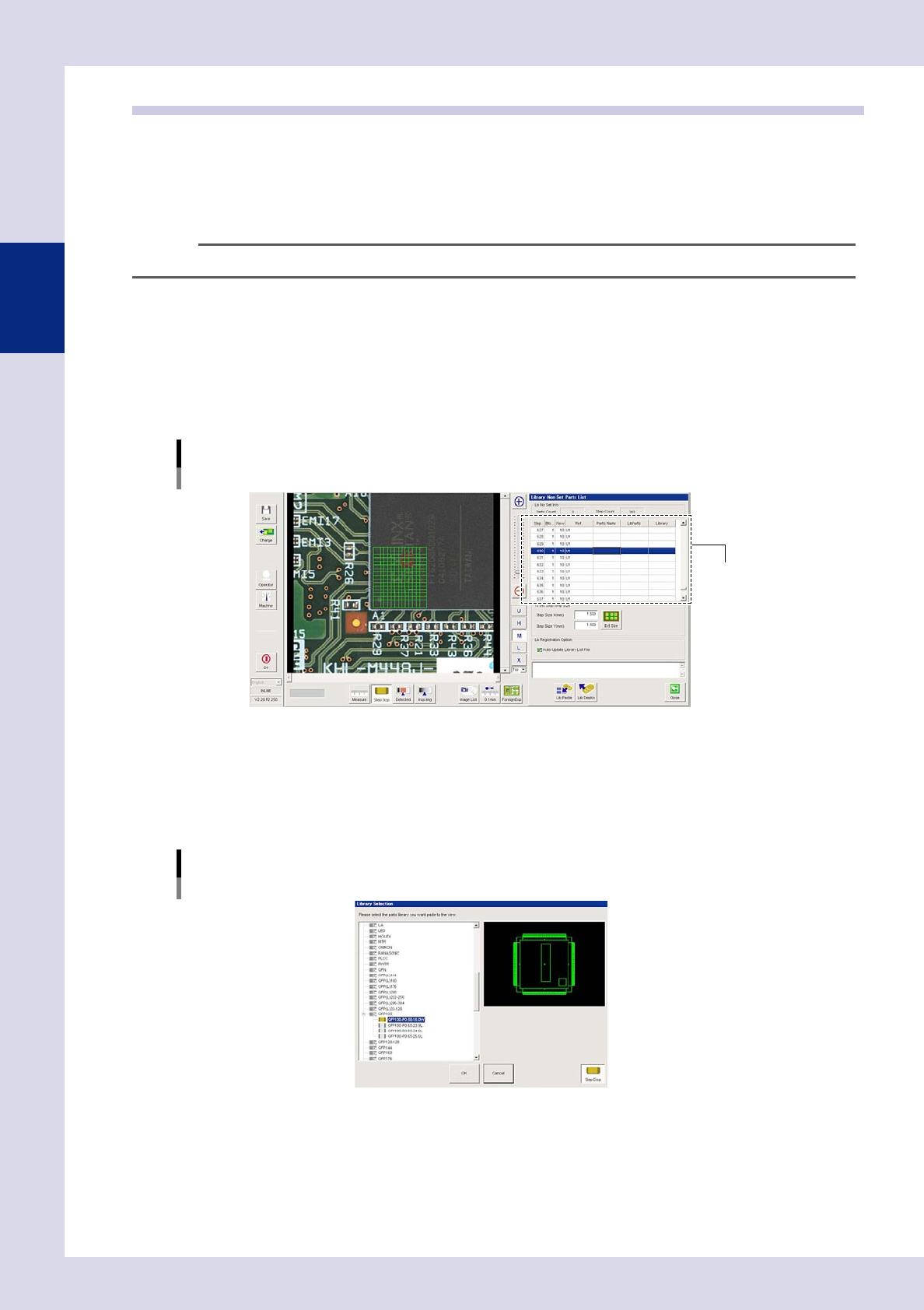
Press the [Lib Non Set] button in the "Utility" tab.
Parts for which libraries have not been deployed appear in the "Library Non Set Parts List".
Library Non Set Parts List
Parts for which libraries
have not been deployed
24238-P6-00
3
Select a part and press the [Close] button.
Move to the applicable part.
4
Press the [Paste] button at the "Tuning" tab.
A "Library Selection" screen appears.
[Library Selection] screen
24239-P6-00
2-39
2
Creating inspection programs
5
Select the applicable library and press the [OK] button.
The "Library Selection" screen is closed, and the library selected for the view image is displayed in
yellow.
Selected library display
The selected library is displayed.
24257-P6-00
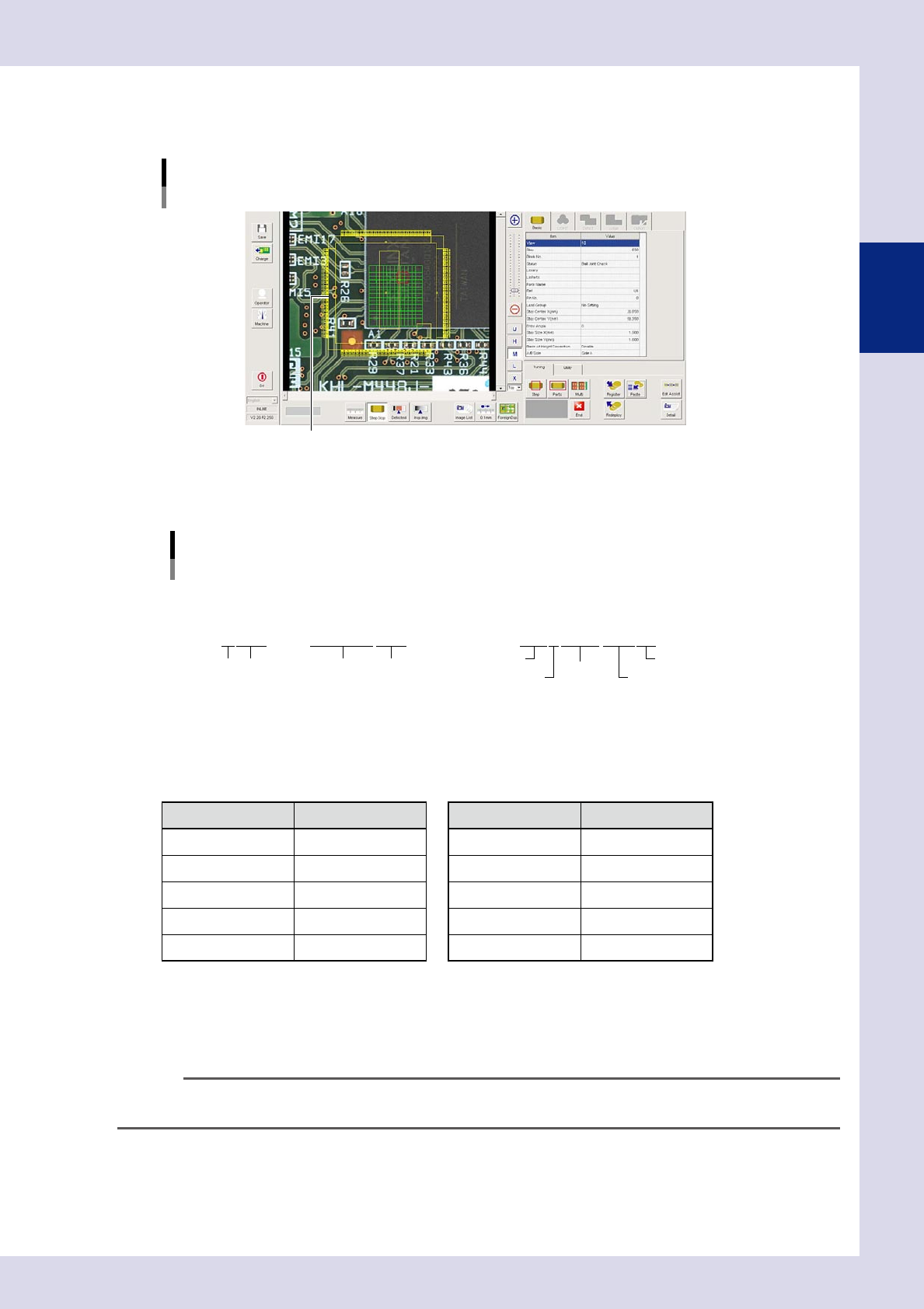
If the applicable library does not exist, select a similar library. Details example names of standard library
names are described below.
R1005 TANTALC1005
SOP4-P1.27-3.5W2.9
Standard library
Lib parts name examples
Example 1: resistor, capacitor, tantalum capacitor Example 2: SOP
(4 pins, pitch: 1.27, lead opposing side width:
3.5 mm, parts body width: 2.9 mm)
Parts type
Parts type
No. of pins
Pitch
Lead opposing side width
Parts body width
Dimensions
Parts type Dimensions
23217-P6-00
• Leadopposingsidewidth(distancefromleadtiptoleadtiponotherside)
W : Square parts with leads on 2 sides or leads on 4 sides
L : Parts with leads on 4 sides, distance in longer direction
The following table shows typical codes.
Parts type Code Parts type Code
Resistor R Network resistor NR
Capacitor C Transistor TR
Mini transistor MTR Diode D
Tantalum capacitor TC Aluminum capacitor AL
Crystal XTL Integrated circuit SOP/QFP/BGA/CSP
6
Paste a library to the mounting position.
1. Move the view image library to the part step position and click.
2. A library parts setting dialog box appears. By pressing the [Yes] button, the library is pasted to the
mounting position.
TIP
If a similar library is pasted, change the parameter settings for that part and register the library. For details on the
registration method, see section 2.7.3, "Registering libraries", in this chapter.