KE2040Instruction Manual Ver2.01,REV04.2003.6.25.pdf - 第436页
5 − 46 5.2.4 General-purpose vision components 5.2.4.1 Overview of a general- purpose vision component The f ollowing types of component s are handled as a gener al-purpose vision component (“ GNRL. vision” displayed as …
5 − 91
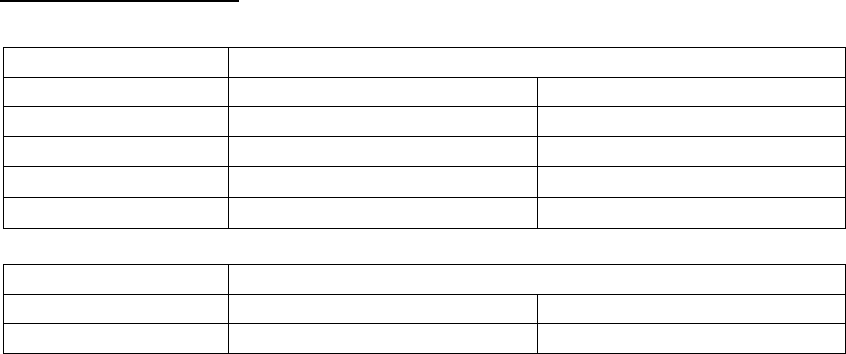
Optional 18.00-mm VCS
- Bottom (reflective) light
Dimensions of applicable components
Division mode Longer side Shorter side
Standard 15.50 – 3.00 mm 15.50 – 3.00 mm
1 × 2
31.00 – 15.51 mm 15.50 – 3.00 mm
1 × 3
46.50 – 31.51 mm 15.50 – 3.00 mm
2 × 2
31.00 – 15.51 mm 31.00 mm – 15.51 mm
- Back (penetrative) light
Dimensions of applicable components
Division mode Longer side Shorter side
Standard 15.50 – 9.00 mm 15.50 – 9.00 mm
5 − 46
5.2.4 General-purpose vision components
5.2.4.1 Overview of a general-purpose vision component
The following types of components are handled as a general-purpose vision
component (“GNRL. vision” displayed as the component type):
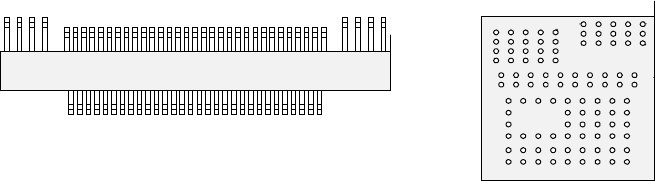
- Components having multi-pitch leads, components having various sized leads,
and components having leads at not-regulated positions (these components are
called “multi-lead” components; see Figure -1.)
- Area array components having two or more arrays (called “complex array
components”; see Figure -2.)
- Components having balls/lands on not-regulated positions (called “random
component”)
- Components having a side or corner (outline-recognized components)
• The components above are classified into the following sub-component types:
Multi-lead component: Lead component group
Complex array component and random component: Ball component
group
Outline-recognized component: Outline-recognized component group
• The data format definition of each type of components is as follows:
Multi-lead component, complex array component and outline-recognized
component → Element group/Element format
Random component → Extended array data format
* The “Element group/Element format” specifies an element to be recognized such
as a lead and ball, defines the group of the same elements (element group): the
pitch and/or quantity is the same, and specifies the direction and position of the
group.
The “Extended array data format” defines the element (ball and land) arrangement
with X and Y coordinates.
Figure -1 Figure -2
Ball component group
(Complex array component)
Lead component group (Multi-lead component)
5 − 47
5.2.4.2 Specifications of a general-purpose vision component
1) Quantity
- Up to 20 element groups can be defined per component.
- Only one element can be specified per element group.
2) Dimensions
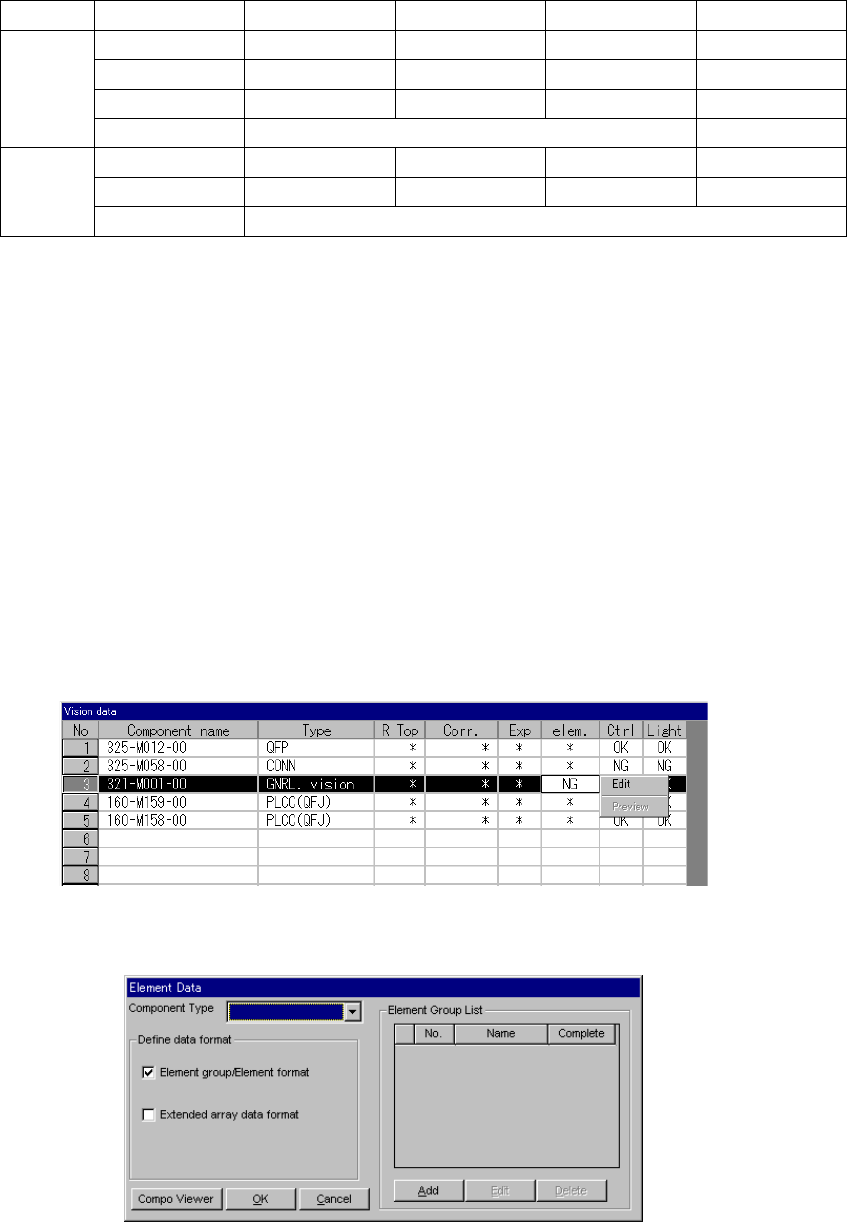
Element Setting item Standard VCS Optional VCS1 Optional VCS2 Optional VCS3
Pitch 0.5 – 22.0 mm 0.4 – 15.0 mm 0.3 – 11.0 mm 0.3 – 6.5 mm
Wd (lead width) 0.22 – 10.0 mm 0.15 – 7.0 mm 0.12 – 5.0 mm 0.12 – 3.5 mm
Len (lead length) 0.4 – 10.0 mm 0.3 – 7.0 mm 0.2 – 5.0 mm 0.14 – 3.5 mm
Lead
element
Number of leads 1 to 384/element group
Pitch 1.0 – 22.0 mm 0.7 – 15.0 mm 0.5 – 11.0 mm 0.35 – 6.5 mm
Diameter 0.4 – 5.0 mm 0.28 – 3.5 mm 0.2 – 2.5 mm 0.14 – 1.5 mm
Ball/Land
element
Number of balls 3 to 6936/element group
3) Shape and size specifications of an outline-recognized component group
- The specifications of the corner/side shape are the same as those of the
outline-recognized component group (See “Limitation on components
depending on the recognition method” of “⑪ Contrast”, “5.2.3 Detailed
description of operation”).
- A filled circle and square marks can be used. A mark whose size is from 2
mm to 10 mm can be recognized with the standard VCS.
5.2.4.3 elem. (element)
This setting item is provided for components whose component type is set to “GNRL.
vision” in the “Type” cell and which cannot be recognized with normal Vision data
because their lead (ball) pitch or lead length is not the same as each other although
their component type is the same.
- When you click this setting item with the right button, the selection pop-up menu
appears on the screen as shown below.
• When you click the [Edit] command on the pop-up menu, the following screen
appears.