00193411-02.pdf - 第50页
2 Operational safety User Manual SIPLACE HS-60 2.5 Safety equipment Software version SR. 503.xx 07/2003 US Edition 50 2.5.3.4 Descri ption of the functions Main power switch in the OFF position (see item 1 in Fig. 2.5 - …
User Manual SIPLACE HS-60 2 Operational safety
Software version SR.503.xx 07/2003 US Edition 2.5 Safety equipment
49
2.5.3.3 Position of UPS, station computer and sockets for connecting the CO trolleys
2
Fig. 2.5 - 6 UPS, station computer, sockets for connecting the CO-trolley
2
(1) Socket for connecting the CO trolley
(2) Push-button for raising the component trolley, with the cover flap over it
(3) UPS and station computer

2 Operational safety User Manual SIPLACE HS-60
2.5 Safety equipment Software version SR.503.xx 07/2003 US Edition
50
2.5.3.4 Description of the functions
Main power switch in the OFF position (see item 1 in Fig. 2.5 - 4
) 2
The main power switch disconnects the three phases L1, L2, and L3 from the power supply.
WARNING 2
The following components still carry potentially lethal voltages even if the main power switch is
switched off:
– Cable connection terminals 1, 3, and 5 of the S1 main power switch
– Mains filter Z1
– BU1 service socket
– F1 automatic circuit breaker for the service socket
– The color of all individual wires, which still carry potentially lethal voltages even if the main
power switch is switched off, is brown.
– The uninterruptible power supply and the station computer may also still carry potentially lethal
voltages when the main power switch is switched off.
Æ Death, serious injury or considerable damage may result if these automatic placement sys-
tems are handled incorrectly.
Æ Always follow the applicable accident prevention and DIN regulations (particularly DIN EN 60
204, part 1) and the applicable regulations in your own country.
Æ The safety door to the power supply must ONLY be opened by appropriately qualified and
trained personnel.
Main power switch in the ON position 2
After switching on the main power switch, the station computer and the machine controller will
start. All supply voltages, apart from the link voltages for the gantry axes (200 V) and the star axes
(100 V) are then available.
Stop button, black (item 2 in Fig. 2.5 - 4) 2
These buttons are used to stop the placement system.
Start button, white (item 3 in Fig. 2.5 - 4) 2
After switching on the main power switch you will be prompted to press the Start button in order
to start the placement system for placement jobs. The same prompt appears if you open the pro-
tective covers or the press the EMERGENCY-STOP button.

User Manual SIPLACE HS-60 2 Operational safety
Software version SR.503.xx 07/2003 US Edition 2.5 Safety equipment
51
Component counter (item 4 in Fig. 2.5 - 4) 2
This displays the number of inserted components.
Service socket (item 5 in Fig. 2.5 - 4) 2
The service socket is contained in the power supply unit and is protected by the safety door. It can
only be used if the placement system is connected to the main power supply via a 5-wire connec-
tion (L1, L2, L3, N, and PE). If a 4-wire connection is used, e.g. without N, the socket cannot be
used.
Always follow the safety instructions concerning potentially lethal voltages - even when the
placement system is switched off. 2
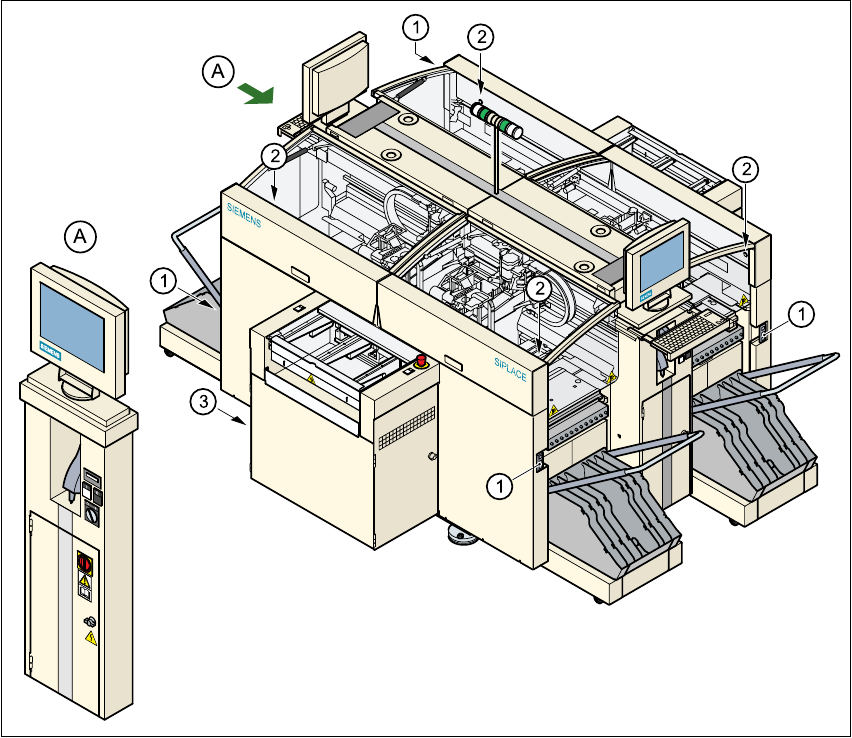
EMERGENCY-STOP-button, latching, with override protection to EN 418 (item 1 in Fig. 2.5 - 5)2
The EMERGENCY-STOP-button is a red mushroom shaped button. It latches in the ON position
when pressed. When you press the EMERGENCY-STOP button the switching contact of the
safety circuit opens and the protective contactor combination (PCC) trips. The link voltage (200 V)
for the gantry axes is switched off, whereas the link voltage (100 V) for the star axis is reduced to
6 VDC. The servo amplifiers for the DP and Z-axes are still supplied with 30 VDC. The signaling
contact of the EMERGENCY-STOP button closes and the message "EMERGENCY-STOP
pressed" appears on the screen. The following modules
– PCB conveyor
– PCB clamping
– width adjustment
– laser light barrier and
– used tape cutter
are deactivated.
PLEASE NOTE
Placement is interrupted and can then either be continued or canceled once the machine is work-
ing correctly again. 2
Protective cover switch (item 2 in Fig. 2.5 - 5) and other cover switches (item 3 in Fig. 2.5 - 5)2
These switches check whether the protective and any other covers are closed. When the covers
are closed, the safety contact is closed and the signaling contact is open. If one of the covers is
opened, the safety circuit opens and the signaling circuit closes. The individual components will
be activated or deactivated, depending on the position of the key-operated switch (item 5).