Nordson_EFD_GV_Series_Operating_Manual.pdf - 第113页
GV Series Automated Dispensing Systems 113 www.nordsonefd.com info@nordsonefd.com +1-401-431-7000 Sales and service of Nordson EFD dispensing systems are available worldwide. Jet Step Click Function Double-click address …
GV Series Automated Dispensing Systems
112 www.nordsonefd.com info@nordsonefd.com +1-401-431-7000 Sales and service of Nordson EFD dispensing systems are available worldwide.
Goto Label
Click Function
Causes the program to jump to the address in the program that has the specified label.
Height Sensor
Click Function
Double-click
address and
select from
drop-down
menu
Measures the height of an object on a workpiece where a dispense dot is to be placed; the measured data is
then used to adjust dispensing accordingly for any height changes between workpieces.
NOTE: For this functionality, the optional height sensor must be installed and set up. Refer to”AppendixF,
Height Sensor Setup and Use” on page142 for all information related to the height sensor.
Initialize
Click Function
Causes the robot to perform an initialization. The dispensing tip moves to the home position (0, 0, 0) and the
robot relocates the home position using the home position sensors.
Input
Click Function
Causes the program to check for an input signal at the specified port and to turn the input ON or OFF.
Parameter Description
Port(1~8) Sets the input port number.
0 Off, 1 On Turns the input OFF or ON.
Address or
Label
Causes the program to check the input at the specified address or label. Click Change to toggle
between Address and Label.
Input Ready
Click Function
Double-click
address and
select from drop-
down menu
Used to communicate with external devices: If Input Ready is ON, the system checks the assigned port and
acts accordingly; if Input Ready is OFF, the system does not check the assigned port and moves on to the
next command.
Parameter Description
Port(1~8) Sets the input port number for the system to check.
0 Off, 1 On Turns Input Ready OFF or ON.
Appendix A, Command Function Reference
(continued)
GV Series Automated Dispensing Systems
113www.nordsonefd.com info@nordsonefd.com +1-401-431-7000 Sales and service of Nordson EFD dispensing systems are available worldwide.
Jet Step
Click Function
Double-click
address and
select from
drop-down
menu
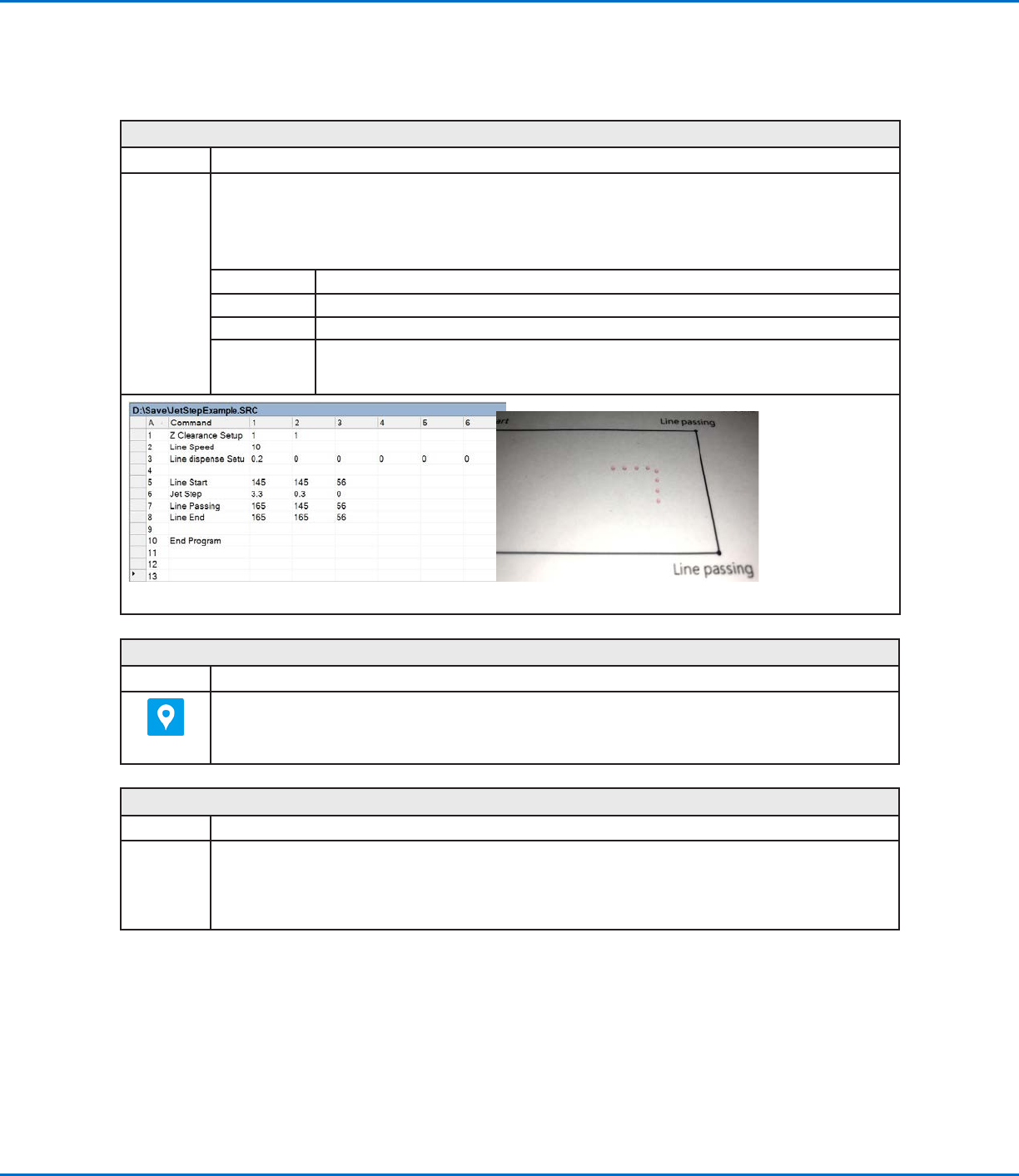
Used in tandem with a Line Start and a Line End command to cause the system to dispense a stitched series
of dots between the commands at the specified length (Jet Step) and for the specified amount of time (Pulse
Width). This command is useful for jetting applications in which extremely quick dispensing is required.
NOTE: For PICO jet dispensing, this command can be used with Line Start and Line End commands to create a
stitched pattern. An example program and resulting pattern are shown below.
Parameter Description
Jet Step The distance (inmm) between the stitched dots.
Pulse Width How long the dispenser stays open (in ms) for each deposited dot.
Adjust Offset value (in mm) that the system applies to each coordinate value in the program. This
setting can be used to compensate when a dispensing program is slightly off from the desired
pattern.
Example of a stitching program using the Jet Step command for a PICO jet valve
Label
Click Function
Registers a numeric label that can be used as a reference in the Goto Address, Goto Label, Loop Address, Step
& RepeatX, Step & Repeat Y, and Call Subroutine commands. Using a Label is a good alternative to using an
address number because a Label does not change when commands are inserted or removed. A maximum of 64
labels is allowed per program; each label can have up to 8 numbers.
Light
Click Function
Double-click
address and
select from
drop-down
menu
Sets the luminance of the light source at a specified point in the program between 0 (no luminance) and 255
(brightest).
NOTE: This command is present only if an optional light accessory is installed.
Appendix A, Command Function Reference
(continued)
GV Series Automated Dispensing Systems
114 www.nordsonefd.com info@nordsonefd.com +1-401-431-7000 Sales and service of Nordson EFD dispensing systems are available worldwide.
Appendix A, Command Function Reference
(continued)
Line Dispense Setup
Click Function
Sets how the system dispenses a line of fluid. When dispensing high-viscosity fluids, there is often a delay
between when the dispenser opens and when fluid begins to flow. Use the Line Dispense Setup parameters to
compensate for this delay.
Parameter Description
Pre-move
Delay
The time the dispenser stays open at the start of a line before moving. This delay time prevents
the tip from moving along the line until fluid is flowing.
Settling
Distance
The distance the robot moves from the beginning of a Line Start before the dispenser turns on.
This distance allows the robot sufficient time to build speed and is used primarily to eliminate the
deposit of too much fluid at the beginning of a line.
Dwell Time Delay time that occurs at the end of a line after the dispenser closes to allow the pressure to
equalize before the tip moves to the next point.
Node Time Delay time that occurs only for a Line Passing command. The dispensing tip passes through
the Line Passing point and waits at the Line Passing point, with the dispenser activated, for the
specified time period.
Shutoff
Distance
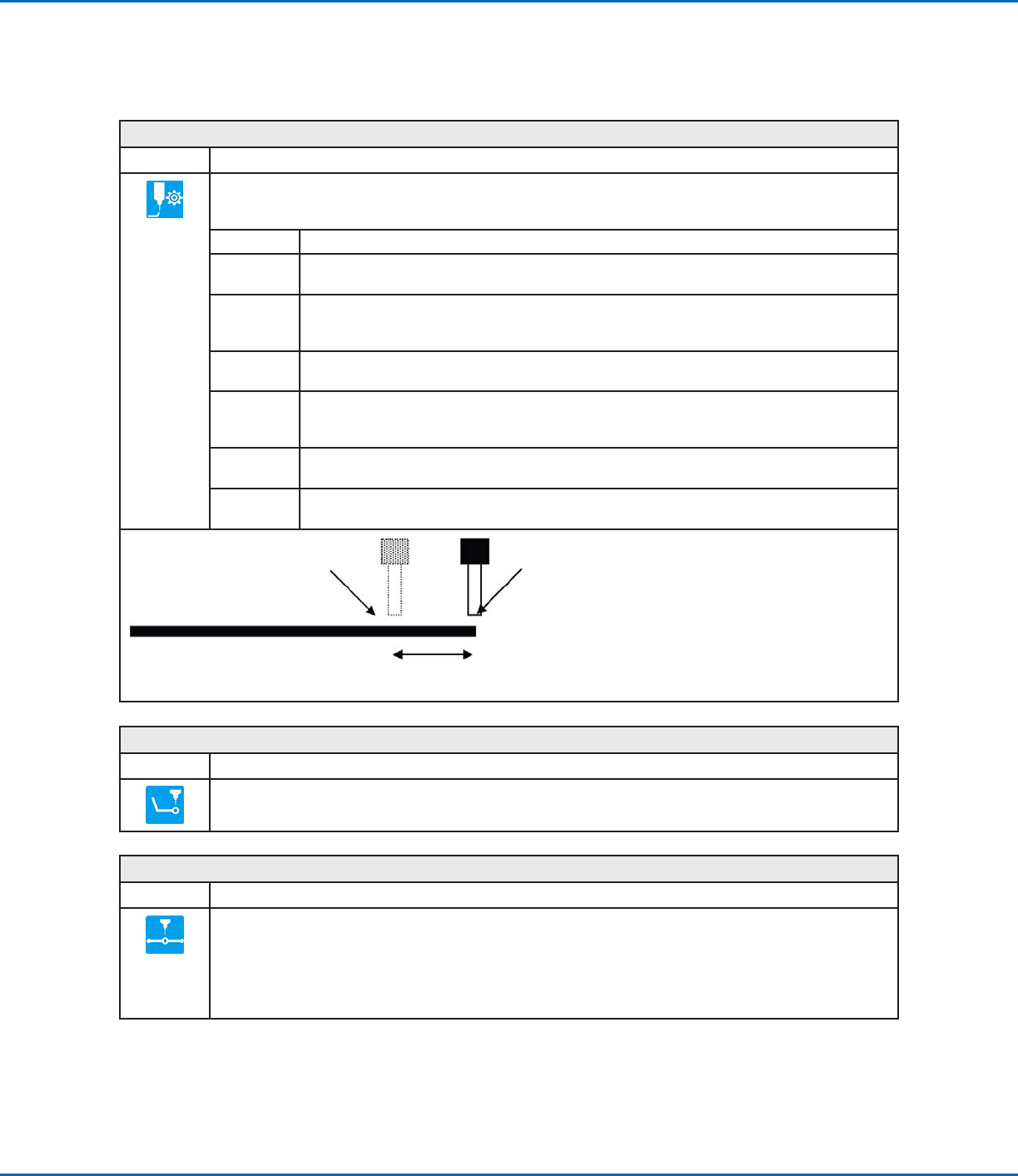
The distance before the end of a line when the dispenser closes to prevent excess fluid from
being deposited at the end of the line, as shown in the illustration below.
Shutoff
Delay
The time the dispenser stays open after it stops at the end of a line.
Shutoff Distance
Tip continues moving to the end of the lineDispenser turns off here
Illustration of the Shutoff Distance parameter
Line End
Click Function
Registers the current XYZ location as a Line End point.
NOTE: The correct sequence of commands for a line is as follows: (1) Line Start, (2) Line Passing, (3) Line End.
Line Passing
Click Function
Registers the current XYZ location as a Line Passing point. This is a location on a line where the dispensing tip
changes direction, such as at the corner of a rectangle.
NOTES:
• The correct sequence of commands for a line is as follows: (1) Line Start, (2) Line Passing, (3) Line End.
• Also use a Line Passing point before and after an Arc Point command.