3OM-1343-008_w.pdf - 第211页
5-26 AKFEDT -ID 3.2 Machine Performance Data 0607-003 3.2 Machine Performance Data When the "Machine Performance Data" tab is pressed in the "Pattern Program Management Data" window , the following ta…
5-25
AKFEDT-ID
3.1 Pattern Program Product History
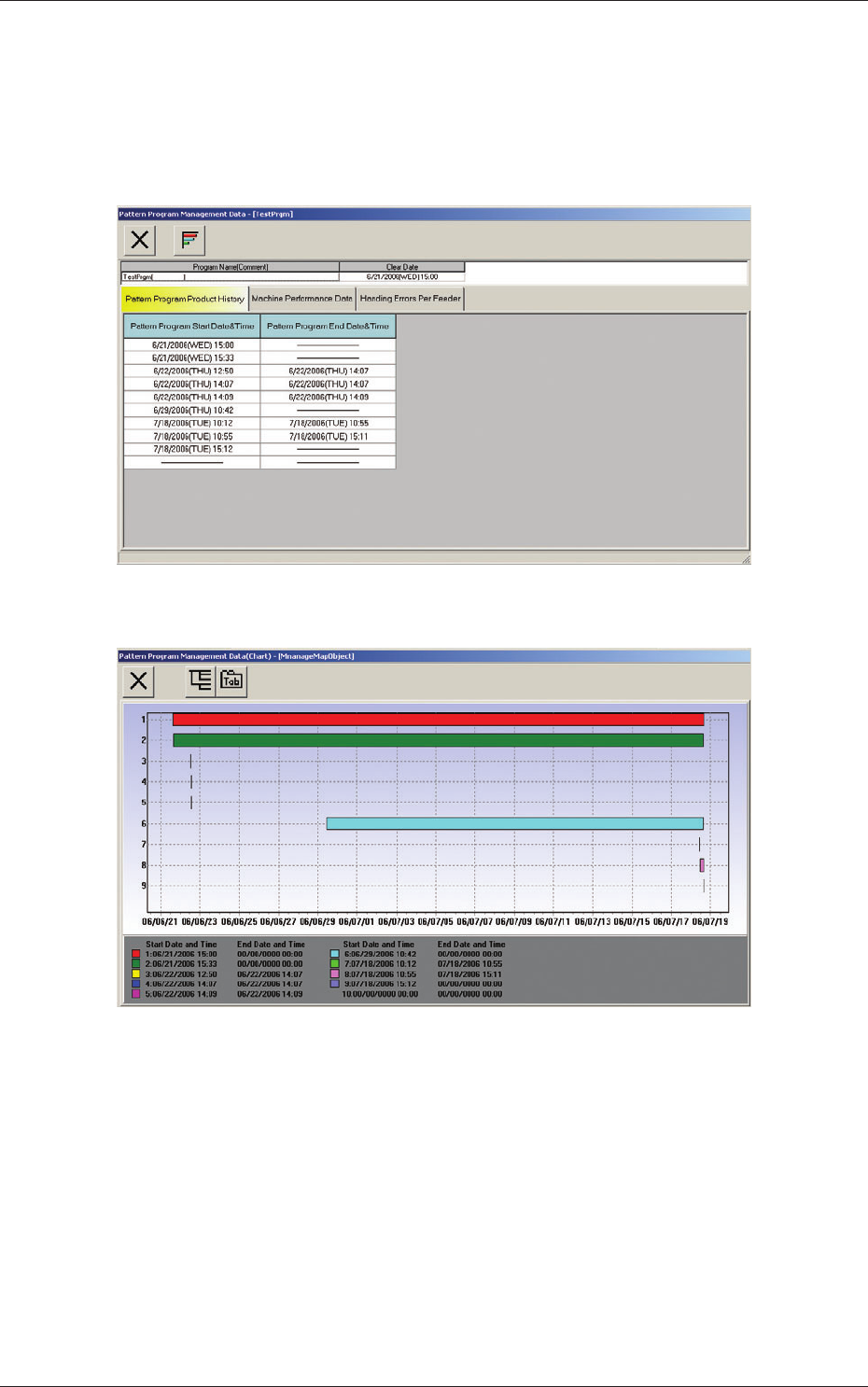
When the "Pattern Program Product History" tab is pressed in the "Pattern
Program management Data" window, the following tab sheet appears inside
the window.
Fig. 3E13 "Pattern Program Product History" Tab Sheet
Fig. 3E13-1 "Pattern Program Management Data (Chart)" Window
for "Pattern Program Product History"
Up to 10 records (logs that show the number of times specifi ed as current
pattern program) are displayed for each individual pattern programs.
The start and end date & time records (logs) are also displayed for the
selected pattern program.
When there are more than 10 logs, the older ones are deleted one by one.
3.1 Pattern Program Product History
0607-003
5-26
AKFEDT-ID
3.2 Machine Performance Data
0607-003
3.2 Machine Performance Data
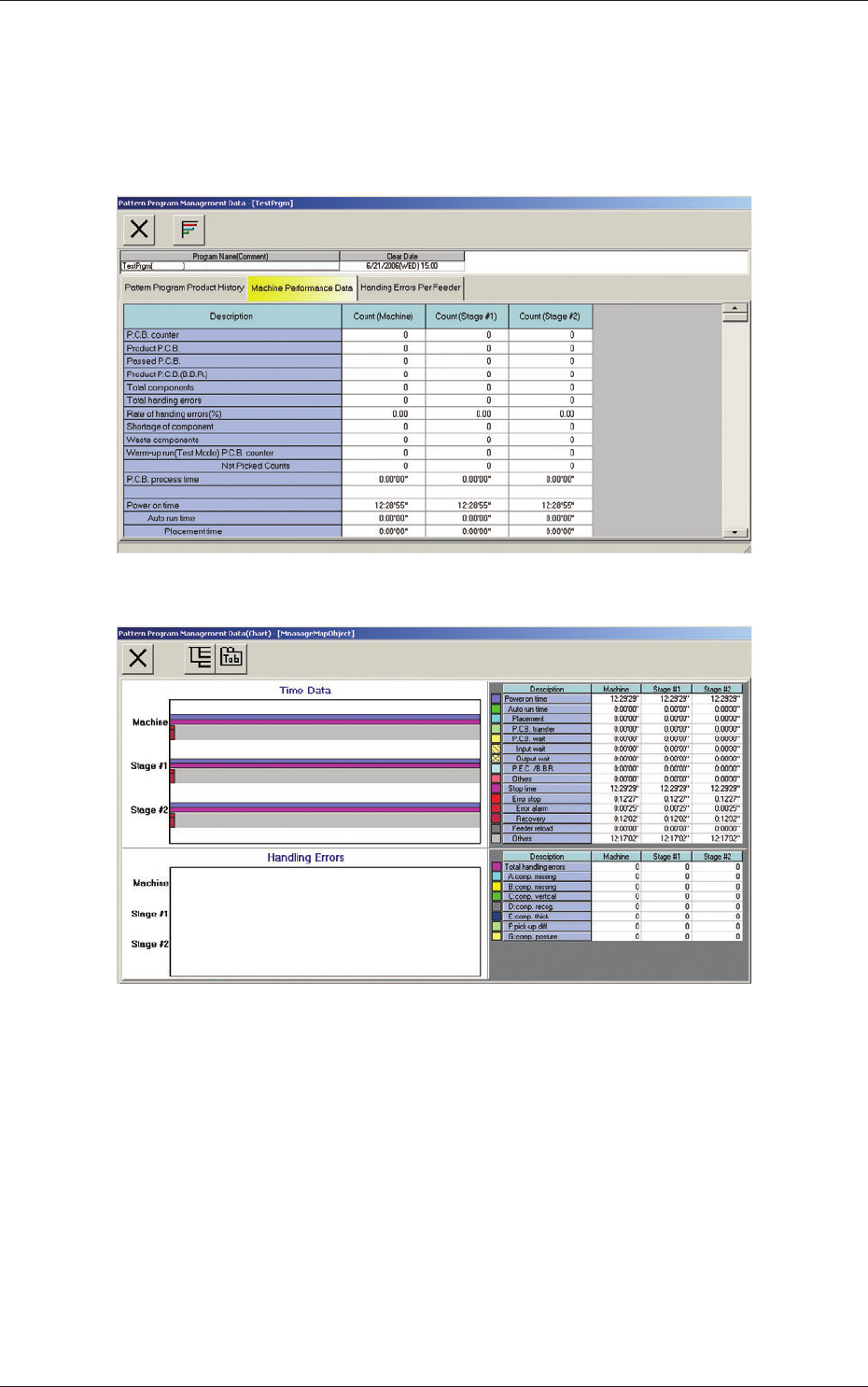
When the "Machine Performance Data" tab is pressed in the "Pattern
Program Management Data" window, the following tab sheet appears inside
the window.
Fig. 3E14 "Machine Performance Data" Tab Sheet
Fig. 3E14-1 "Pattern Program Management Data (Chart)" Window for
"Machine Performance Data"
5-27
AKFEDT-ID
A list of management data (the counted numbers (total counts included)
related to "Stage #1" and "Stage #2" for the current program (model)) is
displayed for each pattern program.
(1) PCB counter
Shown is the number of produced PCBs.
Counting is implemented when the X/Y table is zeroed after component
placement operation (when a PCB is fi nished).
Note
When a particular pattern program is set several times as current one, the
sum total is computed.
(2) Product PCB
The number of produced unit PCBs on multi-unit PCB is summed up.
Counting is implemented when the X/Y beam is zeroed after component
placement operation (when a unit is fi nished).
When the bad board reject (BBR) function (option) is used, defective
unit PCBs are excluded.
(3) Passed PCB
The number of passed PCBs is counted when the machine is set in the
"PASS" mode.
Counting is implemented when the PCB transfer starts (when the PCB
on the PCB positioning section is transferred to the output conveyor).
(4) Product PCB (BBR)
Shown is the number of defective PCBs summed up when the bad
board reject function (option) is used.
(5) Total components
Shown is the number of picked components (the number of pickup
operations).
(6) Total handling errors
Shown is the total number of component handling errors.
(7) Rate of handling errors (%)
Shown is the percentage of handling errors per total number of picked
components.
(8) Shortage of component
Shown is the total number of detected component shortage errors.
0607-003
3.2 Machine Performance Data