3OM-1343-008_w.pdf - 第75页
2-2 AKFEDT -ID [3] Drop-Down List When a text box is pressed quickly twice, the text box is changed to a combo box that has a down arrow on the right side. When you press the down arrow , a drop-down list box opens, show…
2-1
AKFEDT-ID
0604-003
1. Window Composition and Icons
1. Window Composition and Icons
1.1 Window Composition
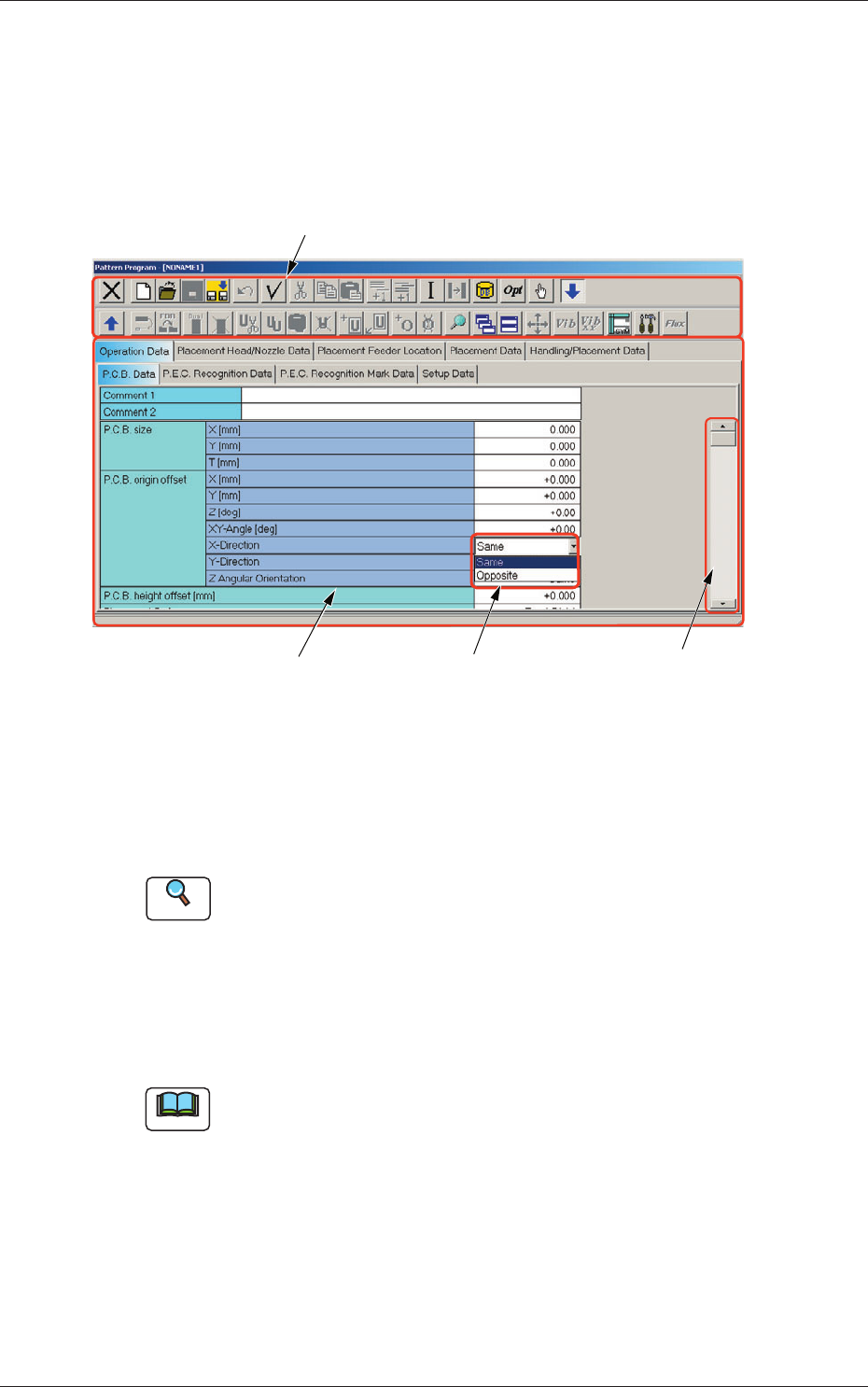
The following describes how the data edit windows are composed.
[1] Toolbar
[2] Tab Sheet [3] Drop-Down List
[4] Scrollbar
Fig. 3B1
"
Pattern Program
"
Edit Window (Example)
[1] Toolbar
The
"
Pattern Program
"
edit window is provided with the operation
commands (the icons on the toolbars) that can be executed.
Reference
Refer to "1.2 Basic Icons" for details.
[2] Tab Sheets
The provided tab sheets enable the operator to edit the data.
When the size and/or the position of an edit window is changed, the size
and/or the position of each tab sheet also changes.
Note
When an item is selected and the right button of the track ball is pressed,
a menu opens and it contains a collection of commands that will be
frequently used.
2-2
AKFEDT-ID
[3] Drop-Down List
When a text box is pressed quickly twice, the text box is changed to a
combo box that has a down arrow on the right side. When you press
the down arrow, a drop-down list box opens, showing the rows of data
(options) to be selected.
When a selection is made, the selected option appears in the text box.
Note
A scrollbar might appear on the right side of a drop-down list when there
are many options.
[4] Scrollbar
When the up arrow (
) is pressed, the window scrolls up.
When the down arrow (
) is pressed, the window scrolls down.
When the left arrow (
) is pressed, the window scrolls left.
When the right arrow (
) is pressed, the window scrolls right.
0604-003
1.1 Window Composition
2-3
AKFEDT-ID
1.2 Basic Icons
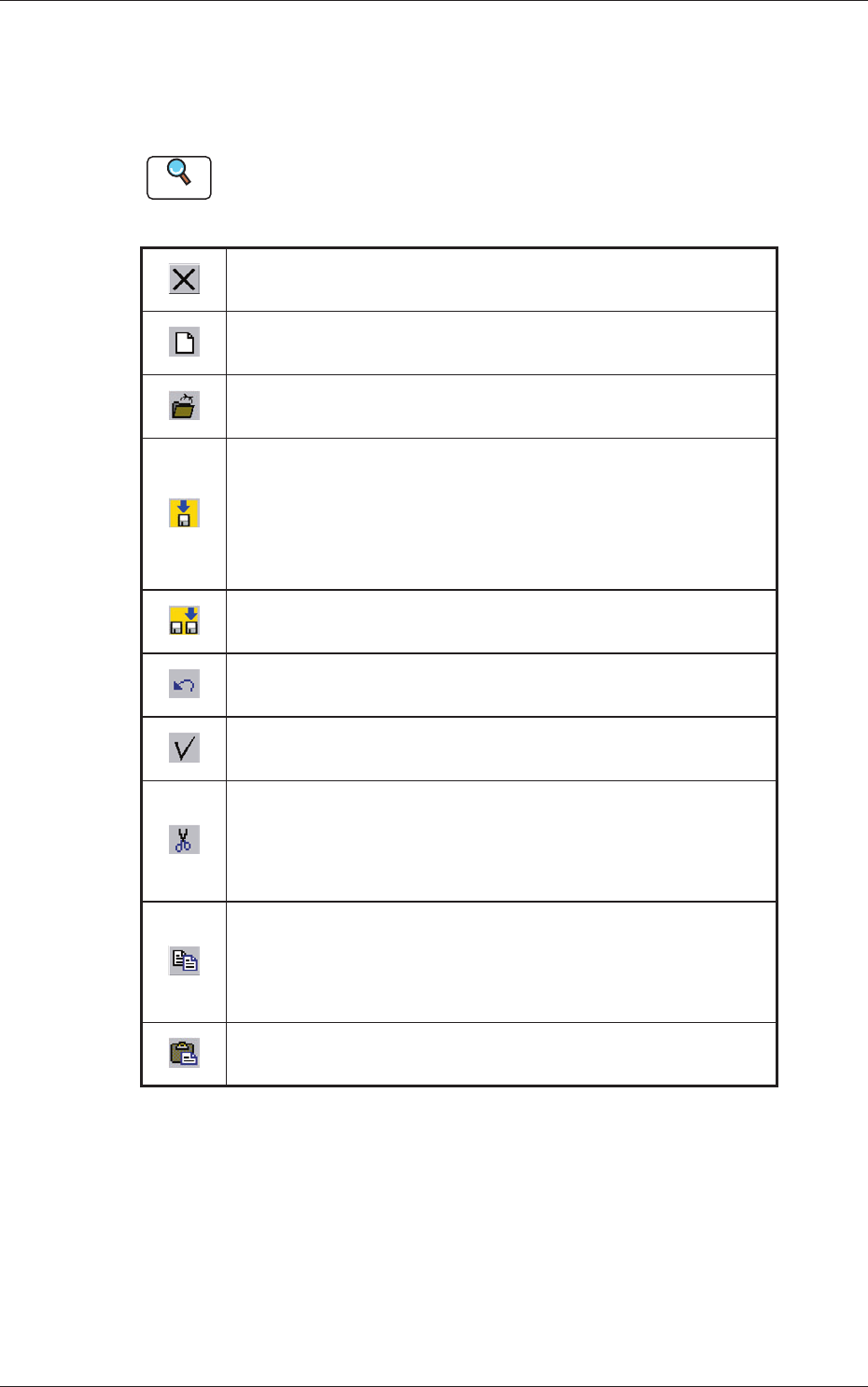
Described in the table below are the basic icons that will be used frequently
in a data edit window.
Reference
Refer to the paragraphs that describe the items for each data editing for
special icons.
Table 3B1
Exiting from application
When pressed, this closes the active data edit window.
New
When pressed, this enables the operator to create a new fi le.
Close
When pressed, this closes the active fi le.
Save
When pressed, this saves the edited data, replacing the existing
fi le with the current one.
When a new fi le is created, it will be saved with a new fi le
name.
Save As
When pressed, this saves the edited data (fi le) with a new name.
Undo
When pressed, this reverses the effect of your previous action.
Check
When pressed, this checks if there is any defi ciency in the data.
Cut
When pressed, this button removes the selection (data) and
stores it in the Clipboard (a temporary holding area).
When
"
Paste
"
is selected, the contents in the Clipboard is pasted.
Copy
When pressed, this button transfers the selection to the
Clipboard without removing the selection.
When
"
Paste
"
is selected, the contents in the Clipboard is pasted.
Paste
When pressed, this pastes the contents of the Clipboard.
0601-002
1.2 Basic Icons