D-serie level 1 EN.pdf - 第21页
Operational Safety Safety and signaling circuit Safety Equipment S tude nt Guide Advanced Level 1 SIPLACE D-Series EN 05/2007 Operational Safety 2-7 2.4.2.2 Safety Loop s 2-4: Safety loops

Operational Safety
Safety Equipment Safety and signaling circuit
Student Guide Advanced Level 1 SIPLACE D-Series
Operational Safety EN 05/2007
2-6
2.4.2 Safety and signaling circuit
2.4.2.1 Safety Circuit Function
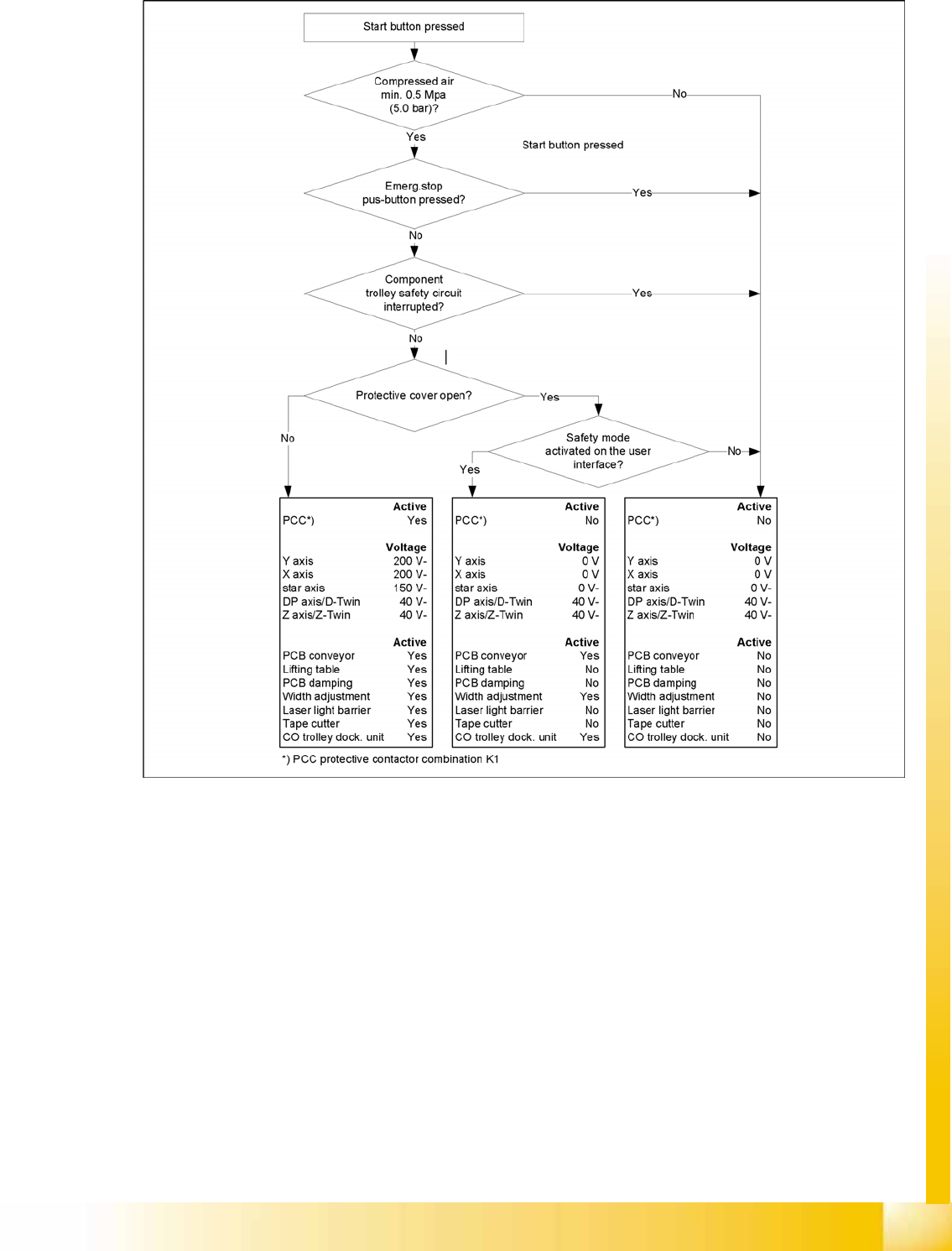
The following conditions must be fulfilled in order to start and operate the placement machine:
All four component trolleys must be docked in and connected.
All protective covers must be closed.
The two cover flaps over the PCB conveyor must be closed.
Both emergency stop buttons must be released.
The cover flaps (option) over the feeder modules must be closed.
The minimum operating pressure must have been reached.
The "software enable" signal must be active. This ensures that the safety circuit is closed.
The power supply must be sending 24 V to the Start buttons and the protective contactor
combination.
If one of the start buttons is pressed now, the protective contactor combination PCC K1 will switch
and enable the following components:
– 200 VDC link voltage for the servo amplifiers for the gantry axes
– 150 VDC link voltage for the star axes
– The axis unit receives a "Servo enable" signal for the servo amplifiers
– 40 VDC operating voltage is switched to the component trolleys.
– 24 VDC operating voltage is switched to the empty tape cutters.
– The PCB conveyor control receives the enable signal for the PCB clamping, the PCB stopper
and the lifting table control.
The machine is then ready for use.
Operational Safety
Safety and signaling circuit Safety Equipment
Student Guide Advanced Level 1 SIPLACE D-Series
EN 05/2007 Operational Safety
2-7
2.4.2.2 Safety Loops
2-4: Safety loops

Operational Safety
ESD Guidelines Handling ESD Assemblies
Student Guide Advanced Level 1 SIPLACE D-Series
Operational Safety EN 05/2007
2-8
2.5 ESD Guidelines
2.5.1 Handling ESD Assemblies
In generally, the following applies: electronic assemblies may only be touched if the work to be
undertaken requires this. Never take hold of printed circuit boards so that you touch the component pins
or conductors.
Only touch components,
If you are wearing an ESD wristband and are therefore connected to ground or
If you are wearing ESD shoes or protective ESD strips on your shoes and are therefore connected
to the ESD ground.
Before touching an electronic assembly, make sure your own body has been discharged. The easiest
way to do this is to simply touch a conductive object - which is connected to ground. This could be
uncoated metal on a switching cabinet, a water pipe etc.
Make sure that the assemblies never touch charged and high-insulated materials, such as plastic
sheets, insulating table plates or covers made of synthetic fibers.
Only place the assembly down on a conductive surface (table with ESD mat, conductive ESD foam
material, ESD packaging bags, ESD transportation containers).
Never put the assemblies near to data display units, monitors or television sets. Keep the assembly at
a minimum distance of > 10 cm to the monitor.
2.5.2 Measuring and Changing ESD Assemblies
The assembly may only be measured, if
The measuring device is connected to ground (e.g. via a protective conductor) or
The measuring head of a potential-free measuring device has been discharged just before
measurement (e.g. by touching the uncoated metal of a control cabinet etc.)
X When soldering, make sure you only use a soldering iron which is connected to ground.
2.5.3 Dispatching ESD Assemblies
X Always keep assemblies and components in conductive packaging (e.g. metallic plastic boxes or
metal tins) and use conductive packaging when dispatching the assemblies.
If the packaging is not conductive, wrap the assemblies in conductive material before packing them.You
can use, for example, conductive rubber foam, ESD bags, aluminum foil or paper but never plastic bags
or plastic sheets.
X When handling assemblies with integrated batteries, make sure that the conductive packaging does
not touch or short circuit the battery connections. We advise that you cover these with insulating tape
or other insulating material.