1OM-1003-007.pdf - 第106页
This machine is provided with a password function which pre- vents various types of data groups from being deleted by mis- take and keeps unauthorized user (third party) from operating the machine. The following three ki…
2. Starting or Exiting from the Application
2.1 Getting Started
(1) When the [POWER ON] button on the operation panel is pressed,
it illuminates in yellowish green and the self-diagnostics function
starts.
(a) Press and hold the [POWER ON] button for more than 1
second.
(b) It takes 2 to 3 minutes until the self-diagnostics operation
is completed. Please wait for a while.
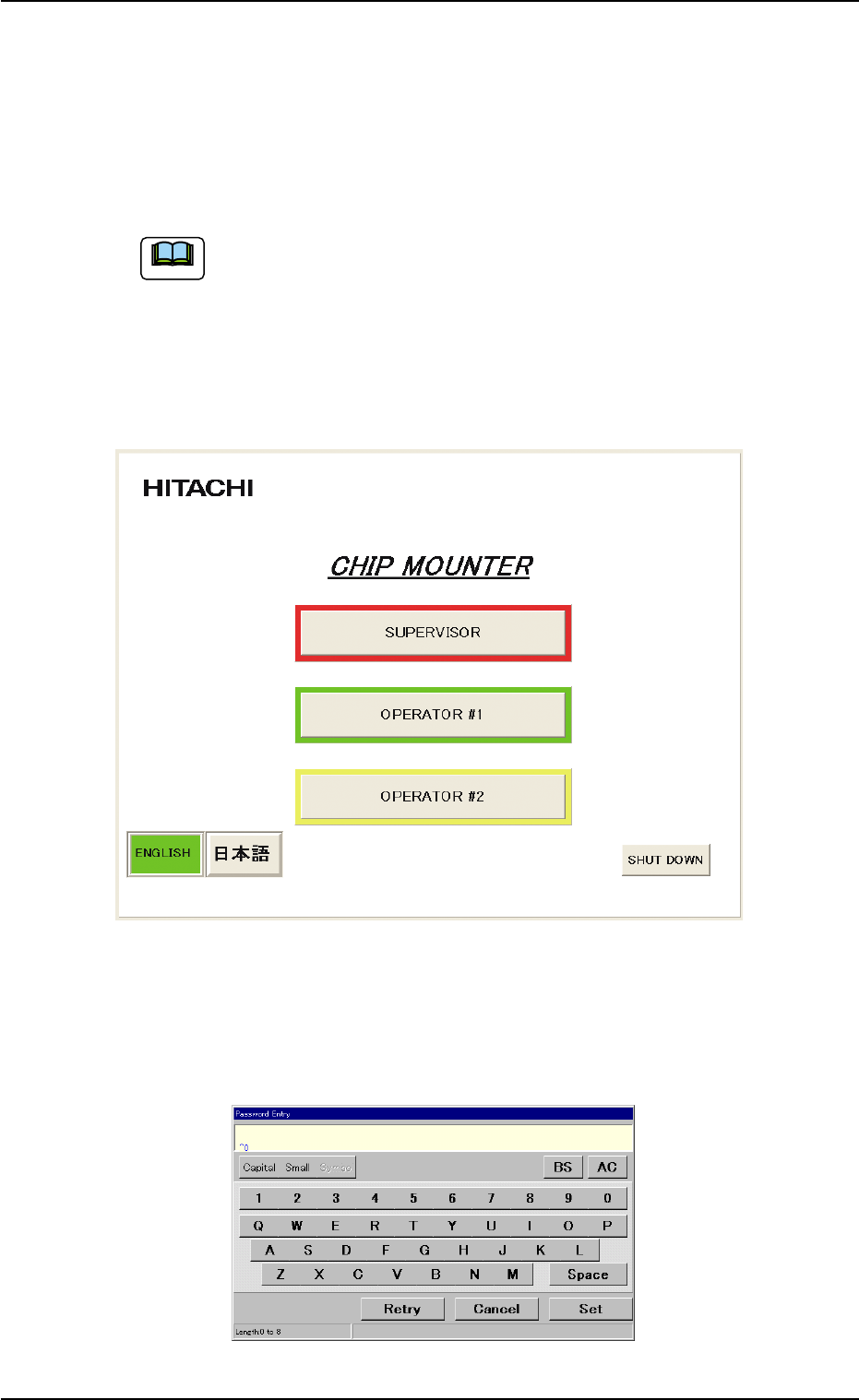
When the self-diagnostics operation is completed, the "Login Type Se-
lection" window appears on the touch screen.
Fig. 1B2 "Login Type Selection" Window
(2) Press the [SUPERVISOR], the [OPERATOR #1], or the [OPERA-
TOR #2] button according to the given authority.
The "Password Entry" dialog box opens.
Fig. 1B3 "Password Entry" Dialog Box
2. Starting or Exiting from the Application
0511-002 2-4 AIL01EOPP
Note
This machine is provided with a password function which pre-
vents various types of data groups from being deleted by mis-
take and keeps unauthorized user (third party) from operating
the machine.
The following three kinds of passwords are available and each
gives individually approved user’s access to the computer sys-
tem of the machine.
Refer to "Section 5 System Setting" in "Volume 3: Program-
ming and Machine Data" for details.
[SUPERVISOR] : Access can be gained by only the person
identified as "Supervisor".
[OPERATOR #1] : Access can be gained by only the person
identified as "Operator #1". For example, the
person identified as "Operator #1" is given
a permission to all machine operations in-
cluding data editing.
[OPERATOR #2] : Access can be gained by only the person
identified as "Operator #2". For example, the
person identified as "Operator #2" is limited
to only the operations related to the auto-
matic operation.
(3) Enter the password.
"*****" appears in the "Password Entry" dialog box.
(4) Press the [OK] button.
The "AUTO OPN." window opens on the touch screen. It is pro-
vided with a main menu bar.
See Fig. 1B4 in "2.2 Structure of Operation Windows" for the dis-
played main menu bar and the "AUTO OPN." window.
When no password is set, press the [SUPERVISOR], the [OP-
ERATOR #1], or the [OPERATOR #2] button according to the
given authority. The "AUTO OPN." window opens.
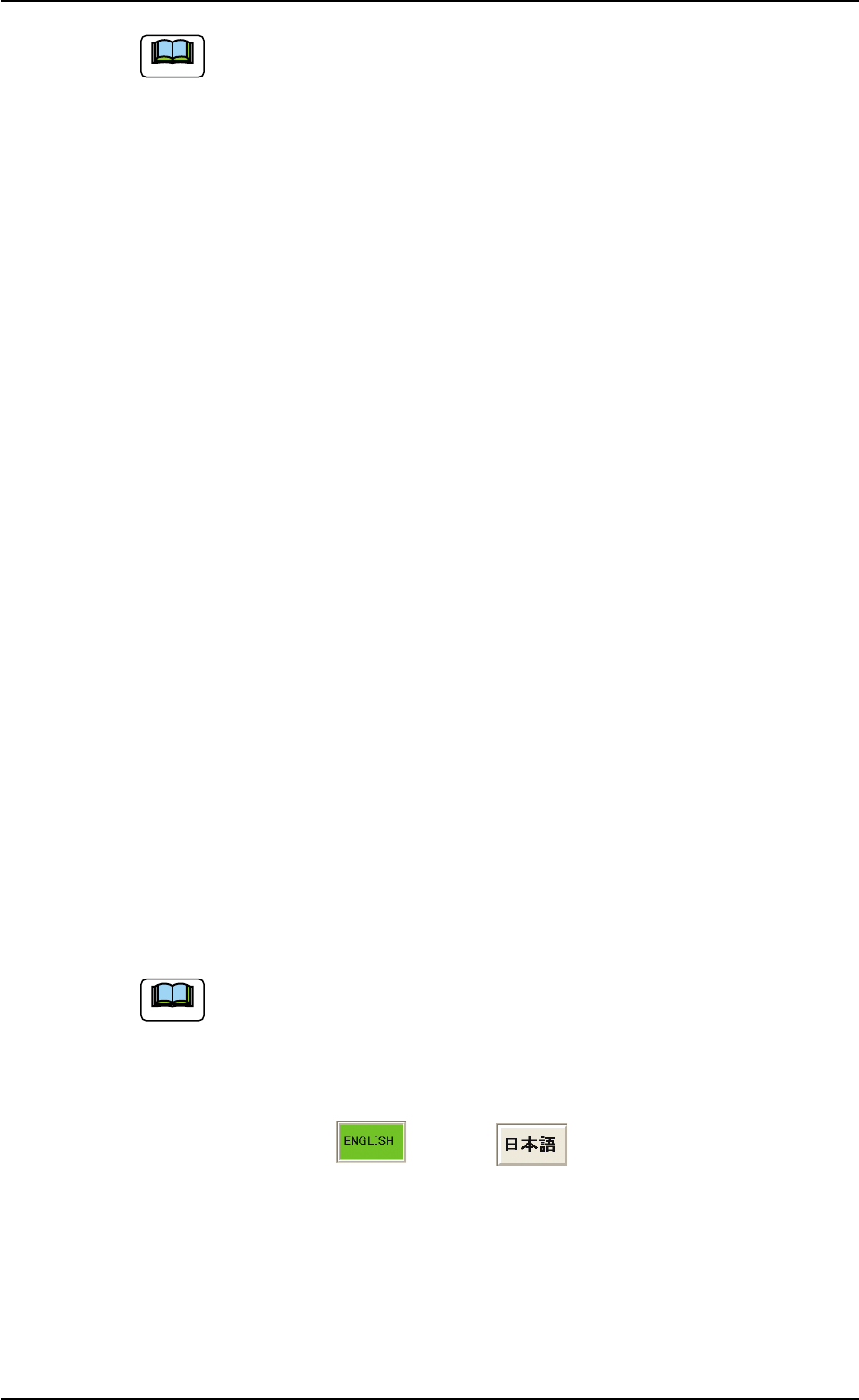
Language Selection
Press either the [ ]
or the [ ]
button in the "Login
Type Selection" window to select the language to be used on the
screen.
The selected button turns green, indicating that it is selected.
2.1 Getting Started
0511-002 2-5 AIL01EOPP
Note
Note
2.2 Structure of Operation Windows
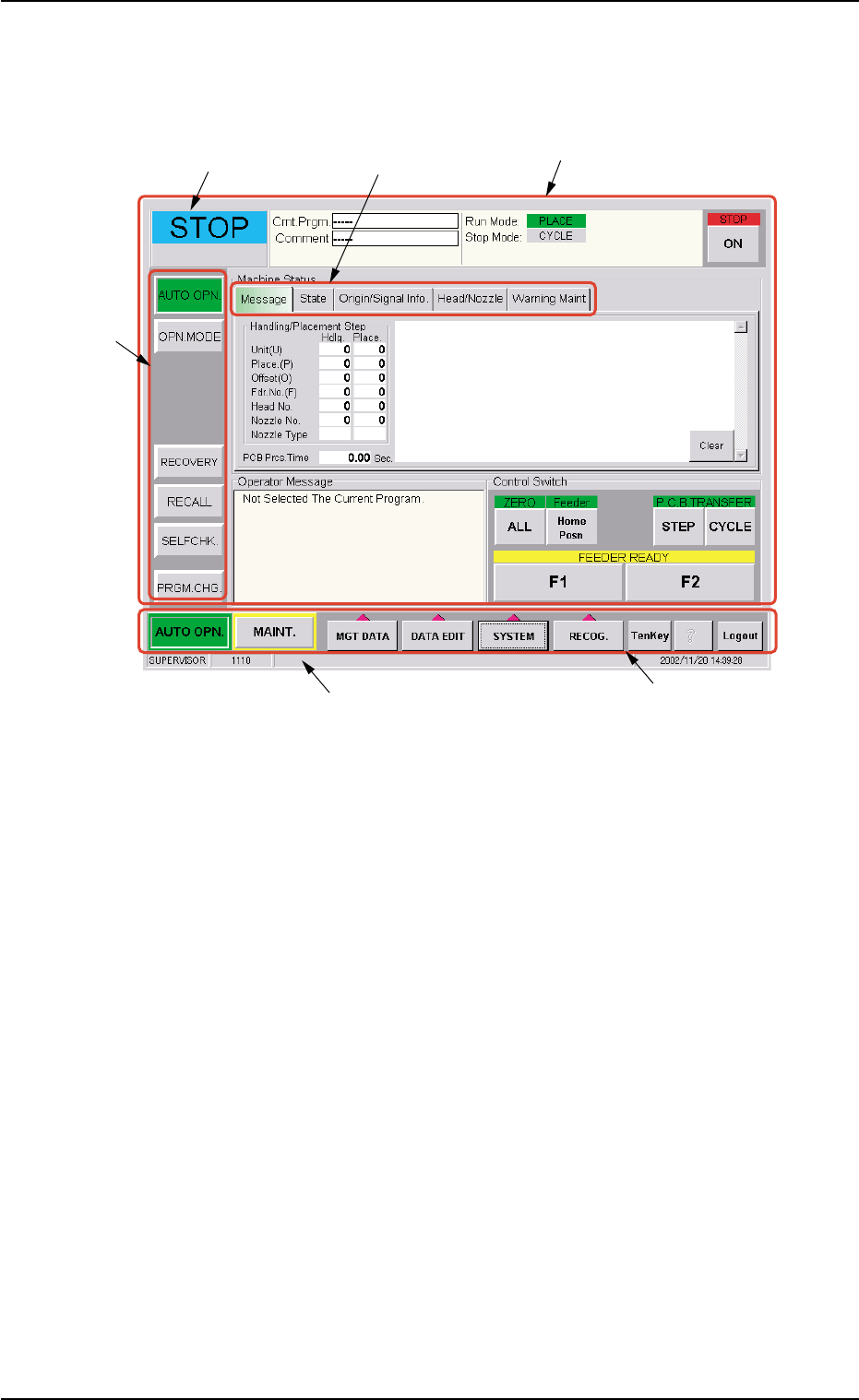
Fig. 1B4 Main Menu Bar and "AUTO OPN." Window
••
••
• Window Composition
*1 Main Menu Bar
The main menu bar has five buttons ([AUTO OPN.], [MAINT.], [MGT
DATA], [DATA EDIT], and [SYSTEM] buttons) as main menus, one
button ([RECOG.] button) for selection of a recognized image pat-
tern to be displayed, and three operation buttons ([TenKey], [?],
and [Logout] buttons).
Refer to "Section 4" in "Volume 2: Operation (Supervisor)" for the
main menu bar.
*2 Submenu Bar
The submenu bar has the buttons to select the submenus. When
each button on the submenu bar is selected, the corresponding
operation window opens.
When a button on the main menu bar is pressed, the correspond-
ing submenu bar appears.
Refer to "Section 4" in "Volume 2: Operation (Supervisor)" for the
submenu bar.
2.2 Structure of Operation Windows
0305-001 2-6 AIL01EOPP
*5 Current Mode
*4 Operation Window
(Menus for Automatic Operation)
*6 Supplementary Explanation
*1 Main Menu Bar
*3 Tab
*2 Sub Menu Bar