IPC-SM-782A 表面安装设计和焊盘设计标准(带BGA).pdf - 第172页
Page Intentionally Left Blank IPC-SM-782 Subject Components with J Leads on Four Sides Date 8/93 Section 12.0 Revision P a g e2o f2 电子技术应用 www.ChinaAET.com

1.0 INTRODUCTION
This section covers land patterns for components with J leads
on four sides. Each subsection contains information in accor-
dance with the following format:
1.0 Scope
2.0 Applicable Documents
3.0 General Component Description (Figure 1)
4.0 Component Dimensions (Figure 2)
5.0 Land Pattern Dimensions (Figure 3)
6.0 Tolerance and Solder Joint Analysis (Figure 4)
The following is the table of contents for this section:
2.0 APPLICABLE DOCUMENTS
The following documents, of the issue in effect on the revision
date of this section, form a part of this specification to the
extent specified herein.
2.1 Electronic Industries Association (EIA)
1
EIA-481-A
Taping of Surface Mount Components for Auto-
matic Placement
EIA-481-3
32 mm, 44 mm, and 56 mm Embossed Carrier
Taping of Surface Mount Components for Automated Han-
dling
JEDEC Publication 95
Registered and Standard Outlines for
Solid State and Related Products
2.2 International Electrotechnical Commission (IEC)
2
IEC 97
Grid Elements
3.0 General Information
3.1 General Component Description
Leaded Chip Carri-
ers are either ceramic or plastic packages with terminations
which extend beyond the package outlines. These termina-
tions typically space the body of the package from the pack-
aging and interconnect structure for reasons of cleaning,
inspecting, or accommodating differences in thermal expan-
sion. The leads may be attached to the package body either
before or after chip attachment.
In plastic leaded chip carriers, the primary packaging distinc-
tion concerns the point in which a chip is incorporated into the
package. A pre-molded package is supplied as a leaded body
with an open cavity for chip attachment. A post-molded body
part typically has the chip attached to a lead frame with an
insulating plastic body molded around the assembly. It is sup-
plied from the manufacturer without apertures.
Leaded ceramic chip carriers may be similarly classified, but
with a difference in category. The distinction concerns the
point at which leads, if desired, are attached to the ceramic
body. A pre-leaded ceramic chip carrier is supplied with cop-
per or Kovar leads brazed to metallization integral with the
ceramic package. Typically, the package is supplied with an
open cavity for chip attach. A metal or ceramic lid is epoxied,
soldered, or attached with glass frit to provide a hermetic seal
around the chip. After these steps, the leaded assembly is
attached to the printed board.
A post-leaded ceramic chip carrier typically has leads sol-
dered to metallization on the ceramic package after chip
attachment. These leads may take the form of edge clips or
solder columns. Incorporation of leads into the assembly typi-
cally occurs immediately prior to board attachment.
High lead-end coplanarity in surface-mounted lead chip carri-
ers is an important factor in reliable solder attachment to the
printed board. Planarity may be measured from the lowest
three leads of a leaded package. Coplanarity of 0.1 mm
[0.004 in] maximum is recommended with 0.05 mm [0.002 in]
preferred.
1. Application for copies should be addressed to Global Engi-
neering Documents, 1990 M St. N.W., Washington, DC
20036.
2. Application for copes should be addressed to IEC, 3 rue
de Varembe, PO Box 131 - 1211 Geneva 20, Switzerland
IPC-SM-782
Surface Mount Design
and Land Pattern Standard
Date
8/93
Section
12.0
Revision Subject
Components with J Leads
on Four Sides
Page1of2
电子技术应用 www.ChinaAET.com

Page Intentionally Left Blank
IPC-SM-782
Subject
Components with J Leads on Four Sides
Date
8/93
Section
12.0
Revision
Page2of2
电子技术应用 www.ChinaAET.com
1.0 SCOPE
This subsection provides the component and land pattern
dimensions for plastic leaded chip carriers, square (PLCC
components) with J leads on four sides. Basic construction of
the PLCC device is also covered. At the end of this subsec-
tion is a listing of the tolerances and target solder joint dimen-
sions used to arrive at the land pattern dimensions.
2.0 APPLICABLE DOCUMENTS
See Section 12.0 for documents applicable
to the subsections.
2.1 Electronic Industries Association (EIA)
JEDEC Publication 95
Registered and Standard Outlines for
Solid State and Related Products, ‘‘Plastic Chip Carrier
(PLCC) Family, 1.27 mm [0.050 in] Lead Spacing, Square,’’
Outline MO-047, issue ‘‘B,’’ dated 11/88
Application for copies should be addressed to:
Global Engineering Documents
1990 M Street N.W.
Washington, DC
3.0 COMPONENT DESCRIPTIONS
Plastic leaded chip carriers are employed where a hermetic
seal is not required. Other constraints include limited tempera-
ture range (typically 0°C or 70°C) and nominal environmental
protection. As with plastic DIPs, they have the advantage of
low cost as compared to ceramic packages.
3.1.1 Pre-molded Plastic Chip Carriers
The pre-molded
plastic chip carrier was designed to be connected to the P&I
substrate by means of a socket. Spring pressure on both
sides of the package is intended to constrain movement as
well as allow for substrate warpage as high as 0.5%. Solder
attach to the P&I substrate is also possible. The design is also
intended to make use of silicone encapsulant technology for
chip coverage and protection.
3.1.2 Post-molded Plastic Chip Carriers
The post-
molded plastic leaded chip carrier is composed of a compos-
ite metal/dielectric assembly that includes a conductor lead
frame and a molded insulating body. Compared to the pre-
molded package which has an aperture for mounting micro-
electronic components, the post-molded package comes
complete with no apertures. In both types of plastic chip car-
riers, all necessary plating operations are performed by the
package manufacturer to eliminate tinning or plating by the
user.
The Joint Device Engineering Council (JEDEC) defines the
Type A Leaded Chip Carrier as a plastic package with leads
wrapped down and around the body on all four sides. This
package can be either directly mounted to a printed wiring
board or used with a socket. It is available with 28, 44, 52, 68,
84, 100, or 124 leads. This family is based on 1.27 mm [0.050
in] lead pitch. The original mechanical outline drawing of this
package was defined based on a premolded package. How-
ever, actual construction is not specified and the package
could be of post-molded construction.
Post-molded packages which have J-lead configuration and
are
JEDC standard MO-047, are available in 20-, 28-, 44-, 52-,
68-, 84-, 100- and 124-lead counts with the
same spacing.
3.1.3 Marking
All parts shall be marked with a part number
and ‘‘Pin 1’’ location. ‘‘Pin 1’’ location may be molded into the
plastic body.
3.1.4 Carrier Package Format
Bulk rods, 24 mm tape/
8–12 mm pitch is preferred for best handling. Tube carriers
are also used.
3.1.5 Resistance to Soldering
Parts should be capable of
withstanding ten cycles through a standard reflow system
operating at 215°C. Each cycle shall consist of 60 seconds
exposure at 215°C. Parts must also be capable of withstand-
ing a minimum of 10 seconds immersion in molten solder at
260°C.
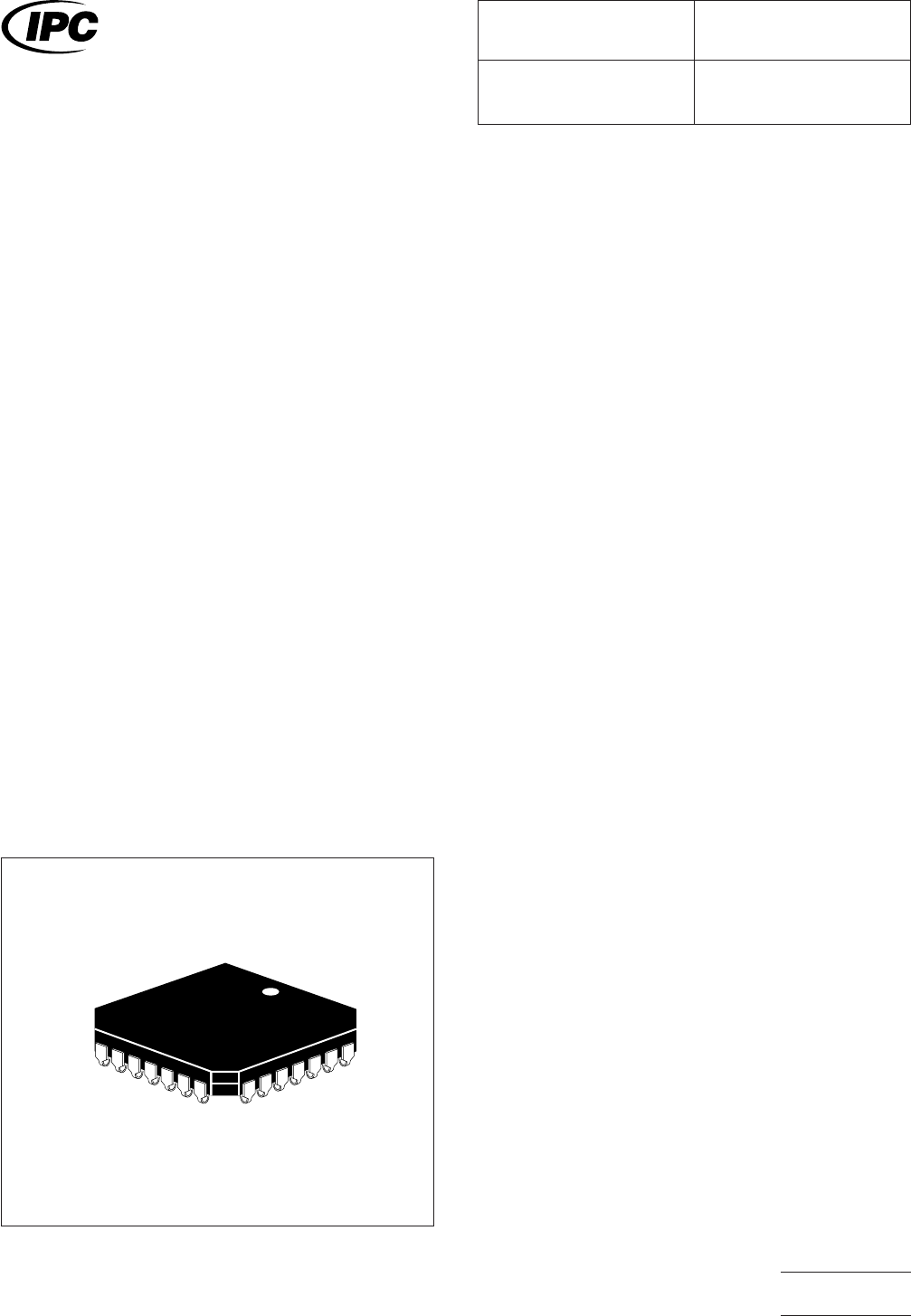
IPC-782-12-1-1
Figure 1 PLCC (Square)
IPC-SM-782
Surface Mount Design
and Land Pattern Standard
Date
5/96
Section
12.1
Revision
A
Subject
PLCC (Square)
Page1of4
电子技术应用 www.ChinaAET.com