IPC-CM-770D-1996.pdf - 第100页
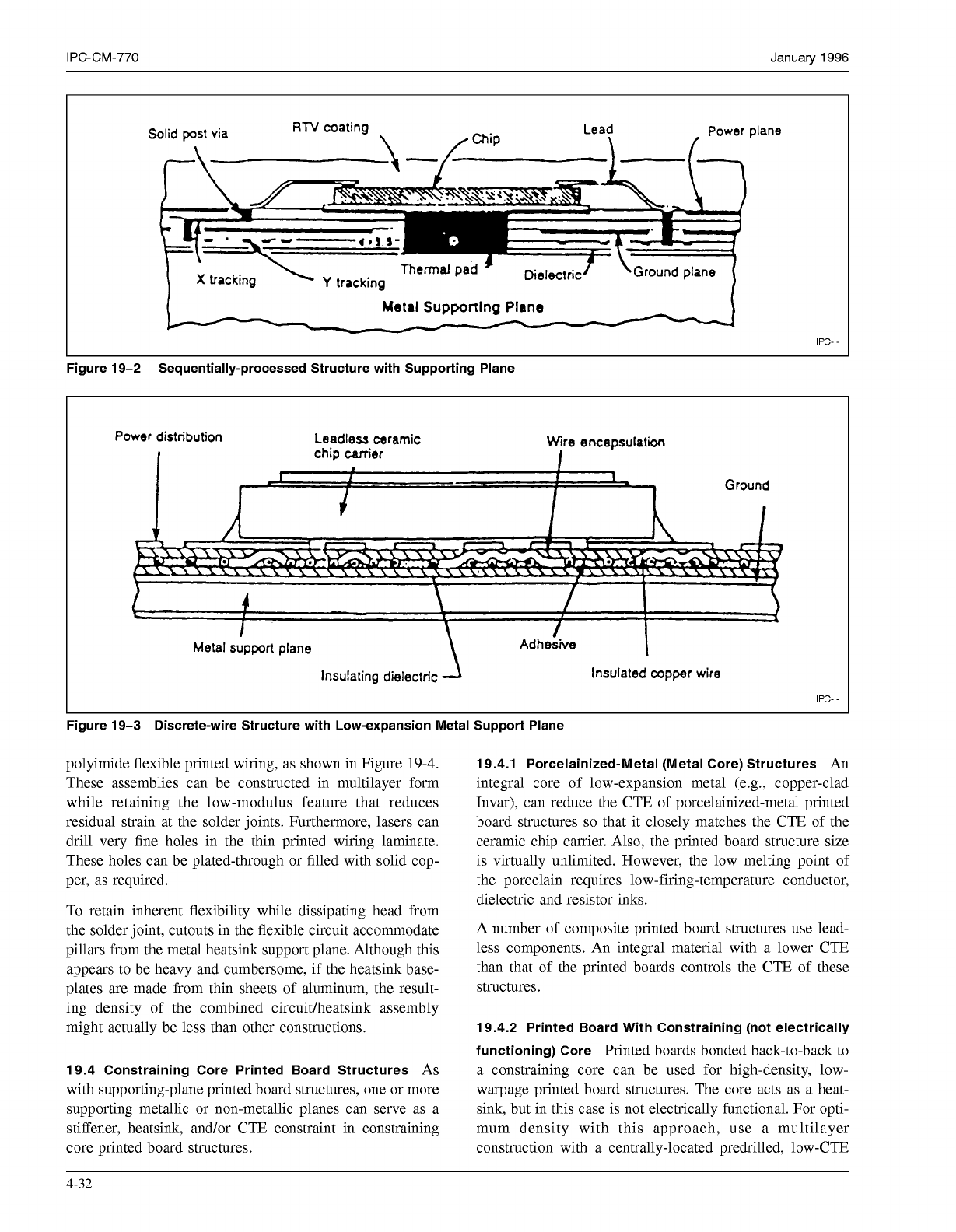
IPC-CM-770 Januaty 1996 Power plane Metal Supporting Plane IPC-I- Figure 19-2 Sequentially-processed Structure with Supporting Plane Power distribution Leadless ceramic Wire encapsulation Metal support plane Insulating d…
January
1996
IPC-CM-770
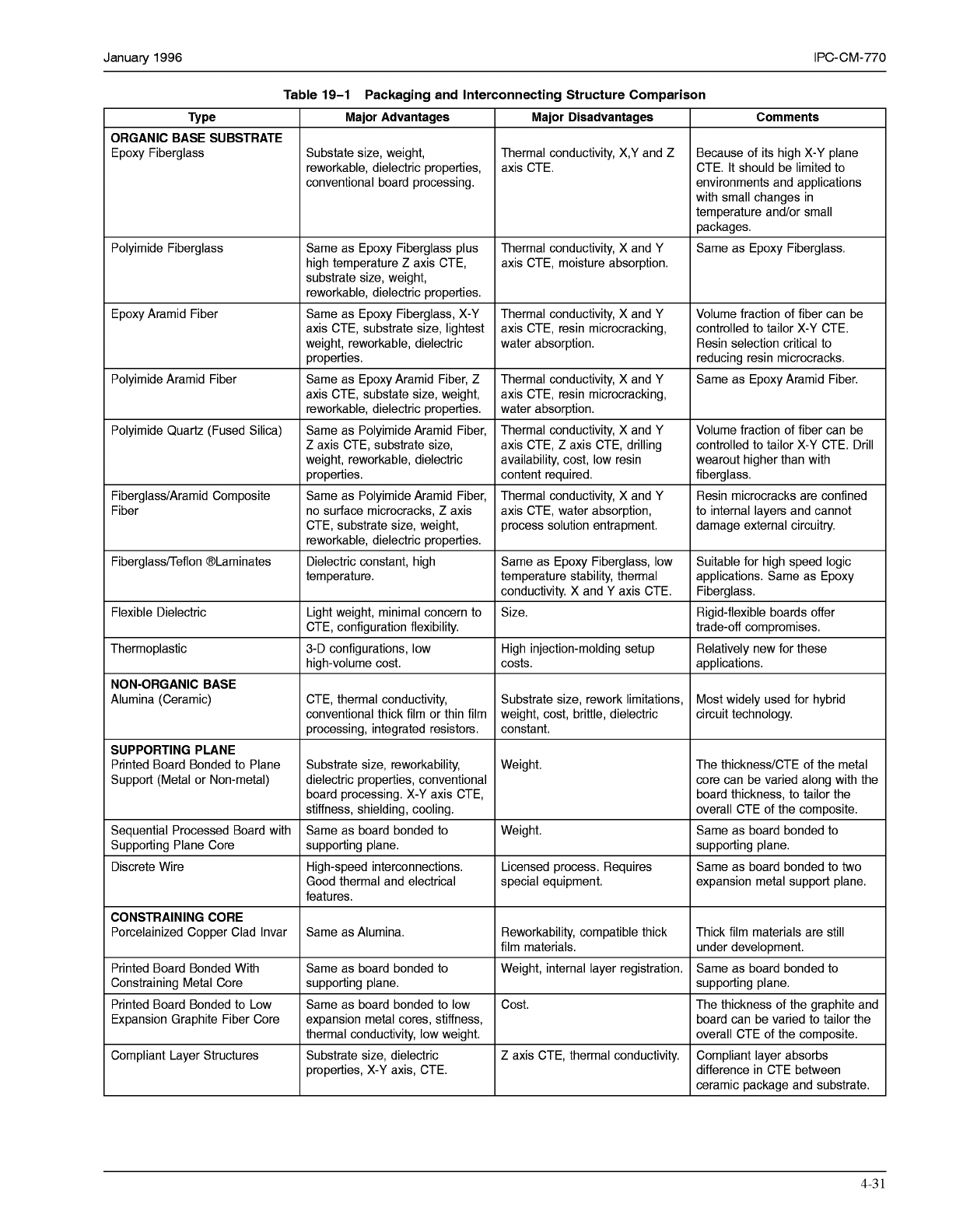
Table
19-1
Packaging and Interconnecting Structure Comparison
ORGANIC BASE SUBSTRATE
Epoxy Fiberglass
Polyimide Fiberglass
Epoxy Aramid Fiber
Polyimide Aramid Fiber
Polyimide Quartz (Fused Silica)
Fiberglass/Aramid Composite
Fiber
Fiberglass/Teflon @Laminates
Flexible Dielectric
Thermoplastic
NON-ORGANIC BASE
Alumina (Ceramic)
SUPPORTING PLANE
Printed Board Bonded to Plane
Support (Metal or Non-metal)
Sequential Processed Board with
Supporting Plane Core
Discrete Wire
CONSTRAINING CORE
Porcelainized Copper Clad Invar
Printed Board Bonded With
Constraining Metal Core
Printed Board Bonded to Low
Expansion Graphite Fiber Core
Compliant Layer Structures
Major Advantages
Substate size, weight,
reworkable, dielectric properties,
conventional board processing.
Same as Epoxy Fiberglass plus
high temperature
Z
axis CTE,
substrate size, weight,
reworkable, dielectric properties.
Same as Epoxy Fiberglass, X-Y
axis CTE, substrate size, lightest
weight, reworkable, dielectric
properties.
Same as Epoxy Aramid Fiber,
Z
axis CTE, substate size, weight,
reworkable, dielectric properties.
Same as Polyimide Aramid Fiber,
Z
axis CTE, substrate size,
weight, reworkable, dielectric
properties.
Same as Polyimide Aramid Fiber,
no surface microcracks,
Z
axis
CTE, substrate size, weight,
reworkable, dielectric properties.
Dielectric constant, high
temperature.
Light weight, minimal concern to
CTE, configuration flexibility.
3-D configurations, low
high-volume cost.
CTE, thermal conductivity,
conventional thick film or thin film
processing, integrated resistors.
Substrate size, reworkability,
dielectric properties, conventional
board processing. X-Y axis CTE,
stiffness, shielding, cooling.
Same as board bonded to
supporting plane.
High-speed interconnections.
Good thermal and electrical
features.
Same as Alumina.
Same as board bonded to
supporting plane.
Same as board bonded to low
expansion metal cores, stiffness,
thermal conductivity, low weight.
Substrate size, dielectric
properties, X-Y axis, CTE.
Major Disadvantages
Because of its high X-Y plane Thermal conductivity, X,Y and
Z
Comments
axis CTE. CTE. It should be limited to
environments and applications
with small changes in
temperature and/or small
packages.
Thermal conductivity, X and Y
axis CTE, moisture absorption.
Same as Epoxy Fiberglass.
Thermal conductivity, X and Y
Resin selection critical to water absorption.
controlled to tailor X-Y CTE. axis CTE, resin microcracking,
Volume fraction of fiber can be
reducing resin microcracks.
Thermal conductivity, X and Y Same as Epoxy Aramid Fiber.
axis CTE, resin microcracking,
water absorption.
Thermal conductivity, X and Y Volume fraction of fiber can be
axis CTE,
Z
axis CTE, drilling controlled to tailor X-Y CTE. Drill
availability, cost, low resin wearout higher than with
content required.
fiberglass.
Thermal conductivity, X and Y Resin microcracks are confined
axis CTE, water absorption, to internal layers and cannot
process solution entrapment.
damage external circuitry.
Same as Epoxy Fiberglass, low Suitable for high speed logic
temperature stability, thermal applications. Same as Epoxy
conductivity. X and Y axis CTE.
Fiberglass.
Size. Rigid-flexible boards offer
High injection-molding setup Relatively new for these
trade-off compromises.
costs.
applications.
Substrate size, rework limitations,
circuit technology. weight, cost, brittle, dielectric
Most widely used for hybrid
constant.
Weight.
The thickness/CTE of the metal
core can be varied along with the
board thickness, to tailor the
overall CTE of the composite.
supporting plane.
Weight.
expansion metal support plane. special equipment.
Same as board bonded to two
Licensed process. Requires
Same as board bonded to
Reworkability, compatible thick
Same as board bonded to Weight, internal layer registration.
under development. film materials.
Thick film materials are still
supporting plane.
board can be varied to tailor the
overall CTE of the composite.
difference in CTE between
ceramic package and substrate.
Cost. The thickness of the graphite and
Z
axis CTE, thermal conductivity. Compliant layer absorbs
4-3
1
COPYRIGHT Association Connecting Electronics Industries
Licensed by Information Handling Services
COPYRIGHT Association Connecting Electronics Industries
Licensed by Information Handling Services
IPC-CM-770
Januaty
1996
Power
plane
Metal
Supporting Plane
IPC-I-
Figure 19-2 Sequentially-processed Structure with Supporting Plane
Power
distribution
Leadless
ceramic
Wire
encapsulation
Metal support plane
Insulating dielectric Insulated copper wire
IPC-I-
Figure 19-3 Discrete-wire Structure with Low-expansion Metal Support Plane
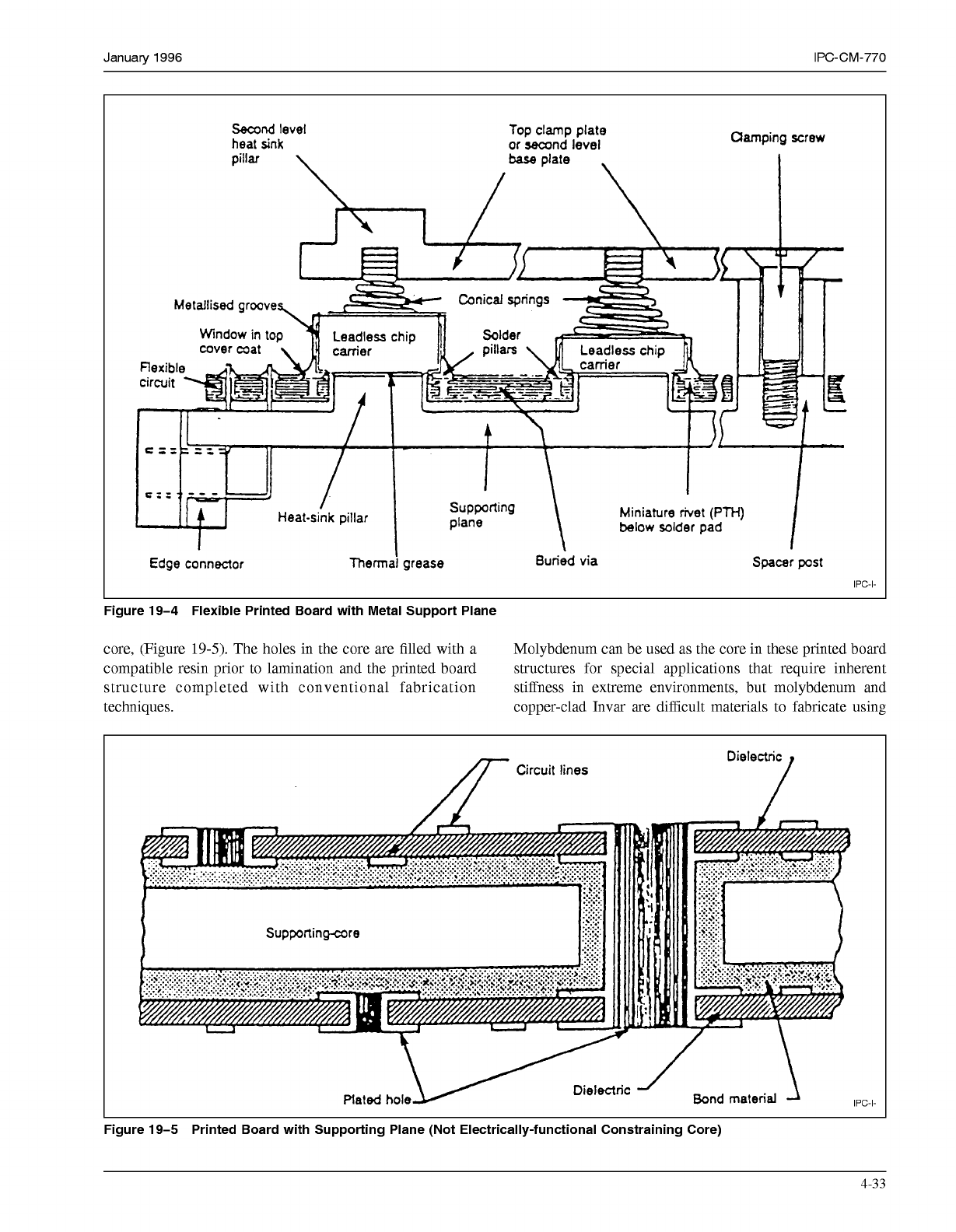
polyimide flexible printed wiring, as shown in Figure
19-4.
These assemblies can be constructed in multilayer form
while retaining the low-modulus feature that reduces
residual strain at the solder joints. Furthermore, lasers can
drill very fine holes in the thin printed wiring laminate.
These holes can be plated-through or filled with solid cop-
per, as required.
To retain inherent flexibility while dissipating head from
the solder joint, cutouts in the flexible circuit accommodate
pillars from the metal heatsink support plane. Although this
appears to be heavy and cumbersome, if the heatsink base-
plates are made from thin sheets of aluminum, the result-
ing density of the combined circuidheatsink assembly
might actually be less than other constructions.
19.4 Constraining Core Printed Board Structures
As
with supporting-plane printed board structures, one or more
supporting metallic or non-metallic planes can serve as a
stiffener, heatsink, and/or CTE constraint in constraining
core printed board structures.
19.4.1 Porcelainized-Metal (Metal Core) Structures
An
integral core of low-expansion metal (e.g., copper-clad
Invar), can reduce the CTE of porcelainized-metal printed
board structures
so
that it closely matches the CTE of the
ceramic chip carrier. Also, the printed board structure size
is virtually unlimited. However, the low melting point of
the porcelain requires low-firing-temperature conductor,
dielectric and resistor inks.
A number of composite printed board structures use lead-
less components. An integral material with a lower CTE
than that of the printed boards controls the CTE of these
structures.
19.4.2 Printed Board With Constraining (not electrically
functioning) Core
Printed boards bonded back-to-back to
a constraining core can be used for high-density, low-
warpage printed board structures. The core acts as a heat-
sink, but in this case is not electrically functional. For opti-
mum density with this approach, use a multilayer
construction with a centrally-located predrilled, low-CTE
4-32
COPYRIGHT Association Connecting Electronics Industries
Licensed by Information Handling Services
COPYRIGHT Association Connecting Electronics Industries
Licensed by Information Handling Services
Januaw
1996
IPC-CM-770
Second
level Top clamp plate
heat
sink
or
second
level
Clamping screw
Edge
connector
Thermal
grease
I
Buried via
Spacar
post
IPC-I-
Figure 19-4 Flexible Printed Board with Metal Support Plane
core, (Figure
19-5).
The holes in the core are filled with a Molybdenum can be used as the core in these printed board
compatible resin prior to lamination and the printed board structures for special applications that require inherent
structure completed with conventional fabrication stiffness in extreme environments, but molybdenum and
techniques.
copper-clad Invar are difficult materials to fabricate using
Dielectric
Circuit lines
/
Supportingare
\
/
m.
I"
IPC-I-
Figure 19-5 Printed Board with Supporting Plane (Not Electrically-functional Constraining Core)
4-33
COPYRIGHT Association Connecting Electronics Industries
Licensed by Information Handling Services
COPYRIGHT Association Connecting Electronics Industries
Licensed by Information Handling Services