IPC-CM-770D-1996.pdf - 第61页
January 1996 IPC-CM-770 The interconnections between the package and the sub- strate (Printed Wiring Board structure) is typically made with a solder pillar connecting the lands on the bottom of the package and a set of …
IPC-CM-770
Januaty
1996
DIPS. This should extend the useful life of present day
technology for some high lead count applications.
soot-
.OSO'
SOLID
CRlD
I
I
l
lo'
50
110
110
id0
II0
300
PACKAQE
LEAD
COUNT
Ipc.I.
L
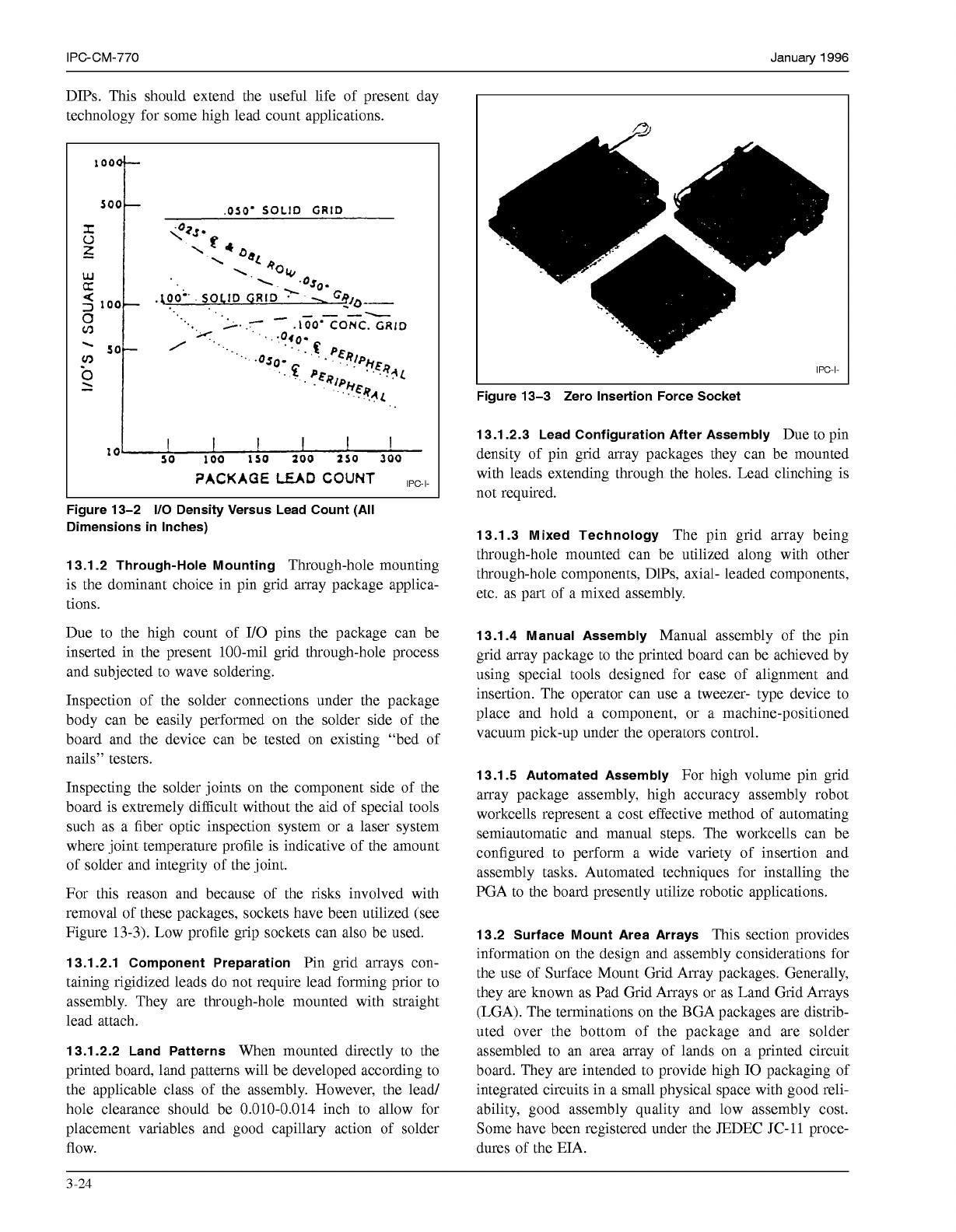
Figure 13-2
110
Density Versus Lead Count (All
Dimensions in Inches)
13.1.2 Through-Hole Mounting
Through-hole mounting
is the dominant choice in pin grid array package applica-
tions.
Due to the high count of I/O pins the package can be
inserted in the present 100-mil grid through-hole process
and subjected to wave soldering.
Inspection of the solder connections under the package
body can be easily performed on the solder side of the
board and the device can be tested on existing "bed
of
nails" testers.
Inspecting the solder joints on the component side of the
board is extremely difficult without the aid of special tools
such as a fiber optic inspection system or a laser system
where joint temperature profile is indicative of the amount
of solder and integrity of the joint.
For this reason and because of the risks involved with
removal of these packages, sockets have been utilized (see
Figure
13-3).
Low profile grip sockets can also be used.
13.1.2.1 Component Preparation
Pin grid arrays con-
taining rigidized leads do not require lead forming prior to
assembly. They are through-hole mounted with straight
lead attach.
13.1.2.2 Land Patterns
When mounted directly to the
printed board, land patterns will be developed according to
the applicable class of the assembly. However, the lead
hole clearance should be
0.010-0.014
inch to allow for
placement variables and good capillary action of solder
flow.
Figure 13-3 Zero Insertion Force Socket
13.1.2.3 Lead Configuration After Assembly
Due to pin
density of pin grid array packages they can be mounted
with leads extending through the holes. Lead clinching is
not required.
13.1.3 Mixed Technology
The pin grid array being
through-hole mounted can be utilized along with other
through-hole components, DlPs, axial- leaded components,
etc. as part of a mixed assembly.
13.1.4 Manual Assembly
Manual assembly of the pin
grid array package to the printed board can be achieved by
using special tools designed for ease of alignment and
insertion. The operator can use a tweezer- type device to
place and hold a component, or a machine-positioned
vacuum pick-up under the operators control.
13.1.5 Automated Assembly
For high volume pin grid
array package assembly, high accuracy assembly robot
workcells represent a cost effective method of automating
semiautomatic and manual steps. The workcells can be
configured to perform a wide variety of insertion and
assembly tasks. Automated techniques for installing the
PGA to the board presently utilize robotic applications.
13.2 Surface Mount Area Arrays
This section provides
information on the design and assembly considerations for
the use of Surface Mount Grid Array packages. Generally,
they are known as Pad Grid Arrays or as Land Grid Arrays
(LGA). The terminations on the BGA packages are distrib-
uted over the bottom of the package and are solder
assembled to an area array of lands on a printed circuit
board. They are intended to provide high IO packaging of
integrated circuits in a small physical space with good reli-
ability, good assembly quality and low assembly cost.
Some have been registered under the JEDEC JC-11 proce-
dures of the EIA.
3
-24
COPYRIGHT Association Connecting Electronics Industries
Licensed by Information Handling Services
COPYRIGHT Association Connecting Electronics Industries
Licensed by Information Handling Services
January
1996
IPC-CM-770
The interconnections between the package and the sub-
strate (Printed Wiring Board structure) is typically made
with a solder pillar connecting the lands on the bottom of
the package and a set of matching lands on the substrate.
There are two common ways of forming the solder pillars.
In Ball Grid Arrays (BGA) an eutectic or near eutectic sol-
der ball is fused to the pads on the bottom of the package
during package manufacture. In assembly the solder balls
are reflow soldered to the substrate lands (with the assis-
tance of flux or solder paste). Since the solder ball is mol-
ten during assembly, the package has a tendency to self
center on the footprint producing a very robust assembly
process. The height of the solder pillar is determined by the
solder ball volume and the weight of the package. Ball
Grid Arrays are most common in plastic body packages.
In Column Grid Arrays (CGA) The solder pillars are cast
directly onto the package lands out of a high melting point
solder. They are soldered to the substrate footprint with
solder paste
so
that only the very bottom and the pillars
reflow. This provides a controlled height of the solder col-
umn (with an accompanying increase in fatigue lifetime) at
the cost of a less robust assembly procedure. CGAs are
most common in ceramic body packages.
The material in this section is specific to plastic packages
which have been registered under JEDEC. While ceramic
LGA packages are offered as custom devices by some sup-
pliers, they are not yet registered with the EIA and neither
design nor reliability information is available on them.
13.2.1 Ball Grid Arrays (BGA).
Surface Mount Plastic Ball Grid Array (PBGA or BGA)
packages are considered an alternative to finer pitch, higher
I/O packages. The packages is typically an overmolded, BT
resin glass/epoxy substrate. The BGA package distributes
the pin outs over the bottom of the package and are solder
assembled to a complimentary area array of lands on a
printed circuit board. The pin-outs are typically 30 mil
diameter solder spheres that are reflowed onto the pads of
the package. BGAs provide high I/O per unit area of pack-
age, are compatible with existing SMT assembly process,
reduce PWB and component requirements and improve
manufacturing yields. Because of these advantages over
peripheral leaded devices BGAs are receiving a lot of
attention.
Specific configuration details of Ball Grid Array packages
can differ due to package performance requirements. Over-
all, the package outline the assembly methods are common.
BGAs have been registered under the JEDEC JC-11 proce-
dures of the EIA.
13.2.1.1 Summary
of
BGA Requirement and Recom-
mendations
Solder joints shall not be touched up. Via-In-
Pad (VIP) technology shall not be used at present. PWB
footprint shall have circular lands matching each termina-
tion on the BGA package. The diameter of the PWB land
should be the same as the land on BGA.
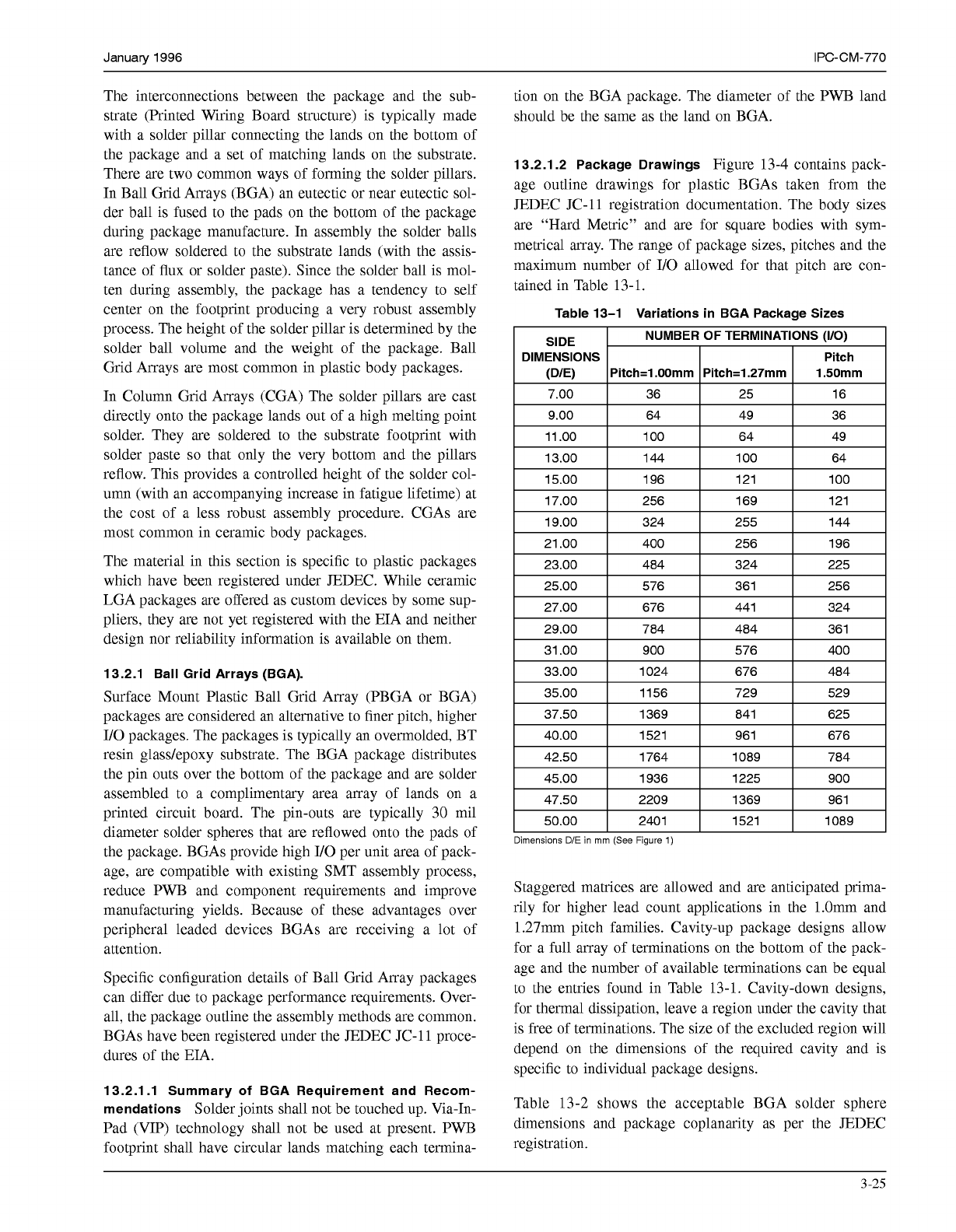
13.2.1.2 Package Drawings
Figure 13-4 contains pack-
age outline drawings for plastic BGAs taken from the
JEDEC JC-11 registration documentation. The body sizes
are “Hard Metric” and are for square bodies with sym-
metrical array. The range of package sizes, pitches and the
maximum number of I/O allowed for that pitch are con-
tained in Table 13-1.
Table 13-1 Variations in BGA Package Sizes
Dimensions DIE in mm (See Figure
1)
Staggered matrices are allowed and are anticipated prima-
rily for higher lead count applications in the l.Omm and
1.27mm pitch families. Cavity-up package designs allow
for a full array of terminations on the bottom of the pack-
age and the number of available terminations can be equal
to the entries found in Table 13-1. Cavity-down designs,
for thermal dissipation, leave a region under the cavity that
is free of terminations. The size of the excluded region will
depend on the dimensions of the required cavity and is
specific to individual package designs.
Table 13-2 shows the acceptable BGA solder sphere
dimensions and package coplanarity as per the JEDEC
registration.
3-25
COPYRIGHT Association Connecting Electronics Industries
Licensed by Information Handling Services
COPYRIGHT Association Connecting Electronics Industries
Licensed by Information Handling Services

IPC-CM-770
Januaty
1996
Table 13-2 BGA Solder Sphere Dimensions and Package Coplanarity
All
Dimensions are in mm.
aaa =Coplanarity of solder spheres
bbb =Coplanarity of
BT
substrate
ccc =Coplanarity of overmolding
AI
=
Height of reflowed solder sphere on packaging
b
=
Solder sphere diameter
13.2.1.3 Assembly
BGA assembly has been proven to be consistent with the
best current practices (BCP) for surface mount (SM)
assembly. They can be assembled concurrently with periph-
eral leaded devices on a typical automated assembly line.
Paste is printed, packages are placed and then the boards
are reflowed. Reflow is typically done in an IRIConvection
oven with a nitrogen atmosphere with a profile similar to
those used for SM assembly. The assembly process of the
BGA is robust because the package tends to self center
during reflow and the molten ball can accommodate to
board or package planarity variations. Packages are avail-
able in trays or tape and reel and can be placed with stan-
dard placement machinery without special considerations.
They are currently a class
3
component and require special
handling. They must be used within 24 hours of their
removal from dry pack and must be stored in low humid-
ity once opened. The solder process is very robust for
BGAs.
Solder paste should be applied using a stencil having an
aperture of no greater than the pad diameter on all lands
with a stencil thickness no less than
6
mils. The assembly
process is relatively insensitive to solder paste thickness as
long as planarity is good enough for the solder paste to
make contact with both package and land.
Only the outer ring of solder terminations is accessible for
visual inspection. This along with measuring the collapse
of the package onto the board (approximately a 20 mil
standoff) is generally adequate for process control but does
not allow
100%
visual inspection of solder joints.
Repair can only be accomplished by total removal and
replacement of the BGA package. This can be done with
standard hot gas removal and replacement of the BGA
package. Solder joints shall NOT be touched up.
14.0 UNPACKAGED SEMICONDUCTOR COMPONENTS
There are several ways to package and assemble integrated
circuits (IC) on printed boards, see Figure 14-1.
The benefit of using Chip On Board (COB) technology all
stems from the absence of the IC package. The wire
bonded bare IC chip, COB, takes up about 114 of the area
of a Dual Inline Package (DIP) and is more space efficient
that Leadless Chip Carrier (LCC) packages. Lower profile
COB can be used in applications not possible with other
packaged chips, such as in “smart” credit cards. Trends in
low power CMOS type semi- conductor technology have
paved the way for the power limited COB technology.
14.1 Part Type Description
Semiconductor dice (chip)
types used in COB technology are comprised of back-
bonded chips and front bonded chips.
14.1.1 Back-Bonded Semiconductor Chips
Back-
bonded chips are components that install into discrete
packages. For example, in transistors the bottom of the
chip serves as the collector an metal lands serve as the base
and emitter. The chip’s collector is bonded directly to the
mounting substrate and discrete connections are made to
the base and emitter. For chip-on-board (COB) application,
chip-and-wire technology is ideally suited for use with the
back-bonded chips. The use of back-bonded chips has
advantages and disadvantages.
The advantages of using back-bonded chips are:
Availability: Most discrete IC come in chip form.
Small sizelhigh packaging densities.
Heat transfer: Intimate contact heat dissipation.
Cost: No additional processing by IC manufacturer.
The disadvantages of using back-bonded chips are:
Handling and testing is difficult due to small size.
Fragility: Susceptible to handling damage.
14.1.2 Face Bonded Semiconductor Chips
Face-
bonded chips have supplementary features that provide
access to its inputloutput lands. For COB applications,
common forms of these components include beam-tape,
TAB devices and flip chips. The use of face-bonded chips
has several advantages and disadvantages.
The advantages of using face-bonding chips are:
Mounting: Bonded circuit connections to metallization
accomplishes both mechanical mounting and electrical
3-26
COPYRIGHT Association Connecting Electronics Industries
Licensed by Information Handling Services
COPYRIGHT Association Connecting Electronics Industries
Licensed by Information Handling Services