IPC-CM-770D-1996.pdf - 第23页
January 1996 IPC-CM-770 enhance the interconnection capabilities and to interface with housings, supports, test equipment and other periph- eral structures. The details of these special components are contained in Sectio…
IPC-CM-770
Januaty
1996
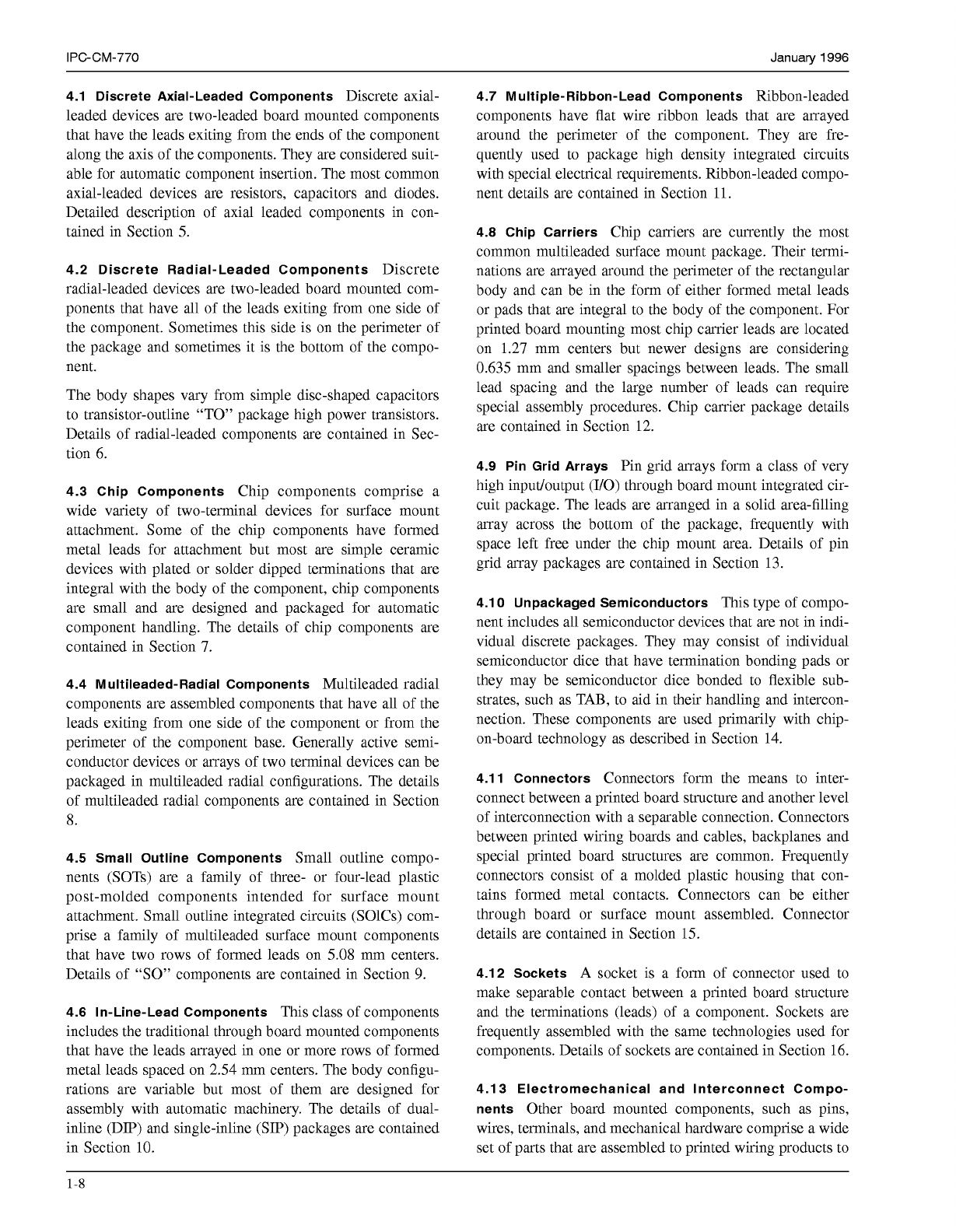
4.1 Discrete Axial-Leaded Components
Discrete axial-
leaded devices are two-leaded board mounted components
that have the leads exiting from the ends of the component
along the axis of the components. They are considered suit-
able for automatic component insertion. The most common
axial-leaded devices are resistors, capacitors and diodes.
Detailed description of axial leaded components in con-
tained in Section
5.
4.2 Discrete Radial-Leaded Components
Discrete
radial-leaded devices are two-leaded board mounted com-
ponents that have all of the leads exiting from one side of
the component. Sometimes this side is on the perimeter of
the package and sometimes it is the bottom of the compo-
nent.
The body shapes vary from simple disc-shaped capacitors
to transistor-outline “TO” package high power transistors.
Details of radial-leaded components are contained in Sec-
tion 6.
4.3 Chip Components
Chip components comprise a
wide variety of two-terminal devices for surface mount
attachment. Some of the chip components have formed
metal leads for attachment but most are simple ceramic
devices with plated or solder dipped terminations that are
integral with the body of the component, chip components
are small and are designed and packaged for automatic
component handling. The details of chip components are
contained in Section 7.
4.4 Multileaded-Radial Components
Multileaded radial
components are assembled components that have all of the
leads exiting from one side of the component or from the
perimeter of the component base. Generally active semi-
conductor devices or arrays of two terminal devices can be
packaged in multileaded radial configurations. The details
of multileaded radial components are contained in Section
8.
4.5 Small Outline Components
Small outline compo-
nents (SOTS) are a family of three- or four-lead plastic
post-molded components intended for surface mount
attachment. Small outline integrated circuits (SolCs) com-
prise a family of multileaded surface mount components
that have two rows of formed leads on
5.08
mm centers.
Details of
“SO”
components are contained in Section
9.
4.6 ln-Line-Lead Components
This class of components
includes the traditional through board mounted components
that have the leads arrayed in one or more rows of formed
metal leads spaced on 2.54 mm centers. The body configu-
rations are variable but most of them are designed for
assembly with automatic machinery. The details of dual-
inline (DIP) and single-inline (SIP) packages are contained
in Section
10.
4.7 Multiple-Ribbon-Lead Components
Ribbon-leaded
components have flat wire ribbon leads that are arrayed
around the perimeter of the component. They are fre-
quently used to package high density integrated circuits
with special electrical requirements. Ribbon-leaded compo-
nent details are contained in Section
11.
4.8 Chip Carriers
Chip carriers are currently the most
common multileaded surface mount package. Their termi-
nations are arrayed around the perimeter of the rectangular
body and can be in the form of either formed metal leads
or pads that are integral to the body of the component. For
printed board mounting most chip carrier leads are located
on 1.27 mm centers but newer designs are considering
0.635 mm and smaller spacings between leads. The small
lead spacing and the large number of leads can require
special assembly procedures. Chip carrier package details
are contained in Section 12.
4.9 Pin Grid Arrays
Pin grid arrays form a class of very
high inputloutput (I/O) through board mount integrated cir-
cuit package. The leads are arranged in a solid area-filling
array across the bottom of the package, frequently with
space left free under the chip mount area. Details of pin
grid array packages are contained in Section 13.
4.1
O
Unpackaged Semiconductors
This type of compo-
nent includes all semiconductor devices that are not in indi-
vidual discrete packages. They may consist of individual
semiconductor dice that have termination bonding pads or
they may be semiconductor dice bonded to flexible sub-
strates, such as TAB, to aid in their handling and intercon-
nection. These components are used primarily with chip-
on-board technology as described in Section 14.
4.1 1 Connectors
Connectors form the means to inter-
connect between a printed board structure and another level
of interconnection with a separable connection. Connectors
between printed wiring boards and cables, backplanes and
special printed board structures are common. Frequently
connectors consist of a molded plastic housing that con-
tains formed metal contacts. Connectors can be either
through board or surface mount assembled. Connector
details are contained in Section
15.
4.12 Sockets
A socket is a form of connector used to
make separable contact between a printed board structure
and the terminations (leads) of a component. Sockets are
frequently assembled with the same technologies used for
components. Details of sockets are contained in Section 16.
4.1 3 Electromechanical and Interconnect Compo-
nents
Other board mounted components, such as pins,
wires, terminals, and mechanical hardware comprise a wide
set of parts that are assembled to printed wiring products to
1-8
COPYRIGHT Association Connecting Electronics Industries
Licensed by Information Handling Services
COPYRIGHT Association Connecting Electronics Industries
Licensed by Information Handling Services
January
1996
IPC-CM-770
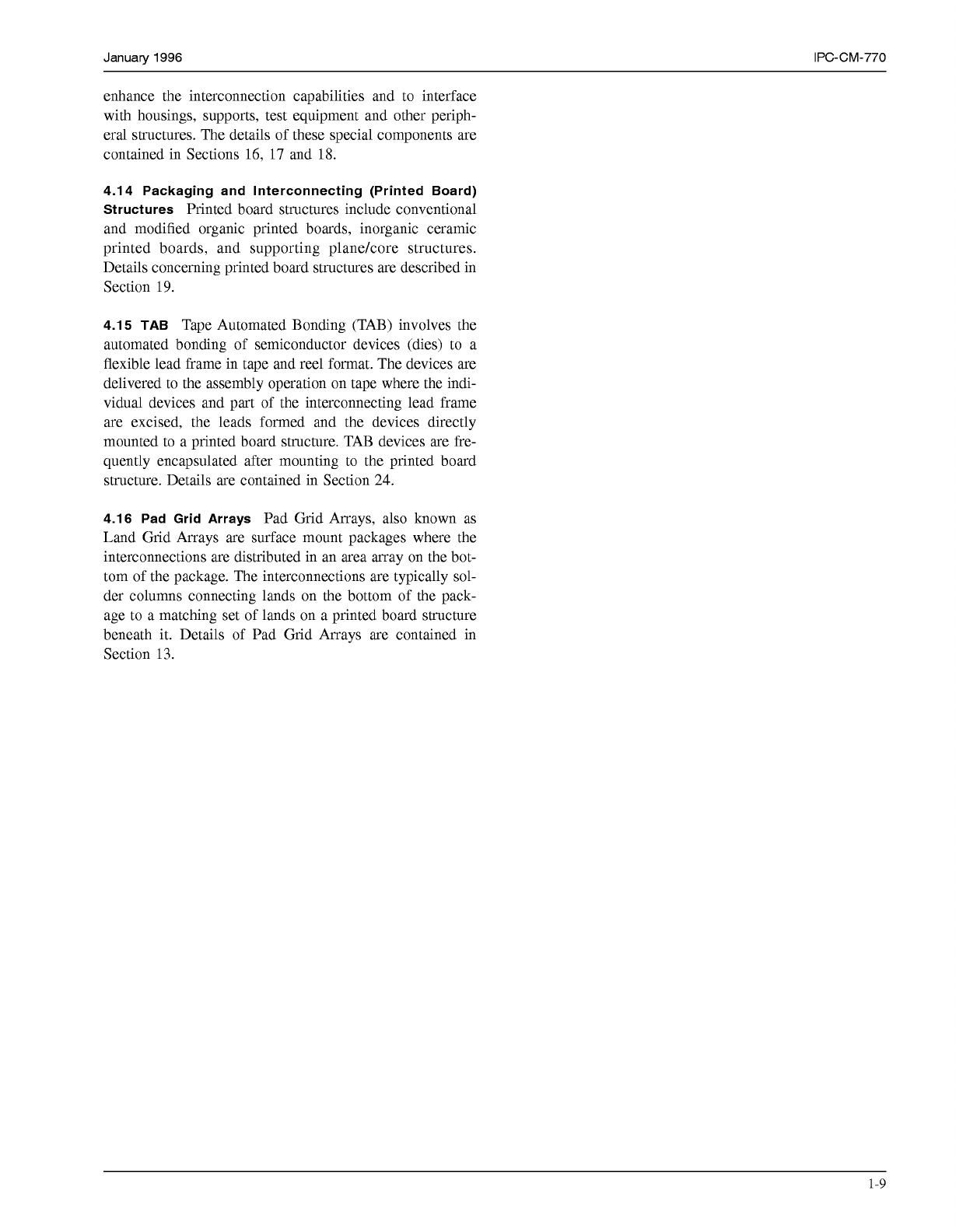
enhance the interconnection capabilities and to interface
with housings, supports, test equipment and other periph-
eral structures. The details of these special components are
contained in Sections
16,
17
and
18.
4.1 4 Packaging and Interconnecting (Printed Board)
Structures
Printed board structures include conventional
and modified organic printed boards, inorganic ceramic
printed boards, and supporting planekore structures.
Details concerning printed board structures are described in
Section
19.
4.1
5
TAB
Tape Automated Bonding (TAB) involves the
automated bonding of semiconductor devices (dies) to a
flexible lead frame in tape and reel format. The devices are
delivered to the assembly operation on tape where the indi-
vidual devices and part of the interconnecting lead frame
are excised, the leads formed and the devices directly
mounted to a printed board structure. TAB devices are fre-
quently encapsulated after mounting to the printed board
structure. Details are contained in Section
24.
4.16 Pad Grid Arrays
Pad Grid Arrays, also known as
Land Grid Arrays are surface mount packages where the
interconnections are distributed in an area array on the bot-
tom of the package. The interconnections are typically sol-
der columns connecting lands on the bottom of the pack-
age to a matching set of lands on a printed board structure
beneath it. Details of Pad Grid Arrays are contained in
Section
13.
1-9
COPYRIGHT Association Connecting Electronics Industries
Licensed by Information Handling Services
COPYRIGHT Association Connecting Electronics Industries
Licensed by Information Handling Services

IPC-CM-770
Januaty
1996
1-10
COPYRIGHT Association Connecting Electronics Industries
Licensed by Information Handling Services
COPYRIGHT Association Connecting Electronics Industries
Licensed by Information Handling Services