IPC-CM-770D-1996.pdf - 第20页
IPC-CM-770 Januaty 1996 3.21 *Jumper Wire A discrete electrical connection that is part of the basic conductive pattern formed on a printed board. (See also “Haywire.”) 3.22 *Land A portion of a conductive pattern usuall…
January
1996
IPC-CM-770
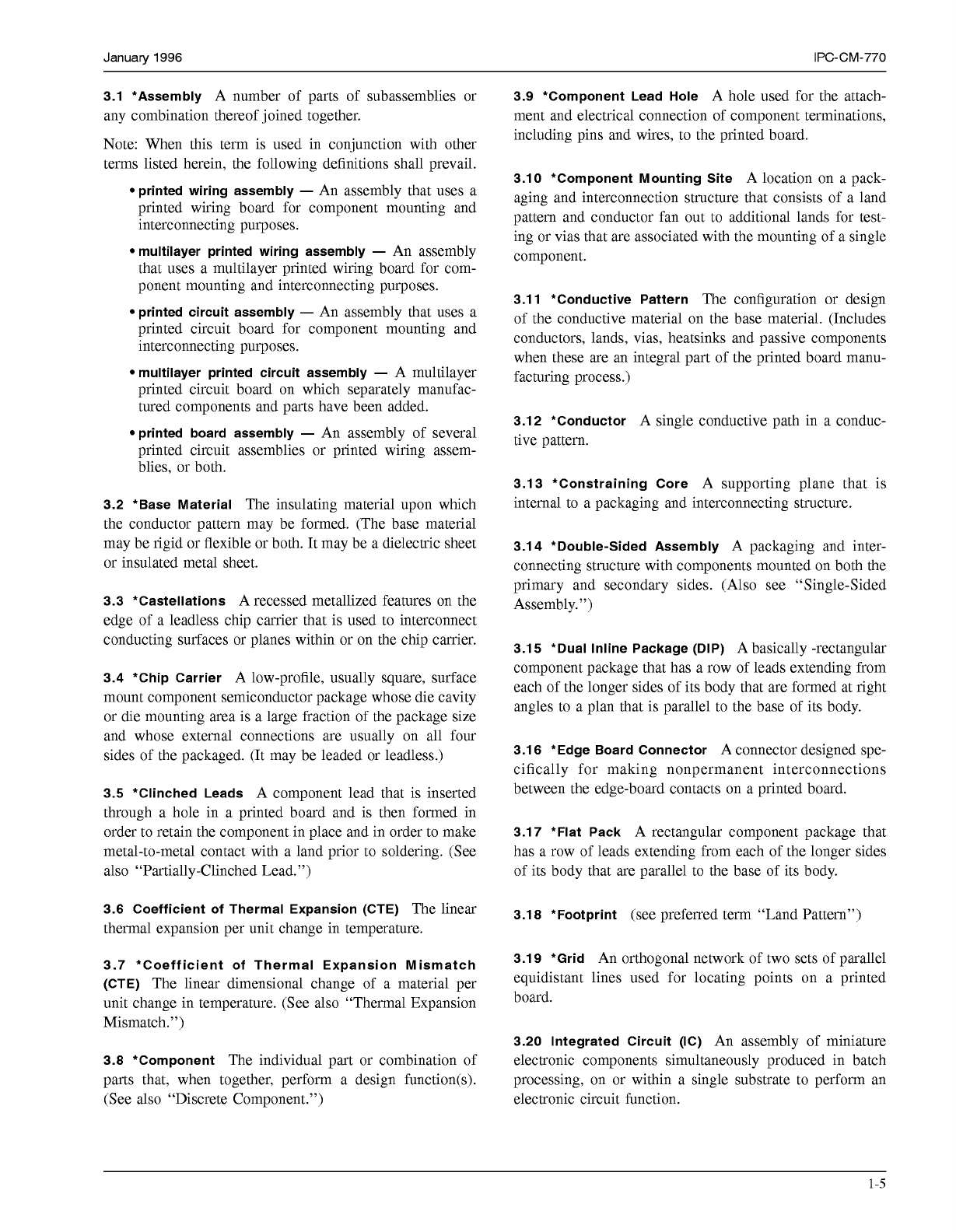
3.1 *Assembly
A number of parts of subassemblies or
any combination thereof joined together.
Note: When this term is used in conjunction with other
terms listed herein, the following definitions shall prevail.
printed wiring assembly
-
An assembly that uses a
printed wiring board for component mounting and
interconnecting purposes.
multilayer printed wiring assembly
-
An assembly
that uses a multilayer printed wiring board for com-
ponent mounting and interconnecting purposes.
printed circuit assembly
-
An assembly that uses a
printed circuit board for component mounting and
interconnecting purposes.
multilayer printed circuit assembly
-
A multilayer
printed circuit board on which separately manufac-
tured components and parts have been added.
printed board assembly
-
An assembly of several
printed circuit assemblies or printed wiring assem-
blies, or both.
3.2 *Base Material
The insulating material upon which
the conductor pattern may be formed. (The base material
may be rigid or flexible or both. It may be a dielectric sheet
or insulated metal sheet.
3.3 *Castellations
A recessed metallized features on the
edge of a leadless chip carrier that is used to interconnect
conducting surfaces or planes within or on the chip carrier.
3.4 *Chip Carrier
A low-profile, usually square, surface
mount component semiconductor package whose die cavity
or die mounting area is a large fraction of the package size
and whose external connections are usually on all four
sides of the packaged. (It may be leaded or leadless.)
3.5 *Clinched Leads
A component lead that is inserted
through a hole in a printed board and is then formed in
order to retain the component in place and in order to make
metal-to-metal contact with a land prior to soldering. (See
also “Partially-Clinched Lead.”)
3.6 Coefficient of Thermal Expansion (CTE)
The linear
thermal expansion per unit change in temperature.
3.7 *Coefficient of Thermal Expansion Mismatch
(CTE)
The linear dimensional change of a material per
unit change in temperature. (See also “Thermal Expansion
Mismatch.”)
3.8 *Component
The individual part or combination of
parts that, when together, perform a design function(s).
(See also “Discrete Component.”)
3.9 *Component Lead Hole
A hole used for the attach-
ment and electrical connection of component terminations,
including pins and wires, to the printed board.
3.10 *Component Mounting Site
A location on a pack-
aging and interconnection structure that consists of a land
pattern and conductor fan out to additional lands for test-
ing or vias that are associated with the mounting of a single
component.
3.11 *Conductive Pattern
The configuration or design
of the conductive material on the base material. (Includes
conductors, lands, vias, heatsinks and passive components
when these are an integral part of the printed board manu-
facturing process.)
3.12 *Conductor
A single conductive path in a conduc-
tive pattern.
3.13 *Constraining Core
A supporting plane that is
internal to a packaging and interconnecting structure.
3.14 *Double-Sided Assembly
A packaging and inter-
connecting structure with components mounted on both the
primary and secondary sides. (Also see “Single-Sided
Assembly.”)
3.1
5
*Dual lnline Package (DIP)
A basically -rectangular
component package that has a row of leads extending from
each of the longer sides of its body that are formed at right
angles to a plan that is parallel to the base of its body.
3.1 6 *Edge Board Connector
A connector designed spe-
cifically for making nonpermanent interconnections
between the edge-board contacts on a printed board.
3.17 *Flat Pack
A rectangular component package that
has a row of leads extending from each of the longer sides
of its body that are parallel to the base of its body.
3.1 8 *Footprint
(see preferred term “Land Pattern”)
3.1 9 *Grid
An orthogonal network of two sets of parallel
equidistant lines used for locating points on a printed
board.
3.20 Integrated Circuit (IC)
An assembly of miniature
electronic components simultaneously produced in batch
processing, on or within a single substrate to perform an
electronic circuit function.
1-5
COPYRIGHT Association Connecting Electronics Industries
Licensed by Information Handling Services
COPYRIGHT Association Connecting Electronics Industries
Licensed by Information Handling Services
IPC-CM-770
Januaty
1996
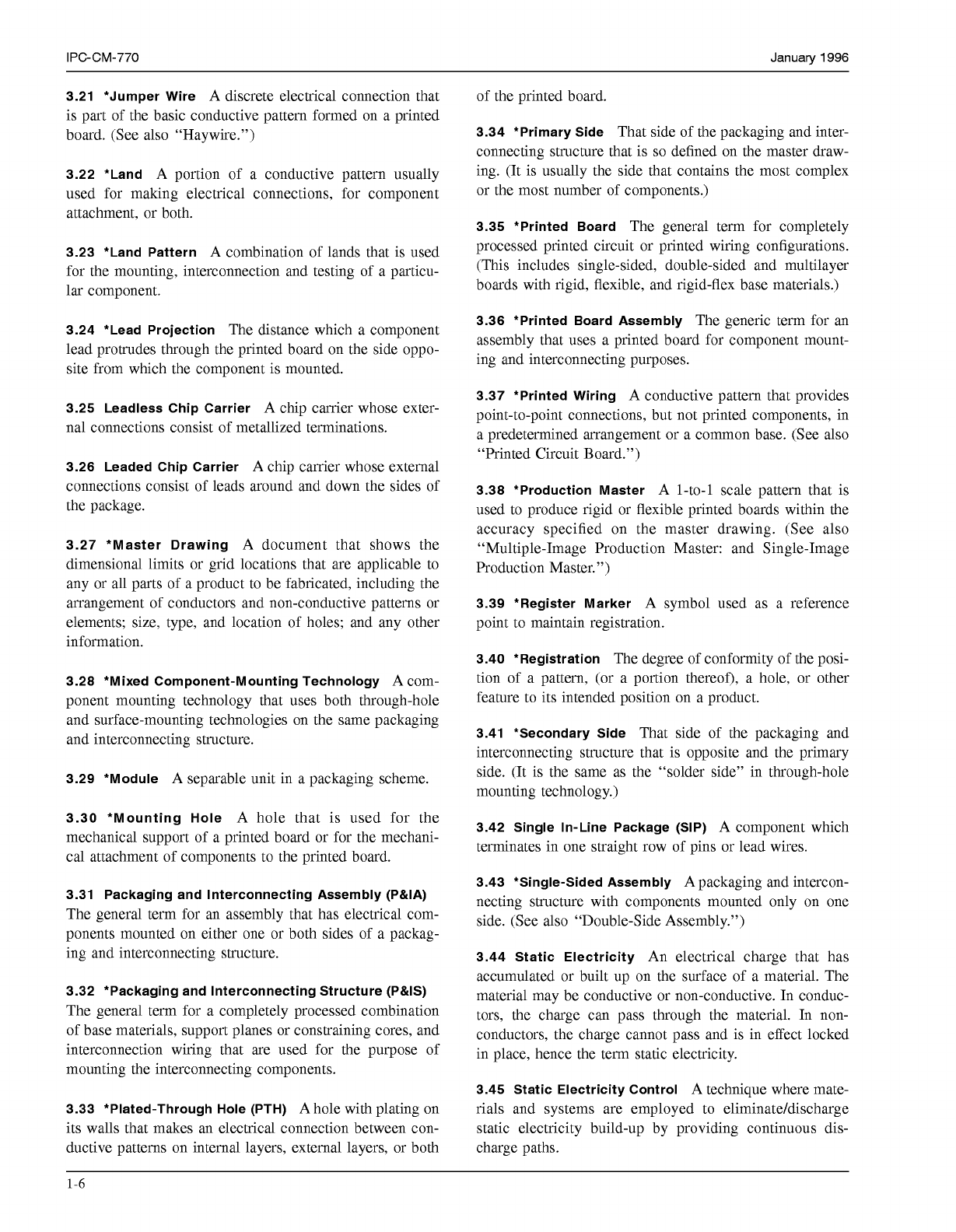
3.21 *Jumper Wire
A discrete electrical connection that
is part of the basic conductive pattern formed on a printed
board. (See also “Haywire.”)
3.22 *Land
A portion of a conductive pattern usually
used for making electrical connections, for component
attachment, or both.
3.23 *Land Pattern
A combination of lands that is used
for the mounting, interconnection and testing of a particu-
lar component.
3.24 *Lead Projection
The distance which a component
lead protrudes through the printed board on the side oppo-
site from which the component is mounted.
3.25 Leadless Chip Carrier
A chip carrier whose exter-
nal connections consist of metallized terminations.
3.26 Leaded Chip Carrier
A chip carrier whose external
connections consist of leads around and down the sides of
the package.
3.27 *Master Drawing
A document that shows the
dimensional limits or grid locations that are applicable to
any or all parts of a product to be fabricated, including the
arrangement of conductors and non-conductive patterns or
elements; size, type, and location of holes; and any other
information.
3.28 *Mixed Component-Mounting Technology
A com-
ponent mounting technology that uses both through-hole
and surface-mounting technologies on the same packaging
and interconnecting structure.
3.29 *Module
A separable unit in a packaging scheme.
3.30 *Mounting Hole
A hole that is used for the
mechanical support of a printed board or for the mechani-
cal attachment of components to the printed board.
3.31 Packaging and Interconnecting Assembly (P&lA)
The general term for an assembly that has electrical com-
ponents mounted on either one or both sides of a packag-
ing and interconnecting structure.
3.32 *Packaging and Interconnecting Structure (P&lS)
The general term for a completely processed combination
of base materials, support planes or constraining cores, and
interconnection wiring that are used for the purpose of
mounting the interconnecting components.
3.33 *Plated-Through Hole (PTH)
A hole with plating on
its walls that makes an electrical connection between con-
ductive patterns on internal layers, external layers, or both
of the printed board.
3.34 *Primary Side
That side of the packaging and inter-
connecting structure that is
so
defined on the master draw-
ing. (It is usually the side that contains the most complex
or the most number of components.)
3.35 *Printed Board
The general term for completely
processed printed circuit or printed wiring configurations.
(This includes single-sided, double-sided and multilayer
boards with rigid, flexible, and rigid-flex base materials.)
3.36 *Printed Board Assembly
The generic term for an
assembly that uses a printed board for component mount-
ing and interconnecting purposes.
3.37 *Printed Wiring
A conductive pattern that provides
point-to-point connections, but not printed components, in
a predetermined arrangement or a common base. (See also
“Printed Circuit Board.”)
3.38 *Production Master
A 1-to-1 scale pattern that is
used to produce rigid or flexible printed boards within the
accuracy specified on the master drawing. (See also
“Multiple-Image Production Master: and Single-Image
Production Master.”)
3.39 *Register Marker
A symbol used as a reference
point to maintain registration.
3.40 *Registration
The degree of conformity of the posi-
tion of a pattern, (or a portion thereof), a hole, or other
feature to its intended position on a product.
3.41 *Secondary Side
That side of the packaging and
interconnecting structure that is opposite and the primary
side. (It is the same as the “solder side” in through-hole
mounting technology.)
3.42 Single ln-Line Package (SIP)
A component which
terminates in one straight row of pins or lead wires.
3.43 *Single-Sided Assembly
A packaging and intercon-
necting structure with components mounted only on one
side. (See also “Double-Side Assembly.”)
3.44 Static Electricity
An electrical charge that has
accumulated or built up on the surface of a material. The
material may be conductive or non-conductive. In conduc-
tors, the charge can pass through the material. In non-
conductors, the charge cannot pass and is in effect locked
in place, hence the term static electricity.
3.45 Static Electricity Control
A technique where mate-
rials and systems are employed to eliminate/discharge
static electricity build-up by providing continuous dis-
charge paths.
1-6
COPYRIGHT Association Connecting Electronics Industries
Licensed by Information Handling Services
COPYRIGHT Association Connecting Electronics Industries
Licensed by Information Handling Services
January
1996
IPC-CM-770
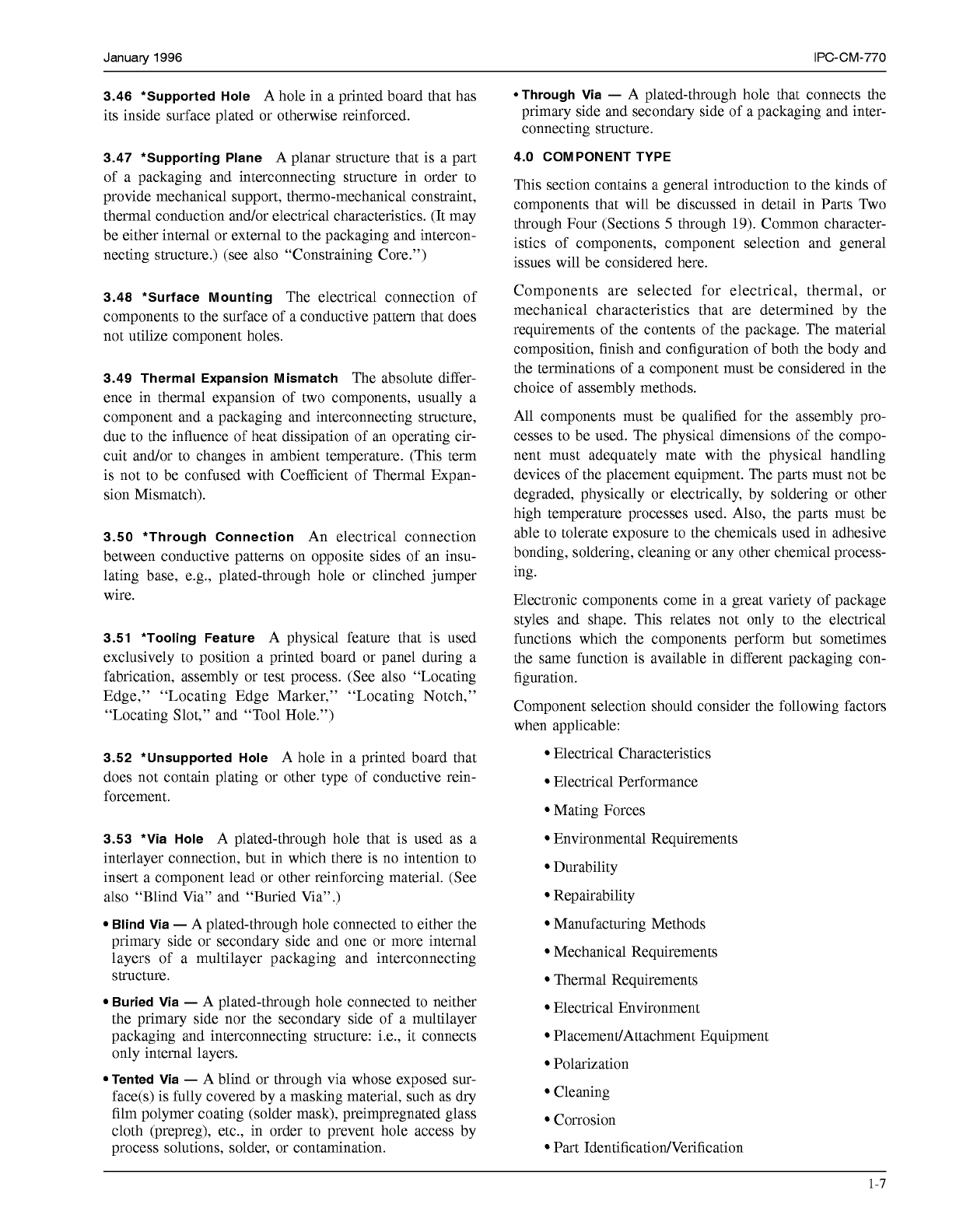
3.46 *Supported Hole
A hole in a printed board that has
its inside surface plated or otherwise reinforced.
3.47 *Supporting Plane
A planar structure that is a part
of a packaging and interconnecting structure in order to
provide mechanical support, thermo-mechanical constraint,
thermal conduction and/or electrical characteristics. (It may
be either internal or external to the packaging and intercon-
necting structure.) (see also “Constraining Core.”)
3.48 *Surface Mounting
The electrical connection of
components to the surface of a conductive pattern that does
not utilize component holes.
3.49 Thermal Expansion Mismatch
The absolute differ-
ence in thermal expansion of two components, usually a
component and a packaging and interconnecting structure,
due to the influence of heat dissipation of an operating cir-
cuit and/or to changes in ambient temperature. (This term
is not to be confused with Coefficient of Thermal Expan-
sion Mismatch).
3.50 *Through Connection
An electrical connection
between conductive patterns on opposite sides of an insu-
lating base, e.g., plated-through hole or clinched jumper
wire.
3.51 *Tooling Feature
A physical feature that is used
exclusively to position a printed board or panel during a
fabrication, assembly or test process. (See also “Locating
Edge,” “Locating Edge Marker,” “Locating Notch,”
“Locating Slot,” and “Tool Hole.”)
3.52 *Unsupported Hole
A hole in a printed board that
does not contain plating or other type of conductive rein-
forcement.
3.53 *Via Hole
A plated-through hole that is used as a
interlayer connection, but in which there is no intention to
insert a component lead or other reinforcing material. (See
also “Blind Via” and “Buried Via”.)
Blind Via
-
A plated-through hole connected to either the
primary side or secondary side and one or more internal
layers of a multilayer packaging and interconnecting
structure.
Buried Via
-
A plated-through hole connected to neither
the primary side nor the secondary side of a multilayer
packaging and interconnecting structure: i.e., it connects
only internal layers.
Tented Via
-
A blind or through via whose exposed sur-
face(s) is fully covered by a masking material, such as
dry
film polymer coating (solder mask), preimpregnated glass
cloth (prepreg), etc., in order to prevent hole access by
process solutions, solder, or contamination.
*Through Via
-
A plated-through hole that connects the
primary side and secondary side of a packaging and inter-
connecting structure.
4.0 COM PONENT TYPE
This section contains a general introduction to the kinds of
components that will be discussed in detail in Parts Two
through Four (Sections
5
through
19).
Common character-
istics of components, component selection and general
issues will be considered here.
Components are selected for electrical, thermal, or
mechanical characteristics that are determined by the
requirements of the contents of the package. The material
composition, finish and configuration of both the body and
the terminations of a component must be considered in the
choice of assembly methods.
All components must be qualified for the assembly pro-
cesses to be used. The physical dimensions of the compo-
nent must adequately mate with the physical handling
devices of the placement equipment. The parts must not be
degraded, physically or electrically, by soldering or other
high temperature processes used. Also, the parts must be
able to tolerate exposure to the chemicals used in adhesive
bonding, soldering, cleaning or any other chemical process-
ing.
Electronic components come in a great variety of package
styles and shape. This relates not only to the electrical
functions which the components perform but sometimes
the same function is available in different packaging con-
figuration.
Component selection should consider the following factors
when applicable:
Electrical Characteristics
Electrical Performance
Mating Forces
Environmental Requirements
Durability
Repairability
Manufacturing Methods
Mechanical Requirements
Thermal Requirements
Electrical Environment
PlacemendAttachment Equipment
Polarization
Cleaning
Corrosion
Part IdentificationNerification
1-7
COPYRIGHT Association Connecting Electronics Industries
Licensed by Information Handling Services
COPYRIGHT Association Connecting Electronics Industries
Licensed by Information Handling Services