IPC-CM-770D-1996.pdf - 第148页
IPC-CM-770 Januaty 1996 strip and individual preforms are chains where each unit is broken off as it is dispensed. The assembly sequence using preforms can be very simple. The placement method of the preforms between com…
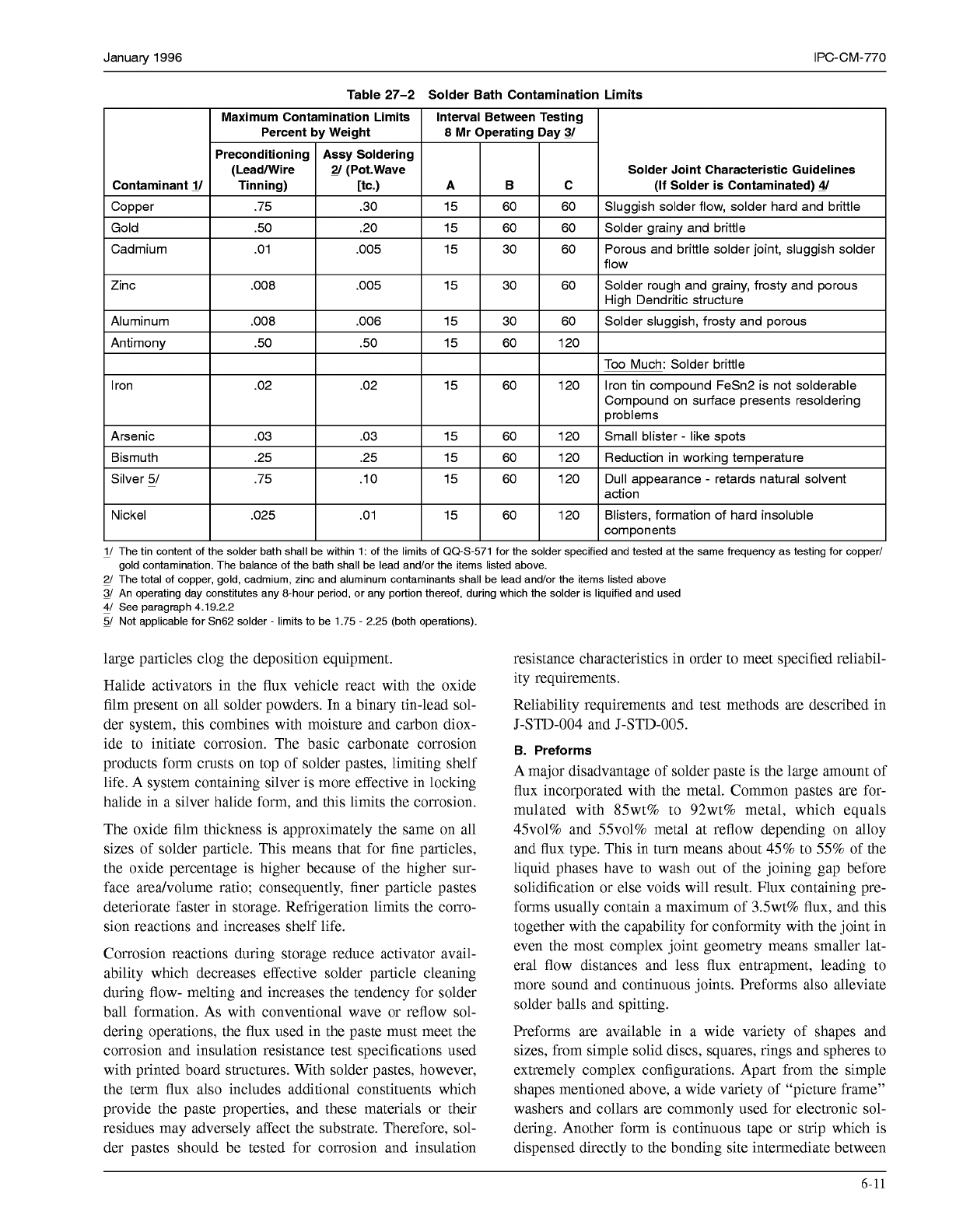
January
1996
IPC-CM-770
Table
27-2
Solder Bath Contamination Limits
Solder Joint Characteristic Guidelines
1/ The tin content of the solder bath shall be within 1: of the limits of 00-5-571 for the solder specified and tested at the same frequency as testing for copper/
2/ The total of copper, gold, cadmium, zinc and aluminum contaminants shall be lead and/or the items listed above
3/
An operating day constitutes any 8-hour period, or any portion thereof, during which the solder is liquified and used
gold contamination. The balance of the bath shall be lead and/or the items listed above.
&/
See paragraph 4.19.2.2
5/ Not applicable for Sn62 solder
-
limits to be 1.75
-
2.25 (both operations).
large particles clog the deposition equipment.
Halide activators in the flux vehicle react with the oxide
film present on all solder powders. In a binary tin-lead sol-
der system, this combines with moisture and carbon diox-
ide to initiate corrosion. The basic carbonate corrosion
products form crusts on top of solder pastes, limiting shelf
life. A system containing silver is more effective in locking
halide in a silver halide form, and this limits the corrosion.
The oxide film thickness is approximately the same on all
sizes of solder particle. This means that for fine particles,
the oxide percentage is higher because of the higher sur-
face aredvolume ratio; consequently, finer particle pastes
deteriorate faster in storage. Refrigeration limits the corro-
sion reactions and increases shelf life.
Corrosion reactions during storage reduce activator avail-
ability which decreases effective solder particle cleaning
during flow- melting and increases the tendency for solder
ball formation. As with conventional wave or reflow sol-
dering operations, the flux used in the paste must meet the
corrosion and insulation resistance test specifications used
with printed board structures. With solder pastes, however,
the term flux also includes additional constituents which
provide the paste properties, and these materials or their
residues may adversely affect the substrate. Therefore, sol-
der pastes should be tested for corrosion and insulation
resistance characteristics in order to meet specified reliabil-
ity requirements.
Reliability requirements and test methods are described in
J-STD-O04 and J-STD-005.
B. Preforms
A major disadvantage of solder paste is the large amount of
flux incorporated with the metal. Common pastes are for-
mulated with 85wt% to 92wt% metal, which equals
45~01% and 55~01% metal at reflow depending on alloy
and flux type. This in turn means about 45% to
55%
of the
liquid phases have to wash out of the joining gap before
solidification or else voids will result. Flux containing pre-
forms usually contain a maximum of 3.5wt% flux, and this
together with the capability for conformity with the joint in
even the most complex joint geometry means smaller lat-
eral flow distances and less flux entrapment, leading to
more sound and continuous joints. Preforms also alleviate
solder balls and spitting.
Preforms are available in a wide variety of shapes and
sizes, from simple solid discs, squares, rings and spheres to
extremely complex configurations. Apart from the simple
shapes mentioned above, a wide variety of “picture frame”
washers and collars are commonly used for electronic sol-
dering. Another form is continuous tape or strip which is
dispensed directly to the bonding site intermediate between
6-11
COPYRIGHT Association Connecting Electronics Industries
Licensed by Information Handling Services
COPYRIGHT Association Connecting Electronics Industries
Licensed by Information Handling Services
IPC-CM-770
Januaty
1996
strip and individual preforms are chains where each unit is
broken off as it is dispensed.
The assembly sequence using preforms can be very simple.
The placement method of the preforms between component
parts or component and substrate is often the single most
unique feature of a preform process. The preform materials
have to be fixed or located between the components of the
joint with sufficient accuracy to insure that on melting the
metal contacts both parts of the joint
so
that they wet, and
surface tension forces can act to draw them into perfect
alignment. After this, the only remaining stage is to reflow
melt the preform. Solder preforms may be located by plac-
ing them over a lead or projection in the chip carrier, or by
positioning them in a groove or notch on the substrate.
Another alternative is to use auxiliary jigs and plates to
immobilize preforms until the reflow operation. Regardless
of the placement method, the preforms may be handled
through simple manual transfer, vibrator units, tumble
plates, or two part alignment plates.
In general, flux cannot be used to tack preforms in place
since the flux layer melts before the metal, allowing the
solid preform to float and move over the substrate. The
same applies to using partial flux reflow from flux filled
and flux coated preforms.
Metal coated preforms, however, can be affixed by partial
reflow, provided there is sufficient difference in melting
point between the cladding alloy and the core. Reflow of
the cladding layer can be used to attach the preform to one
side of the joint, which can then be fully assembled and
reflowed at the higher temperature to complete the bonding
operation.
The vapor-phase process is particularly suited for this if
alloy melting points allow the use of different reflow fluids.
A reflow fluid with a boiling point of 215°C would create
a molten surface zone to attach the preform. Subsequent
use of a reflow fluid with a boiling point of 250°C would
reflow the whole composite assembly.
27.4 Component Retention
Component retention is
described in detail in section 21.4.
27.5 Machine Soldering Processes
Soldering is defined
as a joining process with the use of heat (below 400°C) and
a non-ferrous filler metal that has a melting temperature
below that of the base metals to be joined. Soldering is a
practical technique for producing mechanically sound and
electrically reliable interconnections. Different soldering
processes exist, suited for a variety of electronics assembly
applications and technologies. The following sections
describe the specific details of the most common processes
used for mass production soldering of electronics
assemblies.
27.5.1 Wave Soldering
The large percentage of through-
hole board mounted components are mass wave soldered.
Small surface mount components such as passive chip
capacitors and resistors as well as SOTS (small outline tran-
sistors), bonded to the bottom side of the board with an
adhesive are also wave soldered extensively.
Wave soldering involves the following sequence of
operations:
Fluxing
Preheating
Soldering
27.5.1.1 Fluxing
A flux is applied to the bottom surface
of the electronics assembly as the first step after loading it
into the conveyor system of the wave soldering machine.
The flux also coats the component leads and some flux
enters the plated holes in the board. Flux is required to
remove oxides from the metallic surfaces to be soldered.
Flux also promotes solder wetting, helps the solder to rise
in plated holes, leaves solder joints with a smooth and
oxide-free surface and can prevent solder balls, solder sliv-
ers and webbing from remaining on the board surface after
soldering.
One commonly used method for applying a flux in a wave
soldering machine is foam fluxing. Other methods are
spray fluxing, wave fluxing and brush fluxing. Fluxers are
fabricated from materials which are compatible with the
chemical nature of fluxes. For rosin fluxes, the fluxer is
often fabricated from stainless steel or polyvinylchlo-
ride(PVC), a chemically resistant plastic material. For
water soluble acid fluxes which are more corrosive, the
units are either made of PVC or titanium.
A.
Foam Fluxing
Many wave soldering systems utilize foam fluxers. This is
the simplest method for applying flux. The foam is gener-
ated by feeding low-pressure compressed air into a porous
diffuser stone or a porous plastic diffuser or filter tube
which is immersed into the liquid flux in the fluxer bath.
The pores in the diffuser tube range from
50-60
micron
pore size for regular fluxes down to
10
microns for low
solids fluxes. The fine foam bubbles of flux are generated
by the air coming out of the pores. The flux rises in a cen-
trally mounted chimney nozzle which guides the foam
upward till it overflows the top edge of the chimney. As the
assembly is conveyed over the foam fluxer chimney, the
bottom of the board touches the foam head and becomes
coated with flux. A short distance after the exit end of the
fluxer an air knife is usually used, made from a tube with
small diameter holes drilled in a row along its length. Low
pressure air is directed upward at a slight angle toward the
entry end of the machine to remove excess flux and drip-
pings without disturbing the components. A well designed
6-12
COPYRIGHT Association Connecting Electronics Industries
Licensed by Information Handling Services
COPYRIGHT Association Connecting Electronics Industries
Licensed by Information Handling Services
January
1996
IPC-CM-770
foam fluxer is equipped with the necessary pressure regu-
lators, gauges, valves and flow meters to control the pro-
cess. Other important controls sometimes found are auto-
matic specific gravity controllers and methods for
automatically maintaining the correct liquid level above the
foaming tube.
Foam fluxers can be used where the length of the compo-
nent leads, protruding from the bottom of the board do not
exceed 6 mm.
B. Spray Fluxing
Spray fluxing is widely used for the application of low-
solids fluxes because of the ability to better control the flux
deposit for no-clean applications. While spray fluxers have
existed for years, they were not popular because the sticky
rosin fluxes commonly used at that time, blocked the
nozzles of the spray units, the interior of the soldering
machine was hard to keep clean and there was always a
risk of fire. The use of low solids fluxes, with a solids con-
tent in the range of
1-3%
often contain no rosin. This
reduces blocked nozzles and decreases the maintenance
problems. Nitrogen is often used to direct the flux spray
onto the assembly.
Spray fluxing is used when lead lengths preclude the use of
other fluxing methods or when fine control of the amount
of flux applied to the assembly is required. Use of spray
fluxes is popular to increase control of the application of
the low residue fluxes.
Spray fluxers, in general are more expensive than all other
fluxers used in wave soldering systems.
One spray fluxing methods consists of rotating a fine stain-
less steel screen drum in liquid flux with compressed air or
nitrogen jets inside the drum. The flux fills the mesh of the
screen and the upward pointing jets blow the flux from the
holes in the mesh onto the bottom of the assembly passing
above. The amount of flux transferred is a function of the
mesh size and is controlled by the speed of the rotating
drum and the pressure of jets. As with a foam fluxer, the
need to control the operating parameters is essential,
including frequent measurement of the solids content of the
flux remaining in the flux tank.
Other spray fluxing methods include direct spray jets and
nozzles. These are popular when using a low solids flux
because there is no need to periodically measure and cor-
rect the solids content of the flux as with all other fluxing
techniques.
Some designs have one or more fixed spray nozzles below
the board and spray the flux upward, usually assisted or
driven by compressed air or inert nitrogen which reduces
the risk of fire.
Other designs have one or more spray nozzles or jets which
move back and forth, spraying the flux deposit onto the
bottom of the assembly from below the conveyor. These
nozzles are similar to paint spray nozzles, or they may be
lower cost simple jets. Other designs use ultrasonic energy
to form a mist of flux which is then directed upwards with
a stream or jets of nitrogen. The liquid flux flow and/or gas
flow rate, energy applied, and speed of the traversing
nozzle relative to the conveyor speed are among some of
the essential parameters controlled for consistent applica-
tion of a uniform deposit of flux.
As with a foam fluxer, an air knife is sometimes integrated
after the exit end of some spray fluxers to spread out the
flux deposit.
“Inkjet” spray technology is also used in some spray fluxer
applications. This technique provides precise application of
the flux with no other spray since no air or nitrogen gas is
used. Hole fill with this technology has been demonstrated
to be excellent.
C.
Wave Fluxing
Wave fluxing can be used when the leads protruding below
the bottom of the board exceed 6mm and the flux contains
a high percentage of solids, usually rosin, or when the flux
cannot be applied with a foam fluxer or a spray unit. A
wave fluxer is more expensive than a foam fluxer but less
than a spray unit. The materials must be compatible with
the flux and are similar to those used to fabricate a foam
fluxer.
The liquid flux is pumped up a nozzle to form a symmetri-
cal standing wave of flux. The wave is parabolic in profile
and flows equally in both directions, returning the flux by
gravity to the main tank. The bottom of the assembly is
coated with liquid flux as it contacts the crest of the wave
and as the protruding leads pass through the wave, the
washing action combined with capillary forces promotes
flux rising in the plate holes. For process control, the wave
height is adjustable. As the production day proceeds, the
solvent in the flux will evaporate, but at a slower rate than
from a foam fluxer. Periodic specific gravity checks or an
automatic specific gravity control unit are recommended.
An air knife is available after the exit of the wave fluxer to
remove excess flux and drippings from the bottom of the
assembly.
D.
Brush Fluxing.
Brush fluxing should only be used where special require-
ments preclude other fluxing methods. This method is lim-
ited to assemblies where the components or their leads are
fixed in some way that they cannot be dislodged or moved
by the brush. In brush fluxing, a rotating cylindrical brush
transfers flux to the bottom of the board from either a
foaming flux head or a static bath of liquid flux.
27.5.1.2 Preheating
Preheating the board has several
functions:
a) to evaporate the solvents from the flux deposit on the
6-13
COPYRIGHT Association Connecting Electronics Industries
Licensed by Information Handling Services
COPYRIGHT Association Connecting Electronics Industries
Licensed by Information Handling Services