IPC-CM-770D-1996.pdf - 第57页
January 1996 IPC-CM-770 IPC-I- Figure 12-4 Double Row Plastic Chip Carrier ADEQUATE GOOD SOLDER FILLET A LINE PARALLEL Il TO CHIP CARRIER II SOLDER FILLET INSUFFICIENT LEAD CENTERED ON GOOD SOLDER FILLET CHIP CARRIER TER…
IPC-CM-770 Januaty 1996
close tolerances make these packages particularly adapt-
able to automatic assembly, testing and handling equip-
ment.
The conductors consist of clad copper which is electro-
plated with copper to
0.005
mm, then electroplated with
nickel to 0.000125-0.00025 mm and finally electroplated
with gold to
0.00005-0.0001
mm. This combination of met-
allization provides an excellent base for automatic wire
bonding in the cavity area, and yet does not put enough
gold on the footprint to embrittle the solder joint.
12.1.3 Package Materials and Construction
Chip carri-
ers are available in many constructions and materials com-
parable to dual-inline-packages (DIPs).
Plastic premolded chip carriers, recommended primarily
for commercial application, have the advantages and draw-
backs of a plastic DIP: Low cost, nonhermetic, 0°C to
70°C operating temperature range (sometimes, -25°C to
85”C), and nominal environment protection.
Glass-frit sealed chip carriers are similar in construction to
ceramic DIPs (Cerdips). They are hermetic and are envi-
ronmentally testable, costing more than the plastic con-
struction but less than the solder-sealed carrier. They are
candidates for some high-reliability packaging applica-
tions, but some require special handling to avoid damage to
the package. Solder-sealed 3-layer chip carriers are equiva-
lent of solder- sealed DIPs. These hermetic devices are the
most expensive chip carrier because of high gold content.
However, seal temperature is lower than that of the lower
cost Cerdip-type, and the package accepts all high-
reliability processing required for MIL-M-385
10.
12.1.3.1 Plastic Package Chip Carrier
There are two
types of plastic chip carriers: premolded and postmolded.
Both types are composite metaUdielectric assemblies that
include a conductor lead frame and a molded insulating
body. The premolded chip carrier has one or more aper-
tures for mounting microelectronic elements, while the
postmolded chip carrier is a complete assembly without
apertures. All necessary plating operations are performed
by the package manufacturer to eliminate plating or tinning
by the user.
12.1.3.2 Ceramic Package Chip Carrier
The ceramic
chip carrier is usually constructed from a 90% to 96% alu-
mina or beryllia base, using a single layer or multilayer
cofired metallization process originally developed for the
DIP. The metallization is generally a trimetal combination
of a refractory metal (such as tungsten or molybdenum),
nickel and gold.
12.1.4 Type Designations
The 50-mil center and 40-mil
center chip carrier standard families have the JEDEC des-
ignations shown in Table 12-3 (from JEDEC 95-83).
Table 12-3 JEDEC Designations
Type
Designation Description
MS002
1.27mm [0.050”] center, leaded Type A-24 MS006
1.27mm [0.050”] center, leadless Type
D
MS005
1.27mm [0.050”] center, leadless Type C MS004
1.27mm [0.050”] center, leadless Type
B
MS003
1.27mm [0.050”] center, leadless Tape A
MS007 1.27 mm [0.050”] center, leaded Type A
MS008 1.27 mm [0.050”] center, leaded type
B
MS009 1 .O2 mm [0.040”] center, packages
terminal
12.1.5 Component Considerations
Direct-soldered
leadless ceramic chip carriers exhibit lower junction to
board thermal resistance as compared to leaded chip carri-
ers. However, the rigid interface is more susceptible to sol-
der joint cracking due to thermal expansion mismatch
between the component packages and the substrate.
The compliant leads of the leaded packages are designed to
absorb thermally induced stress. Copper alloy leads with
thermal and electrical conductivity higher than used for
DIPs are used in some leaded plastic chip carriers to facili-
tate lead forming and thermal coupling to the substrate.
Component packages with the cavity up (i.e., with the heat-
radiating surface adjacent to the substrate) are typically
chosen for military systems in which a substrate is cooled
by conduction to the assembly structure.
12.2 Through-Hole Mounting
In general through-hole
mounting does not apply to chip carriers. However, in
some cases leaded chip carriers utilize clip type leads
designed for through-hole mounting. Characterization of
issues related to mounting of these devices
so
configured is
similar to considerations in Sections
10
and
11.
Leaded-type A and all leadless-type chip carriers can be
interconnected to the printed board using through-hole
mounted sockets. There are some advantages to this
approach including simplified replacement of the chip in
the event failure or design change and reduced exposure of
the chip to damage during assembly and soldering.
12.3 Surface Mounting
12.3.1 Component Preparation
12.3.1.1 Metallurgical Considerations
The general
requirement for cleanliness and solderability of termina-
tions on all components is of utmost importance in the case
of both leadless and leaded chip carriers since inspection,
repair and rework of soldered surface mount component
assemblies is in general more complex than that for
through-hole mounted components. Frequent socketing of
3
-20
COPYRIGHT Association Connecting Electronics Industries
Licensed by Information Handling Services
COPYRIGHT Association Connecting Electronics Industries
Licensed by Information Handling Services
January
1996
IPC-CM-770
IPC-I-
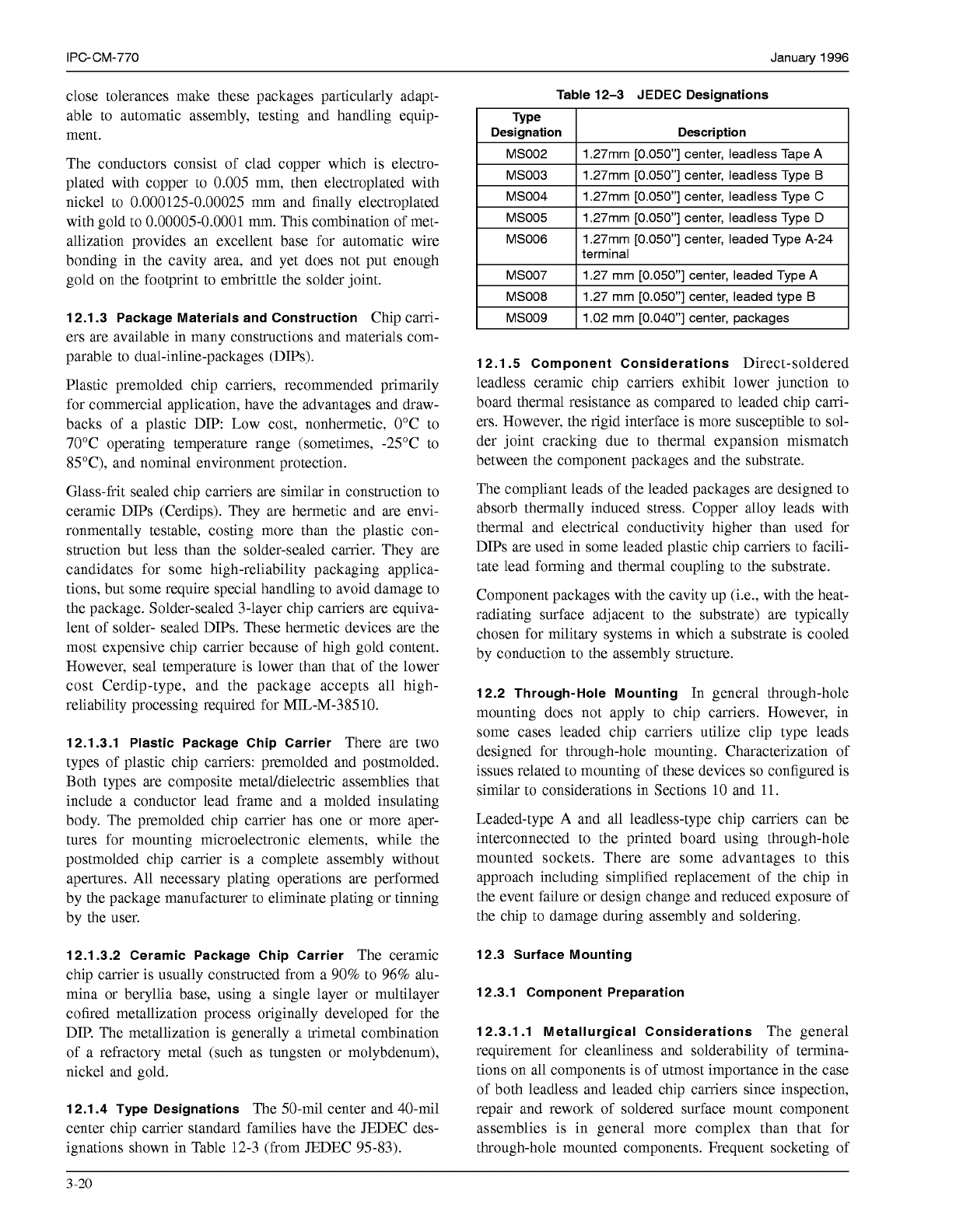
Figure 12-4 Double
Row
Plastic Chip Carrier
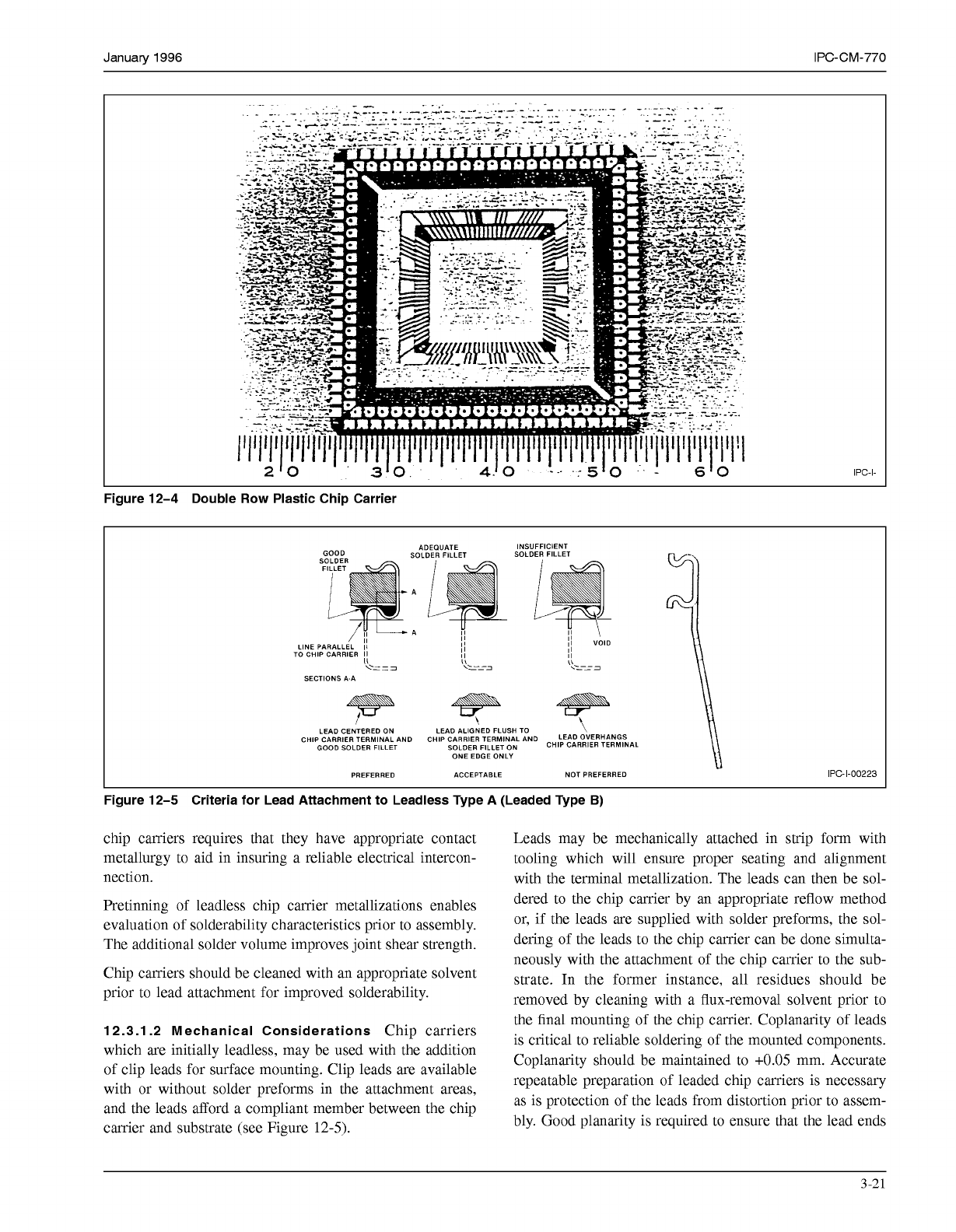
ADEQUATE
GOOD SOLDER FILLET
A
LINE PARALLEL
Il
TO CHIP CARRIER
II
SOLDER FILLET
INSUFFICIENT
LEAD CENTERED ON
GOOD SOLDER FILLET
CHIP CARRIER TERMINAL AND CHIP CARRIER TERMINAL AND
LEAD
OVERHANGS
LEAD ALIGNED FLUSH
TO
\
SOLDER
oN
CHIP CARRIER TERMINAL
\\
ONE EDGE ONLY
PREFERRED ACCEPTABLE NOT PREFERRED
IPC-1-00223
Figure 12-5 Criteria for Lead Attachment to Leadless Type A (Leaded Type
B)
chip carriers requires that they have appropriate contact
metallurgy to aid in insuring a reliable electrical intercon-
nection.
Pretinning of leadless chip carrier metallizations enables
evaluation of solderability characteristics prior to assembly.
The additional solder volume improves joint shear strength.
Chip carriers should be cleaned with an appropriate solvent
prior to lead attachment for improved solderability.
12.3.1.2 Mechanical Considerations
Chip carriers
which are initially leadless, may be used with the addition
of clip leads for surface mounting. Clip leads are available
with or without solder preforms in the attachment areas,
and the leads afford a compliant member between the chip
carrier and substrate (see Figure
12-5).
Leads may be mechanically attached in strip form with
tooling which will ensure proper seating and alignment
with the terminal metallization. The leads can then be sol-
dered to the chip carrier by an appropriate reflow method
or, if the leads are supplied with solder preforms, the sol-
dering of the leads to the chip carrier can be done simulta-
neously with the attachment of the chip carrier to the sub-
strate. In the former instance, all residues should be
removed by cleaning with a flux-removal solvent prior to
the final mounting of the chip carrier. Coplanarity of leads
is critical to reliable soldering of the mounted components.
Coplanarity should be maintained to
+0.05
mm. Accurate
repeatable preparation of leaded chip carriers is necessary
as is protection of the leads from distortion prior to assem-
bly. Good planarity is required to ensure that the lead ends
3-21
COPYRIGHT Association Connecting Electronics Industries
Licensed by Information Handling Services
COPYRIGHT Association Connecting Electronics Industries
Licensed by Information Handling Services
IPC-CM-770
Januaty
1996
make adequate contact with substrate solder lands. Flatness
of the substrate is also of concern and needs to be con-
trolled.
12.3.2 Land Patterns
The land patterns used with chip
carriers fall into two main categories, high density and low
density,based on the local routing density associated with
the surface mounted device. The selection, design and posi-
tion of the land geometry in relation to the chip carrier
have a significant impact on the resultant solder joint con-
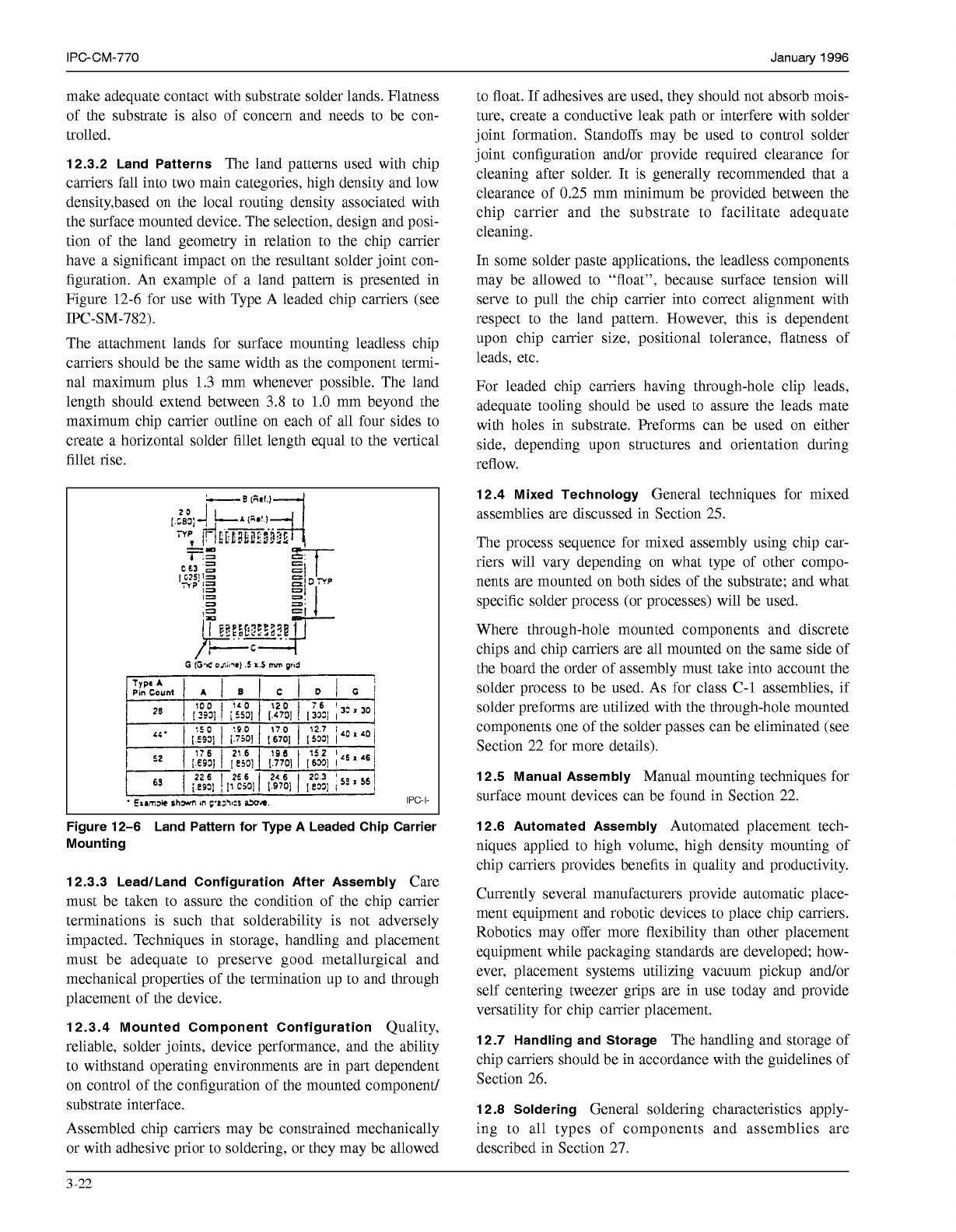
figuration. An example of a land pattern is presented in
Figure 12-6 for use with Type A leaded chip carriers (see
IPC-SM-782).
The attachment lands for surface mounting leadless chip
carriers should be the same width as the component termi-
nal maximum plus 1.3 mm whenever possible. The land
length should extend between 3.8 to
1.0
mm beyond the
maximum chip carrier outline on each of all four sides to
create a horizontal solder fillet length equal to the vertical
fillet rise.
IPC-I-
L
Figure 12-6 Land Pattern for Type A Leaded Chip Carrier
Mounting
12.3.3 LeadlLand Configuration After Assembly
Care
must be taken to assure the condition of the chip carrier
terminations is such that solderability is not adversely
impacted. Techniques in storage, handling and placement
must be adequate to preserve good metallurgical and
mechanical properties of the termination up to and through
placement of the device.
12.3.4 Mounted Component Configuration
Quality,
reliable, solder joints, device performance, and the ability
to withstand operating environments are in part dependent
on control of the configuration of the mounted component/
substrate interface.
Assembled chip carriers may be constrained mechanically
or with adhesive prior to soldering, or they may be allowed
to float.
If
adhesives are used, they should not absorb mois-
ture, create a conductive leak path or interfere with solder
joint formation. Standoffs may be used to control solder
joint configuration and/or provide required clearance for
cleaning after solder. It is generally recommended that a
clearance of 0.25 mm minimum be provided between the
chip carrier and the substrate to facilitate adequate
cleaning.
In some solder paste applications, the leadless components
may be allowed to “float”, because surface tension will
serve to pull the chip carrier into correct alignment with
respect to the land pattern. However, this is dependent
upon chip carrier size, positional tolerance, flatness of
leads, etc.
For leaded chip carriers having through-hole clip leads,
adequate tooling should be used to assure the leads mate
with holes in substrate. Preforms can be used on either
side, depending upon structures and orientation during
reflow.
12.4 Mixed Technology
General techniques for mixed
assemblies are discussed in Section 25.
The process sequence for mixed assembly using chip car-
riers will vary depending on what type of other compo-
nents are mounted on both sides of the substrate; and what
specific solder process (or processes) will be used.
Where through-hole mounted components and discrete
chips and chip carriers are all mounted on the same side of
the board the order of assembly must take into account the
solder process to be used. As for class C-1 assemblies, if
solder preforms are utilized with the through-hole mounted
components one of the solder passes can be eliminated (see
Section 22 for more details).
12.5 Manual Assembly
Manual mounting techniques for
surface mount devices can be found in Section 22.
12.6 Automated Assembly
Automated placement tech-
niques applied to high volume, high density mounting of
chip carriers provides benefits in quality and productivity.
Currently several manufacturers provide automatic place-
ment equipment and robotic devices to place chip carriers.
Robotics may offer more flexibility than other placement
equipment while packaging standards are developed; how-
ever, placement systems utilizing vacuum pickup and/or
self centering tweezer grips are in use today and provide
versatility for chip carrier placement.
12.7 Handling and Storage
The handling and storage of
chip carriers should be in accordance with the guidelines of
Section 26.
12.8 Soldering
General soldering characteristics apply-
ing to all types of components and assemblies are
described in Section 27.
3
-22
COPYRIGHT Association Connecting Electronics Industries
Licensed by Information Handling Services
COPYRIGHT Association Connecting Electronics Industries
Licensed by Information Handling Services