IPC-CM-770D-1996.pdf - 第152页
IPC-CM-770 Januaty 1996 4. After the soldering cycle time at temperature is com- pleted, the power supplies are deactivated and airjets, directed at the heater bars, are activated. Meanwhile, the heater bars maintain the…
January
1996
IPC-CM-770
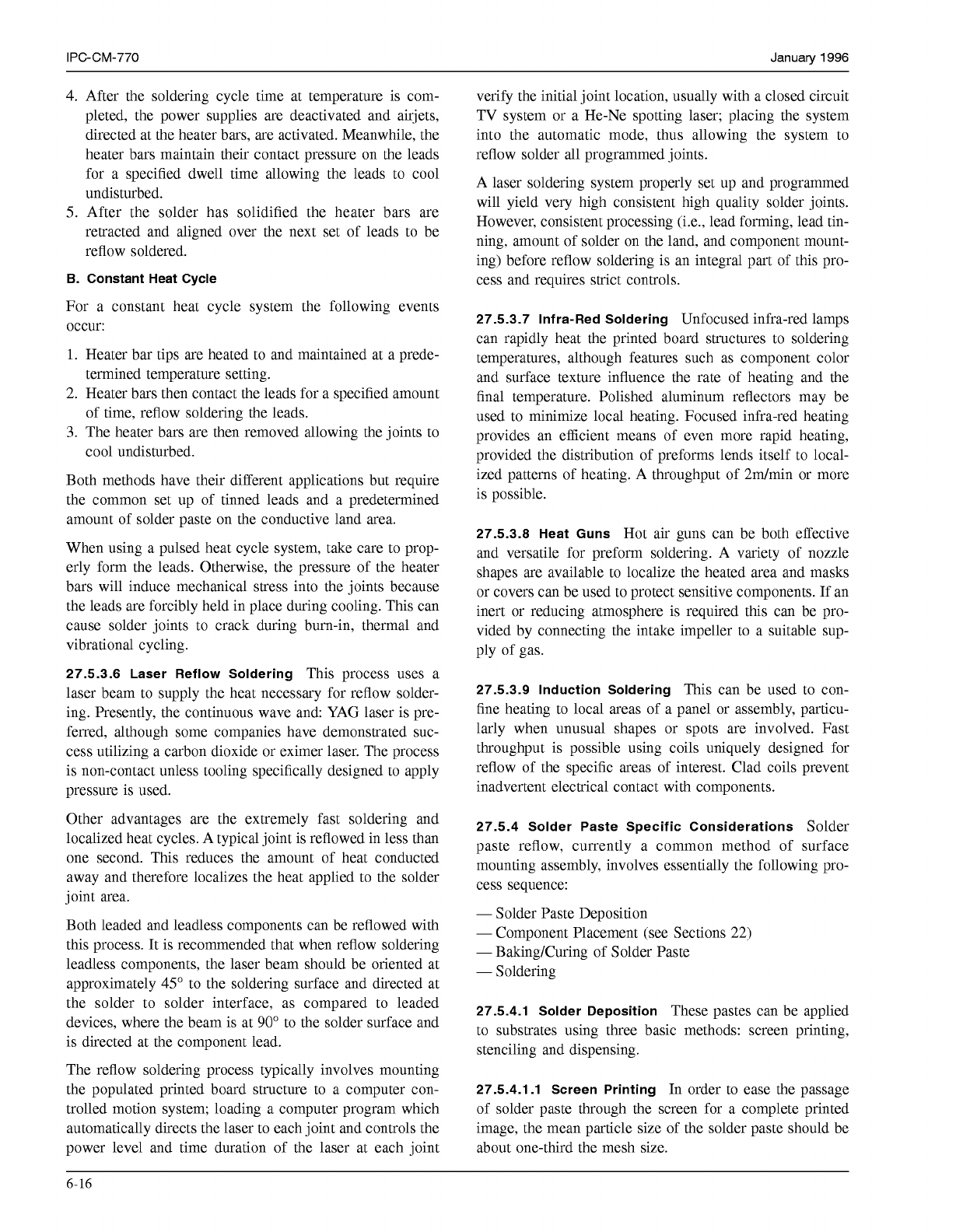
gas used. An oxygen concentration less than
100
ppm has
been found to provide excellent soldering results. Nitrogen
consumption varies depending on the length of machine,
soldering work load, and type of entrylexit interlock sys-
tem employed. The use of atmosphere soldering systems
can produce the following benefits:
-
improved soldering yields
-
reduced flux consumption
-
improved solder joint appearance
-
improved solder joint geometries
-
improved flux residue removability
-
reduced machine maintenance
27.5.3 Reflow Soldering
Several different processes for
flow melting solder pastes involve either vapor-phase
reflow soldering, conduction-reflow belt soldering, infrared
heating, forced hot gas convection, wave soldering, heated
bar soldering, etc.
27.5.3.1 Vapor-Phase Soldering
Although each of the
above techniques can produce acceptable results, vapor-
phase soldering is an extremely consistent soldering pro-
cess because the soldering temperature is maintained con-
stantly at the boiling point of the primary liquid. Also,
vapor-phase soldering can solder both sides of a printed
board structure simultaneously.
The process uses a perfluorinated liquid which is heated to
its boiling point, creating a saturated vapor zone. At atmo-
spheric pressure, the temperature of the saturated vapor is
the same as the boiling liquid. Typically, a perfluorinated
fluid with a working temperature of 215°C is used for
eutectic grade solder. Fluids with other boiling tempera-
tures are available for lower or higher solder compositions,
in multistep soldering, or for use with pure tin.
The soldering process moves the populated printed board
structure into the vapor zone using either a vertically oper-
ating baton system or a conveyorized in-line system. In
either configuration, reflow cycle times of 30 to
60
seconds
are common.
The printed board structures come out of the soldering pro-
cess uniformly soldered and dry. The uniformity results
from the inert, oxygen-free conditions in the vapor and the
precise maximum temperature limitations of the process.
27.5.3.2 Conduction-Reflow Belt Soldering
A
conduction-reflow belt system uses conduction to transfer
heat through the printed board structure. This is accom-
plished by a series of heated platens located under a
continuously-moving belt.
The platen temperature and belt speed are individually con-
trolled
so
that the reflow profile can be varied for different
types of printed board structures, which may have different
melting temperatures. Since heat is conducted through the
board, a thermal gradient exists across the printed board
structure. The cooling rate can also be varied by increasing
or decreasing the flow of air over the belt as the assemblies
travel off the end of the final platen.
Because the conduction of the heat through the printed
board structure depends on the contact of the structure to
the belt, a weighted fixture is usually used to apply pres-
sure to multiple points on the structure. This pressure is
applied from the primary side of the printed board structure
and is designed not to interfere with the chip carriers on
that side. Universal fixtures are usually designed for mul-
tiple printed board structures.
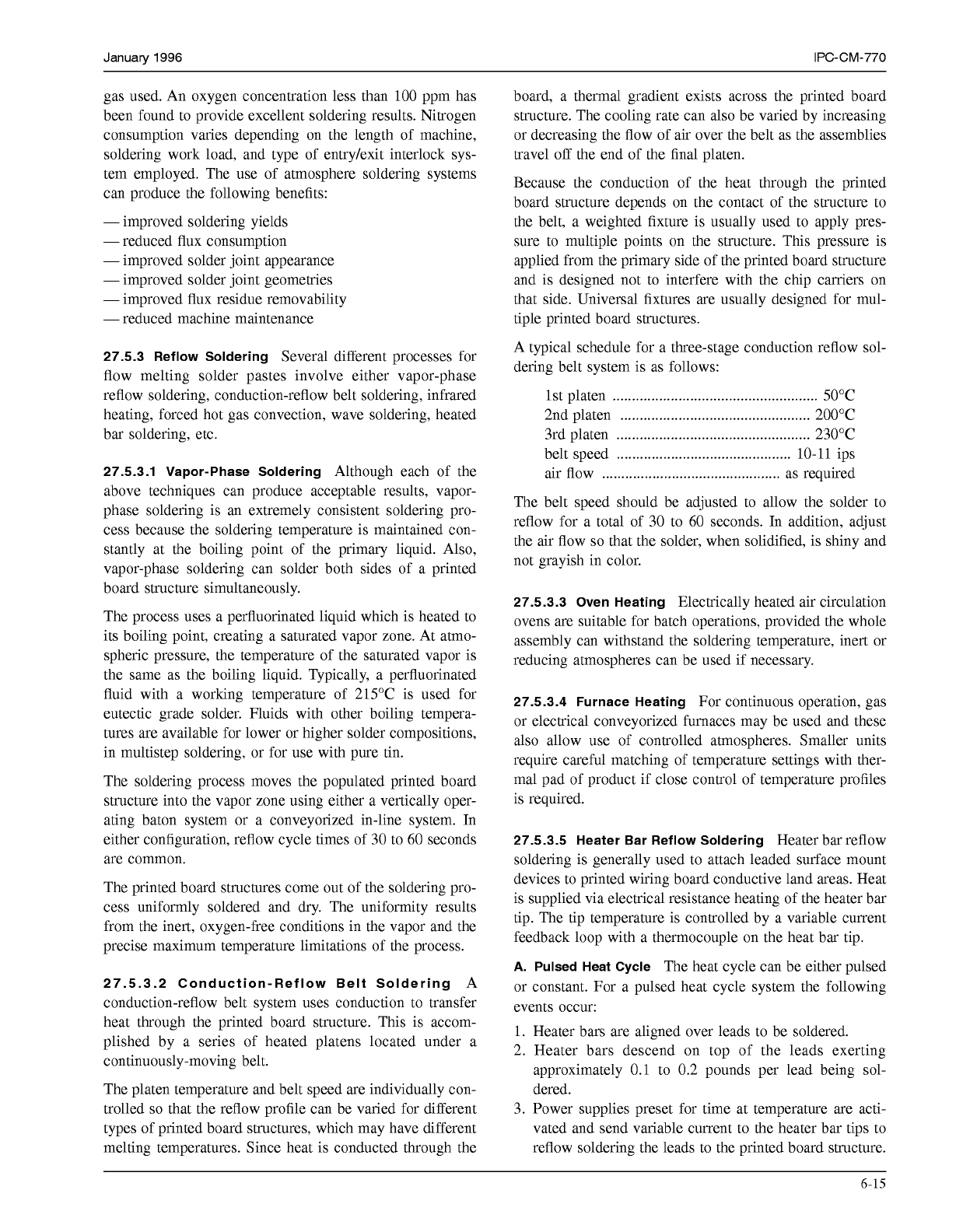
A typical schedule for a three-stage conduction reflow sol-
dering belt system is as follows:
Ist platen
.....................................................
50°C
2nd platen
.................................................
200°C
3rd platen
..................................................
230°C
belt speed
.............................................
10-11
ips
air flow
..............................................
as required
The belt speed should be adjusted to allow the solder to
reflow for a total of 30 to
60
seconds. In addition, adjust
the air flow
so
that the solder, when solidified, is shiny and
not grayish in color.
27.5.3.3 Oven Heating
Electrically heated air circulation
ovens are suitable for batch operations, provided the whole
assembly can withstand the soldering temperature, inert or
reducing atmospheres can be used if necessary.
27.5.3.4 Furnace Heating
For continuous operation, gas
or electrical conveyorized furnaces may be used and these
also allow use of controlled atmospheres. Smaller units
require careful matching of temperature settings with ther-
mal pad of product if close control of temperature profiles
is required.
27.5.3.5 Heater Bar Reflow Soldering
Heater bar reflow
soldering is generally used to attach leaded surface mount
devices to printed wiring board conductive land areas. Heat
is supplied via electrical resistance heating of the heater bar
tip. The tip temperature is controlled by a variable current
feedback loop with a thermocouple on the heat bar tip.
A.
Pulsed Heat Cycle
The heat cycle can be either pulsed
or constant. For a pulsed heat cycle system the following
events occur:
1.
Heater bars are aligned over leads to be soldered.
2. Heater bars descend on top of the leads exerting
approximately
0.1
to 0.2 pounds per lead being sol-
dered.
3. Power supplies preset for time at temperature are acti-
vated and send variable current to the heater bar tips to
reflow soldering the leads to the printed board structure.
6-15
COPYRIGHT Association Connecting Electronics Industries
Licensed by Information Handling Services
COPYRIGHT Association Connecting Electronics Industries
Licensed by Information Handling Services
IPC-CM-770
Januaty
1996
4.
After the soldering cycle time at temperature is com-
pleted, the power supplies are deactivated and airjets,
directed at the heater bars, are activated. Meanwhile, the
heater bars maintain their contact pressure on the leads
for a specified dwell time allowing the leads to cool
undisturbed.
5.
After the solder has solidified the heater bars are
retracted and aligned over the next set of leads to be
reflow soldered.
B.
Constant Heat Cycle
For a constant heat cycle system the following events
occur:
Heater bar tips are heated to and maintained at a prede-
termined temperature setting.
Heater bars then contact the leads for a specified amount
of time, reflow soldering the leads.
The heater bars are then removed allowing the joints to
cool undisturbed.
Both methods have their different applications but require
the common set up of tinned leads and a predetermined
amount of solder paste on the conductive land area.
When using a pulsed heat cycle system, take care to prop-
erly form the leads. Otherwise, the pressure of the heater
bars will induce mechanical stress into the joints because
the leads are forcibly held in place during cooling. This can
cause solder joints to crack during bum-in, thermal and
vibrational cycling.
27.5.3.6 Laser Reflow Soldering
This process uses a
laser beam to supply the heat necessary for reflow solder-
ing. Presently, the continuous wave and YAG laser is pre-
ferred, although some companies have demonstrated suc-
cess utilizing a carbon dioxide or eximer laser. The process
is non-contact unless tooling specifically designed to apply
pressure is used.
Other advantages are the extremely fast soldering and
localized heat cycles. A typical joint is reflowed in less than
one second. This reduces the amount of heat conducted
away and therefore localizes the heat applied to the solder
joint area.
Both leaded and leadless components can be reflowed with
this process. It is recommended that when reflow soldering
leadless components, the laser beam should be oriented at
approximately
45"
to the soldering surface and directed at
the solder to solder interface, as compared to leaded
devices, where the beam is at
90"
to the solder surface and
is directed at the component lead.
The reflow soldering process typically involves mounting
the populated printed board structure to a computer con-
trolled motion system; loading a computer program which
automatically directs the laser to each joint and controls the
power level and time duration of the laser at each joint
verify the initial joint location, usually with a closed circuit
TV system or a He-Ne spotting laser; placing the system
into the automatic mode, thus allowing the system to
reflow solder all programmed joints.
A laser soldering system properly set up and programmed
will yield very high consistent high quality solder joints.
However, consistent processing (i.e., lead forming, lead tin-
ning, amount of solder on the land, and component mount-
ing) before reflow soldering is an integral part of this pro-
cess and requires strict controls.
27.5.3.7 Infra-Red Soldering
Unfocused infra-red lamps
can rapidly heat the printed board structures to soldering
temperatures, although features such as component color
and surface texture influence the rate of heating and the
final temperature. Polished aluminum reflectors may be
used to minimize local heating. Focused infra-red heating
provides an efficient means of even more rapid heating,
provided the distribution of preforms lends itself to local-
ized patterns of heating. A throughput of 2dmin or more
is possible.
27.5.3.8 Heat Guns
Hot air guns can be both effective
and versatile for preform soldering. A variety of nozzle
shapes are available to localize the heated area and masks
or covers can be used to protect sensitive components. If an
inert or reducing atmosphere is required this can be pro-
vided by connecting the intake impeller to a suitable sup-
ply of gas.
27.5.3.9 Induction Soldering
This can be used to con-
fine heating to local areas of a panel or assembly, particu-
larly when unusual shapes or spots are involved. Fast
throughput is possible using coils uniquely designed for
reflow of the specific areas of interest. Clad coils prevent
inadvertent electrical contact with components.
27.5.4 Solder Paste Specific Considerations
Solder
paste reflow, currently a common method of surface
mounting assembly, involves essentially the following pro-
cess sequence:
-
Solder Paste Deposition
-
Component Placement (see Sections 22)
-
BakingKuring of Solder Paste
-
Soldering
27.5.4.1 Solder Deposition
These pastes can be applied
to substrates using three basic methods: screen printing,
stenciling and dispensing.
27.5.4.1.1 Screen Printing
In order to ease the passage
of solder paste through the screen for a complete printed
image, the mean particle size of the solder paste should be
about one-third the mesh size.
6-16
COPYRIGHT Association Connecting Electronics Industries
Licensed by Information Handling Services
COPYRIGHT Association Connecting Electronics Industries
Licensed by Information Handling Services
January
1996
IPC-CM-770
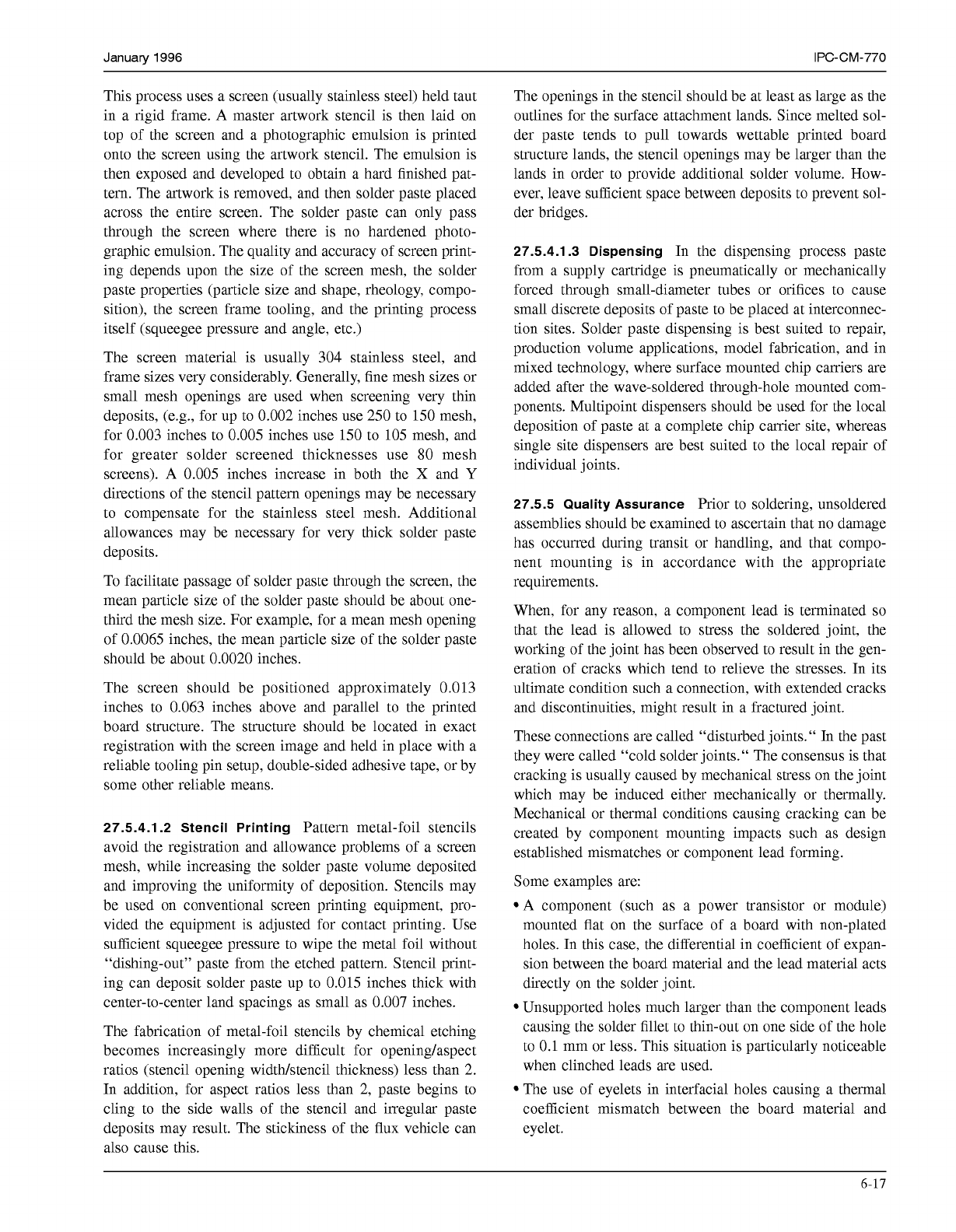
This process uses a screen (usually stainless steel) held taut
in a rigid frame. A master artwork stencil is then laid on
top of the screen and a photographic emulsion is printed
onto the screen using the artwork stencil. The emulsion is
then exposed and developed to obtain a hard finished pat-
tern. The artwork is removed, and then solder paste placed
across the entire screen. The solder paste can only pass
through the screen where there is no hardened photo-
graphic emulsion. The quality and accuracy of screen print-
ing depends upon the size of the screen mesh, the solder
paste properties (particle size and shape, rheology, compo-
sition), the screen frame tooling, and the printing process
itself (squeegee pressure and angle, etc.)
The screen material is usually 304 stainless steel, and
frame sizes very considerably. Generally, fine mesh sizes or
small mesh openings are used when screening very thin
deposits, (e.g., for up to
0.002
inches use
250
to
150
mesh,
for 0.003 inches to
0.005
inches use
150
to
105
mesh, and
for greater solder screened thicknesses use
80
mesh
screens). A
0.005
inches increase in both the
X
and
Y
directions of the stencil pattern openings may be necessary
to compensate for the stainless steel mesh. Additional
allowances may be necessary for very thick solder paste
deposits.
To facilitate passage of solder paste through the screen, the
mean particle size of the solder paste should be about one-
third the mesh size. For example, for a mean mesh opening
of 0.0065 inches, the mean particle size of the solder paste
should be about
0.0020
inches.
The screen should be positioned approximately 0.013
inches to 0.063 inches above and parallel to the printed
board structure. The structure should be located in exact
registration with the screen image and held in place with a
reliable tooling pin setup, double-sided adhesive tape, or by
some other reliable means.
27.5.4.1.2 Stencil Printing
Pattern metal-foil stencils
avoid the registration and allowance problems of a screen
mesh, while increasing the solder paste volume deposited
and improving the uniformity of deposition. Stencils may
be used on conventional screen printing equipment, pro-
vided the equipment is adjusted for contact printing. Use
sufficient squeegee pressure to wipe the metal foil without
“dishing-out’’ paste from the etched pattern. Stencil print-
ing can deposit solder paste up to
0.015
inches thick with
center-to-center land spacings as small as
0.007
inches.
The fabrication of metal-foil stencils by chemical etching
becomes increasingly more difficult for opening/aspect
ratios (stencil opening widthhtencil thickness) less than
2.
In addition, for aspect ratios less than
2,
paste begins to
cling to the side walls of the stencil and irregular paste
deposits may result. The stickiness of the flux vehicle can
also cause this.
The openings in the stencil should be at least as large as the
outlines for the surface attachment lands. Since melted sol-
der paste tends to pull towards wettable printed board
structure lands, the stencil openings may be larger than the
lands in order to provide additional solder volume. How-
ever, leave sufficient space between deposits to prevent sol-
der bridges.
27.5.4.1.3 Dispensing
In the dispensing process paste
from a supply cartridge is pneumatically or mechanically
forced through small-diameter tubes or orifices to cause
small discrete deposits of paste to be placed at interconnec-
tion sites. Solder paste dispensing is best suited to repair,
production volume applications, model fabrication, and in
mixed technology, where surface mounted chip carriers are
added after the wave-soldered through-hole mounted com-
ponents. Multipoint dispensers should be used for the local
deposition of paste at a complete chip carrier site, whereas
single site dispensers are best suited to the local repair of
individual joints.
27.5.5 Quality Assurance
Prior to soldering, unsoldered
assemblies should be examined to ascertain that no damage
has occurred during transit or handling, and that compo-
nent mounting is in accordance with the appropriate
requirements.
When, for any reason, a component lead is terminated
so
that the lead is allowed to stress the soldered joint, the
working of the joint has been observed to result in the gen-
eration of cracks which tend to relieve the stresses. In its
ultimate condition such a connection, with extended cracks
and discontinuities, might result in a fractured joint.
These connections are called “disturbed joints.
“
In the past
they were called “cold solder joints.
“
The consensus is that
cracking is usually caused by mechanical stress on the joint
which may be induced either mechanically or thermally.
Mechanical or thermal conditions causing cracking can be
created by component mounting impacts such as design
established mismatches or component lead forming.
Some examples are:
A component (such as a power transistor or module)
mounted flat on the surface of a board with non-plated
holes. In this case, the differential in coefficient of expan-
sion between the board material and the lead material acts
directly on the solder joint.
Unsupported holes much larger than the component leads
causing the solder fillet to thin-out on one side of the hole
to
0.1
mm or less. This situation is particularly noticeable
when clinched leads are used.
The use of eyelets in interfacial holes causing a thermal
coefficient mismatch between the board material and
eyelet.
6-17
COPYRIGHT Association Connecting Electronics Industries
Licensed by Information Handling Services
COPYRIGHT Association Connecting Electronics Industries
Licensed by Information Handling Services