IPC-CM-770D-1996.pdf - 第75页
January 1996 IPC-CM-770 Figure 15-1 2 Surface Mount Receptacle Figure 15-1 3 Box-contact Surface Mount Receptacle A. Stake-to-the-Board Devices that are mounted horizon- tally or vertically. They are usually manufactured…
IPC-CM-770
Januaty
1996
15.1
O
Soldering
Care must be taken
so
that flux or sol-
der does not wick up into the contact. Some manufacturers
provide anti-wicking devices to prevent flux or solder
wicking.
If
connectors are not mechanically secured to the
board, suitable fixturing should be provided to prevent lift-
ing during soldering. This is especially important with
small lightweight connectors. General soldering guidelines
are discussed in Section
27.
15.1 1 Cleaning
Cleaning agents used after soldering
should not have any harmful effects upon the connector
housing material. Check with the connector manufacturer
to verify the compatibility of any cleaning agent with the
connector housing material. Any residue left on the contact
surfaces must be removed. When possible the open end of
the connector should be turned with the opening downward
so
that the cleaning agent can drain out of the connector
body to facilitate drying.
Ideally, connectors should be provided with standoffs and
should not have blind holes, to permit cleaning agent to
pass between the connector and the printed board.
15.1
2
Coating
Care must be exercised to prevent coat-
ings from getting on the contact surfaces. Wicking can
present a problem, and it may be necessary to seal around
the connector to prevent it.
cessing temperature extremes.
Two classes of sockets are available; namely, low insertion
force and zero insertion force. Low insertion force
describes disconnects where the insertionlextraction forces
associated with the normal forces and component loading
actions are present. Since the magnitude of the force is
additive and related to the number of leads per device, the
maximum size of socket is limited. In situations where high
forcelpin counts are encountered, zero insertion force con-
nectors are used. These are characterized by the presence
of a cdlever arrangement which relieves the normal force
created by the fixed spring segments of connectors.
Synonymous with this is the implication that appropriate
clearances must be provided for the camllever actuation.
The use of a socket carries the inherent cautions associated
most component namely:
Assembly reliability does not deteriorate as a result of
process incompatibility.
Contaminants are not trapped to promote the degradation
of materials in the system.
Proper selection by engineering.
Added costs.
Sockets may be classified in two categories; namely, dis-
IPC-I-
L
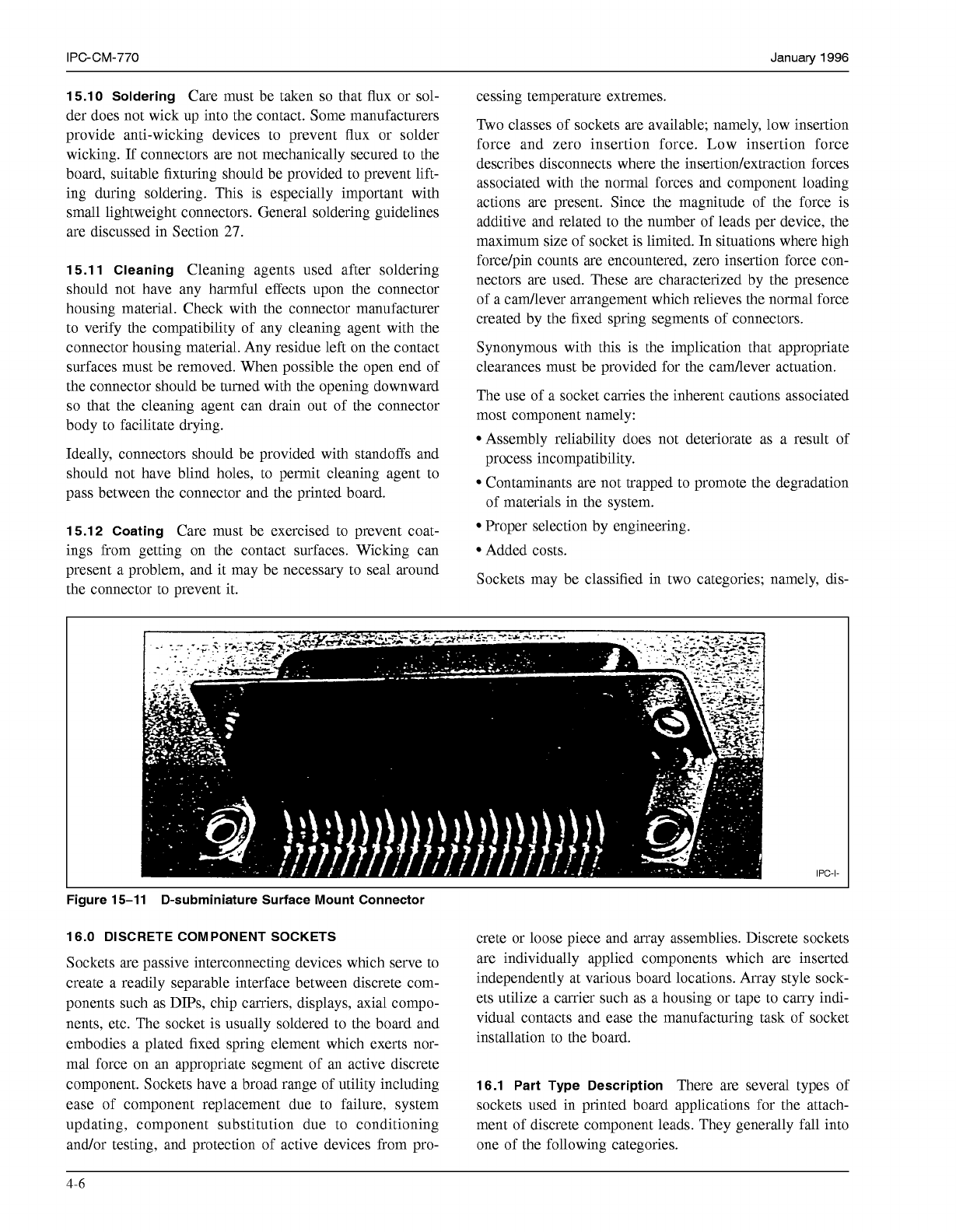
Figure 15-11 D-subminiature Surface Mount Connector
16.0 DISCRETE COMPONENT SOCKETS
Sockets are passive interconnecting devices which serve to
create a readily separable interface between discrete com-
ponents such as DIPS, chip carriers, displays, axial compo-
nents, etc. The socket is usually soldered to the board and
embodies a plated fixed spring element which exerts nor-
mal force on an appropriate segment of an active discrete
component. Sockets have a broad range of utility including
ease of component replacement due to failure, system
updating, component substitution due to conditioning
andor testing, and protection of active devices from pro-
Crete or loose piece and array assemblies. Discrete sockets
are individually applied components which are inserted
independently at various board locations. Array style sock-
ets utilize a carrier such as a housing or tape to carry indi-
vidual contacts and ease the manufacturing task of socket
installation to the board.
16.1 Part Type Description
There are several types of
sockets used in printed board applications for the attach-
ment of discrete component leads. They generally fall into
one of the following categories.
4-6
COPYRIGHT Association Connecting Electronics Industries
Licensed by Information Handling Services
COPYRIGHT Association Connecting Electronics Industries
Licensed by Information Handling Services
January
1996
IPC-CM-770
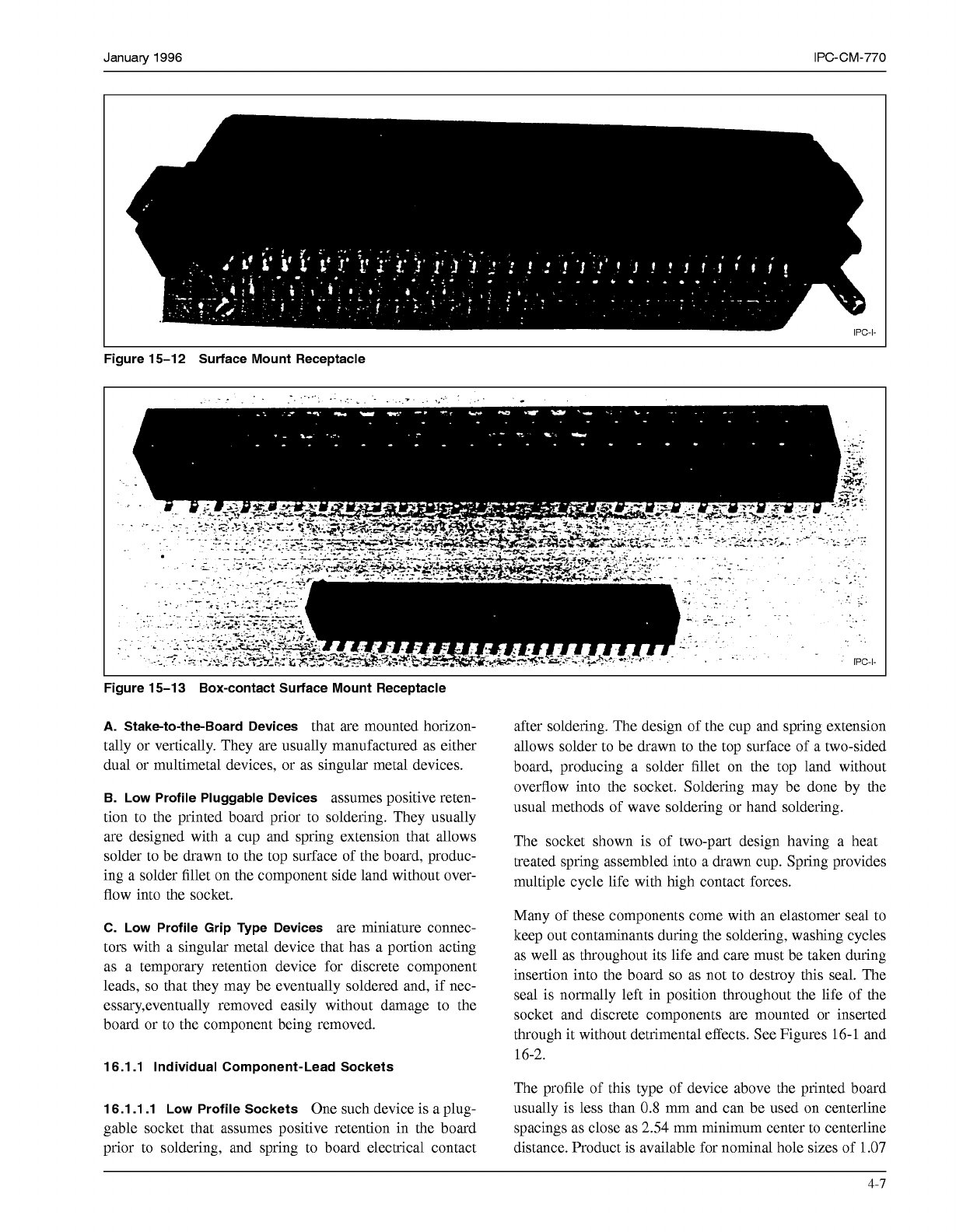
Figure 15-1
2
Surface Mount Receptacle
Figure 15-1
3
Box-contact Surface Mount Receptacle
A.
Stake-to-the-Board Devices
that are mounted horizon-
tally or vertically. They are usually manufactured as either
dual or multimetal devices, or as singular metal devices.
B. Low Profile Pluggable Devices
assumes positive reten-
tion to the printed board prior to soldering. They usually
are designed with a cup and spring extension that allows
solder to be drawn to the top surface of the board, produc-
ing a solder fillet on the component side land without over-
flow into the socket.
C. Low Profile Grip Type Devices
are miniature connec-
tors with a singular metal device that has a portion acting
as a temporary retention device for discrete component
leads,
so
that they may be eventually soldered and, if nec-
essary,eventually removed easily without damage to the
board or to the component being removed.
16.1.1 Individual Component-Lead Sockets
16.1.1.1 Low Profile Sockets
One such device is a plug-
gable socket that assumes positive retention in the board
prior to soldering, and spring to board electrical contact
after soldering. The design of the cup and spring extension
allows solder to be drawn to the top surface of a two-sided
board, producing a solder fillet on the top land without
overflow into the socket. Soldering may be done by the
usual methods of wave soldering or hand soldering.
The socket shown is of two-part design having a heat
treated spring assembled into a drawn cup. Spring provides
multiple cycle life with high contact forces.
Many of these components come with an elastomer seal to
keep out contaminants during the soldering, washing cycles
as well as throughout its life and care must be taken during
insertion into the board
so
as not to destroy this seal. The
seal is normally left in position throughout the life of the
socket and discrete components are mounted or inserted
through it without detrimental effects. See Figures 16-1 and
16-2.
The profile of this type of device above the printed board
usually is less than
0.8
mm and can be used on centerline
spacings as close as 2.54 mm minimum center to centerline
distance. Product is available for nominal hole sizes of
1.07
4-1
COPYRIGHT Association Connecting Electronics Industries
Licensed by Information Handling Services
COPYRIGHT Association Connecting Electronics Industries
Licensed by Information Handling Services
IPC-CM-770
Januaty
1996
INSERTED
OMPONENT
ELASTOMERIC
SEAL
P
IPC-1-00238
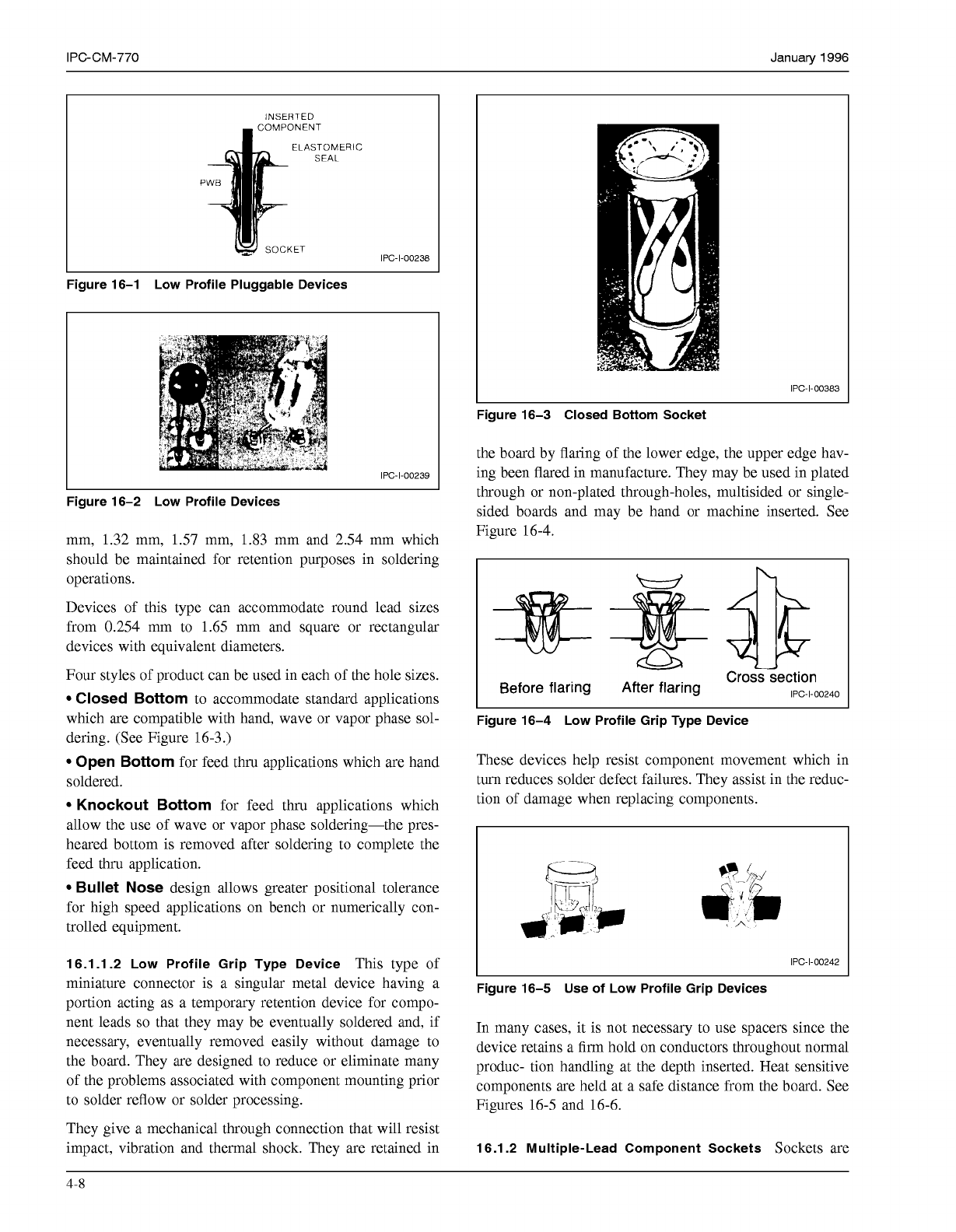
Figure 16-1 Low Profile Pluggable Devices
Figure 16-2 Low Profile Devices
mm, 1.32 mm,
1.57
mm, 1.83 mm and 2.54 mm which
should be maintained for retention purposes in soldering
operations.
Devices of this type can accommodate round lead sizes
from 0.254 mm to 1.65 mm and square or rectangular
devices with equivalent diameters.
Four styles of product can be used in each of the hole sizes.
Closed Bottom
to accommodate standard applications
which are compatible with hand, wave or vapor phase sol-
dering. (See Figure 16-3.)
Open Bottom
for feed thru applications which are hand
soldered.
Knockout Bottom
for feed thru applications which
allow the use of wave or vapor phase soldering-the pres-
heared bottom is removed after soldering to complete the
feed thru application.
Bullet Nose
design allows greater positional tolerance
for high speed applications on bench or numerically con-
trolled equipment.
16.1.1.2 Low Profile Grip Type Device
This type of
miniature connector is a singular metal device having a
portion acting as a temporary retention device for compo-
nent leads
so
that they may be eventually soldered and, if
necessary, eventually removed easily without damage to
the board. They are designed to reduce or eliminate many
of the problems associated with component mounting prior
to solder reflow or solder processing.
They give a mechanical through connection that will resist
impact, vibration and thermal shock. They are retained in
I
IPC-1-00383
Figure 16-3 Closed Bottom Socket
the board by flaring of the lower edge, the upper edge hav-
ing been flared in manufacture. They may be used in plated
through or non-plated through-holes, multisided or single-
sided boards and may be hand or machine inserted. See
Figure 16-4.
I
Before flaring After flaring
Cross
section
IPC-I-O0240
Figure 16-4 Low Profile Grip Type Device
These devices help resist component movement which in
turn reduces solder defect failures. They assist in the reduc-
tion of damage when replacing components.
IPC-I-O0242
I
Figure 16-5 Use of Low Profile Grip Devices
In many cases, it is not necessary to use spacers since the
device retains a firm hold on conductors throughout normal
produc- tion handling at the depth inserted. Heat sensitive
components are held at a safe distance from the board. See
Figures 16-5 and 16-6.
16.1.2 Multiple-Lead Component Sockets
Sockets are
4-8
COPYRIGHT Association Connecting Electronics Industries
Licensed by Information Handling Services
COPYRIGHT Association Connecting Electronics Industries
Licensed by Information Handling Services