00190802-02.pdf - 第228页
8 Product / PCB User’s Manual Line Computer UNIX 8.1 PCB Editor Software Version 402.xx Edition 06/ 96 8 - 10 - Call up the Placement P osition Editor for the definition of placem ent pos ition s (only po ssible in th e …
User’s Manual Line Computer UNIX 8 Product / PCB
Software Version 402.xx Edition 06/96 8.1 PCB Editor
8 - 9
8.1.3.1 FILE Menu
☞
NOTE
Only the first menu option of the menu is described in the following. The functions of the remaining options of
this menu are described in chapter 2.
-
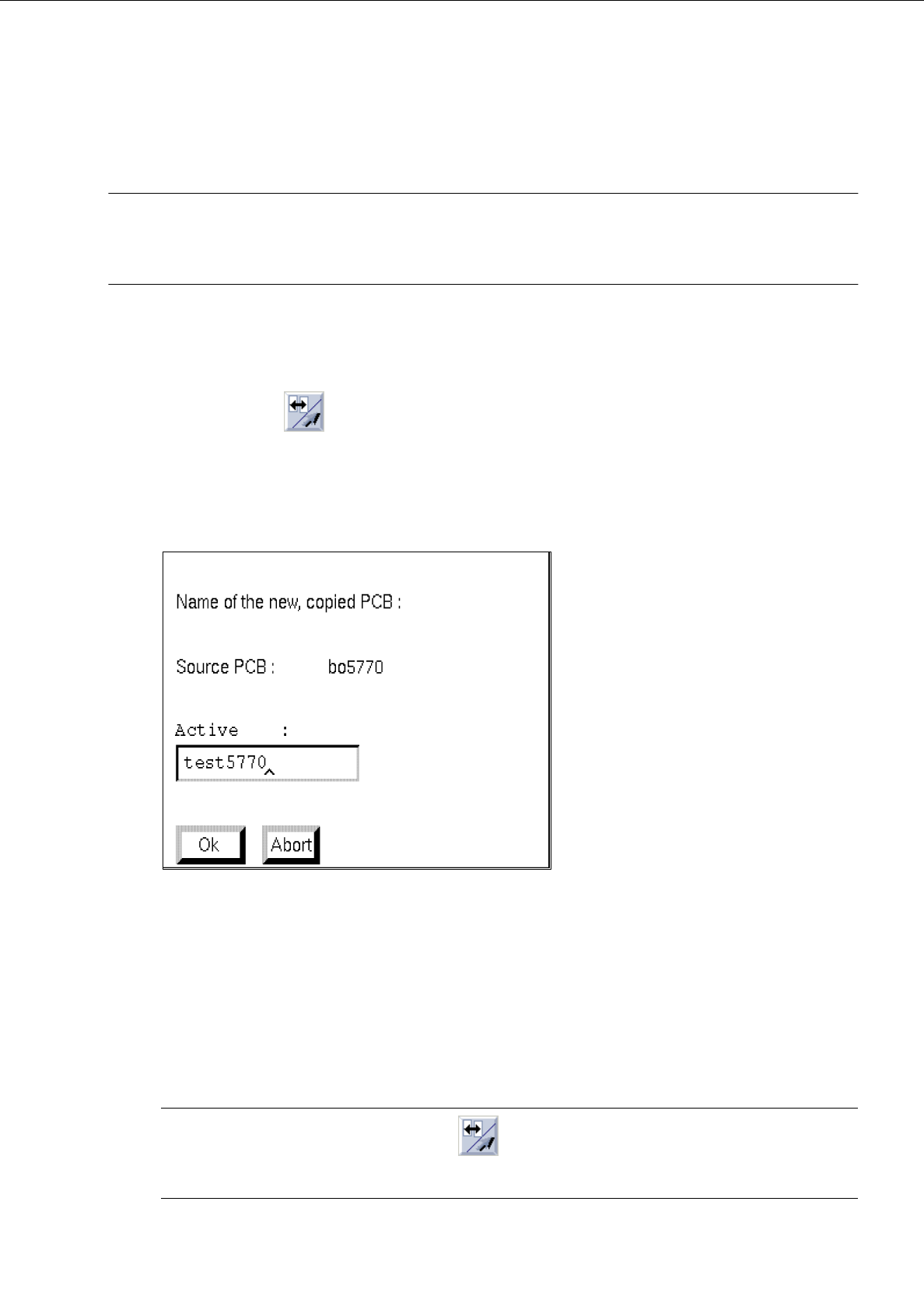
Copying PCB
This function makes it possible to duplicate a currently loaded PCB. All predefined data (placement
positions, cluster, fiducials) will also be copied.
●
Activate icon in the command area.
●
Click on the uppermost partial PCB structure of the PCB structure (see Fig. 8.1.4).
●
Select menu option FILE --> Copy PCB.
The following dialog box appears:
●
Enter the name and confirm with OK.
A second window of the Structure Editor containing the name of the new PCB and the copied
structure are displayed on the screen.
8.1.3.2 SERVICES Menu
The menu options of this menu serve to open the sub-editors for the definition of the cluster data and placement
positions. Moreover, it is possible to toggle between the Structure Mode and Graphic Mode display types.
☞
NOTE
Prior to invoking a menu function, the icon (Connect/Menu) in the command area must be
activated (see Fig. 8.1.4).

8 Product / PCB User’s Manual Line Computer UNIX
8.1 PCB Editor Software Version 402.xx Edition 06/96
8 - 10
-
Call up the
Placement Position Editor
for the definition of placement positions (only possible in the
Structure Mode)
●
In the display area select partial PCB structure with a mouse-click.
●
Select
SERVICES
-->
Placement Position Editor
.
The window of the Placement Position Editor (see Fig. 8.1.11) is opened.
-
Call up the
Cluster Editor
for the definition of the cluster data (only possible in the Structure Mode)
●
In the display area select partial PCB structure with a mouse-click.
●
Select
SERVICES
-->
Cluster Editor
The window of the Cluster Editor (see Fig. 8.1.8) is opened.
-
Structure Mode
This menu option serves to switch the view area from the Graphic Mode to the Structure Mode.
●
Select
SERVICES
-->
Struct. mode
The view area is switched to the Structure Mode (see Fig. 8.1.4).
-
Graphic Mode
This menu option serves to switch the view area from the Structure Mode to the Graphic Mode.
●
Select
SERVICES
-->
Graph. mode
The view area is switched to the Graphic Mode (see Fig. 8.1.6).
-
Call up the
Structure Editor
for the processing of a new PCB
●
Select
SERVICES
-->
Structure Editor...
.
The FSB for the selection of a new PCB is opened (see page 8 - 6).
●
Select PCB and confirm with
OK
.
The structure of the selected PCB is displayed in the display area of the new window.
Or (to obtain an empty window for a new PCB):
●
Enter new name.
The window of the Structure Editor is opened under the name of the new PCB.
8.1.3.3 Command Area of the Structure Editor (Structure Mode)
The commands are symbolized by means of icons. If an icon is activated by clicking upon it, the respective
action can be performed on a partial PCB structure subsequently to be selected.
☞
NOTE
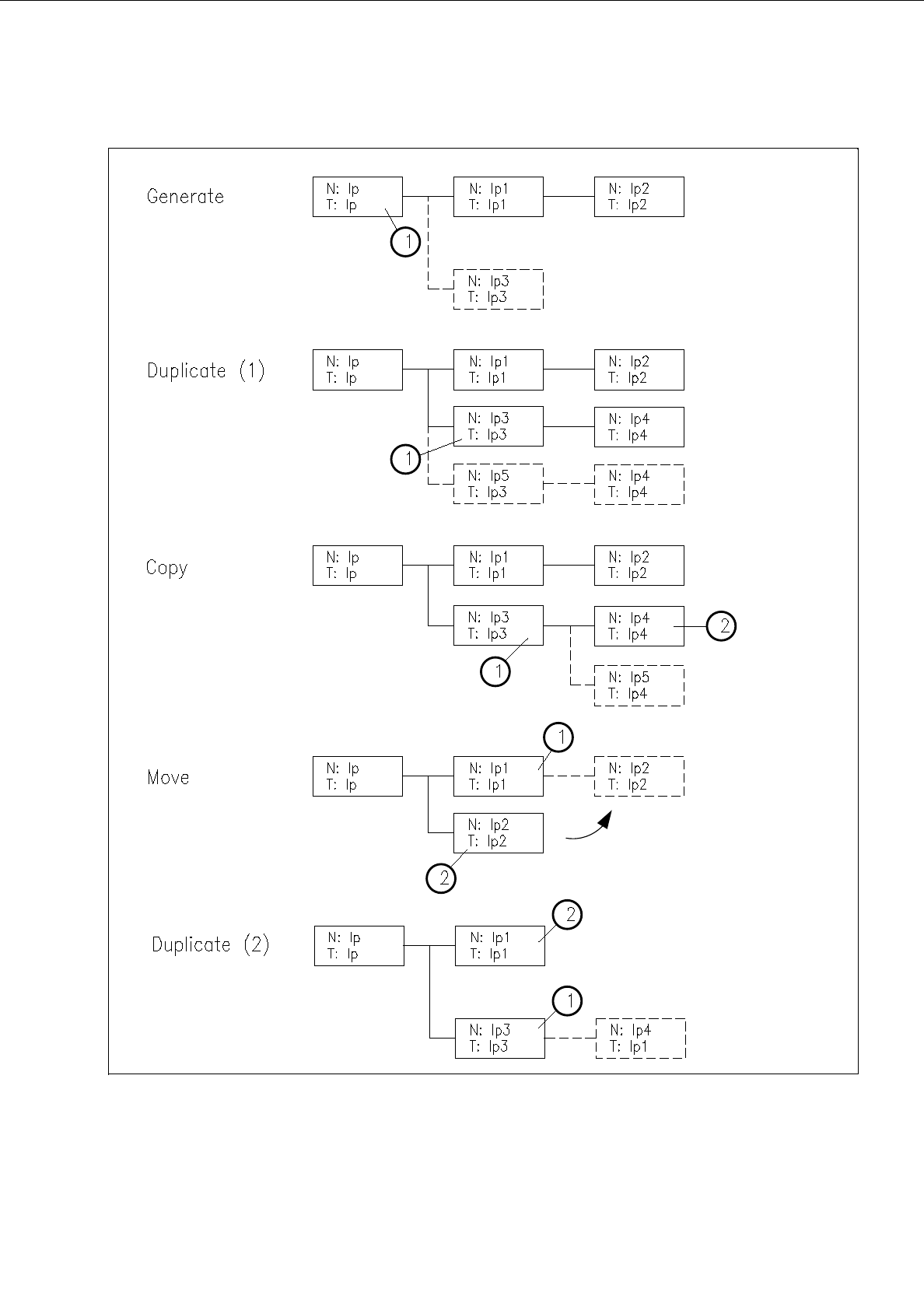
The procedures and results of some of the commands described in the following are shown as examples
in Fig. 8.1.5 where the numbers 1 or 2 indicated in the circles represent the sequence of the steps to be
performed; the structures represented as broken lines stand for the results.
User’s Manual Line Computer UNIX 8 Product / PCB
Software Version 402.xx Edition 06/96 8.1 PCB Editor
8 - 11
Fig. 8.1.5 Examples "Usage and Results of some Commands in the Structure Editor"