80S-20贴片机.pdf - 第325页
SIPLACE 80S-20/F4 Service Manual 9 12-Segment Revolver Head (10000) Edition 07/97 9.6 Star Complete 9 - 29 9.6.4 Removing an d Fitting the Star Motor PLEASE NOT E This wor k may o nly be c arried out by Sieme ns ser vice…

9 12-Segment Revolver Head (10000) SIPLACE 80S-20/F4 Service Manual
9.6 Star Complete Edition 07/97
9 - 28
ATTENTION ∆
!
∆
!
You must be very careful when carrying out this work as otherwise you could pinch or tear away a vacuum
hose.
● Re-insert the vacuum distributor disk (see section 9.4.4).
● Now place the vacuum distributor onto the star with the flat sides facing each other. Pay attention to the
two guide pins.
– Please refer to the adjustment instructions for information on checking the electrical functions.
– Please refer to the Sitest instructions for information on adjusting the entire placement head.
9.6.3 Recording the Zero Point Correction for the Revolver Head Star
Axis
Test equipment
Gauge for star, from item no. 00326164-01
● Load the Sitest program.
● Sitest menu → Axes → Star axis → Modify axis data → Positions → Zero point correction.
● Type 0 into the zero point correction line and carry out a reference run with the axis.
● Disable the star axis and turn the star clockwise until sleeve no. 1 is in the placement position.
● Remove sleeve no. 1.
● Screw the gauge for the star onto the placement head housing.
● Insert the pin through the fork of the gauge for the star and into the segment guide (insert the chamfered
pin end first).
● Sitest menu → Axes → Star axis → Read actual position.
● Press the star axis lightly by hand to the right. Read and make a note of the actual position.
● Now press the star axis lightly by hand to the left. Once again read off and make a note of the actual posi-
tion.
● Calculate the average of the two values you have noted (X1 + X2) / 2.
● Pull the pin out of the segment guide and remove the zero point gauge. Now replace the segment and
switch on the star axis.
● Sitest menu → Axes → Star axis → Modify axis data → Positions → Zero point correction.
● Type in the new zero point correction value.
● Sitest menu → Store MA file → AXMA.DAT.
NOTE
Carry out a reference run with the star axis and check the zero point correction with the zero point gauge.
The deviations from the first and second values should be about the same in the positive and negative direc-
tions of rotation.

SIPLACE 80S-20/F4 Service Manual 9 12-Segment Revolver Head (10000)
Edition 07/97 9.6 Star Complete
9 - 29
9.6.4 Removing and Fitting the Star Motor
PLEASE NOTE
This work may only be carried out by Siemens service technicians or by the customer’s appropriately trained
personnel.
Spare parts
Star drive, from item no. 00319908S01
● Remove the front part of the placement head (see section 9.1.7).
● Remove the complete star (see section 9.6.1).
● Disconnect plug-in connections X13 and X14 from head board C0005.
● Undo the hexagon socket screw (M3 x 8).
● Undo the three hexagon spacer (M3 x 9, M3 x 7 and M3 x 10, see pos. 5, 6 and 7, Fig. 9.3.1, Page 9 - 16.
● Disconnect plug-in connections X3 to X12 from distributor board.
● Carefully pull the hose off the compressed air sensor.
● Undo the four hexagon socket screws (M5 x 16) and remove the star motor (see Fig. 9.6.1).
● When re-installing the star motor, proceed in the reverse sequence of operations.
● Regarding installation of the complete star, see section 9.6.2.
● For recording the star axis zero point correction, see section 9.6.3.
NOTE
The terminals of the motor should point upwards.
9.6.5 Replacing the Forced-Air Unit
Spare parts
Forced-air unit, from item no. 00319777S01
● Remove plug X6 from distributor board.
● Undo the hexagon socket screw (M2 x 10) of the cable holder.
● Pull the compressed air hose off the star assembly.
● Pull the compressed air hose off the Y branch.
● Remove the compressed air hose from the switching valve by undoing the hexagon screw (width across
flats 8).
NOTE
In the case of malfunctions change only the complete forced air unit.
● When re-installing the forced air unit, proceed in the reverse sequence of operations.
9 12-Segment Revolver Head (10000) SIPLACE 80S-20/F4 Service Manual
9.6 Star Complete Edition 07/97
9 - 30
9.6.6 Adjusting the Forced Air Unit
7HVWHTXLSPHQW
– Compressed air testing device, item no. 00313523-01
PLEASE NOTE
The forced air values
that are displayed on the station computer monitor when you select the "Measure forced
air pressure“ option from "Single functions“ or "Test software“ do
QRW
correspond to the air pressures actually
set at the nozzle. They are only used to check that the forced air valve is working correctly.
For this reason, the forced air pressure must
QRW
be set using the values displayed on the monitor. It must
only be set using the compressed air testing device.
The two forced air circuits are activated via a single valve and are thus interdependent.
Nevertheless, various pressures can be set for each circuit using two different flow control valves (see Fig.
9.6.1; points 5 and 6).
6HWWLQJWKH)RUFHG$LU3UHVVXUH9DOXHV8VLQJWKH&RPSUHVVHG$LU7HVWLQJ
'HYLFH
● Load the Sitest program.
● Sitest menu → Head reference run → Close and turn nozzles.
● Sitest menu → Head board → Placement circuit → Switch over forced air.
● Hold the sensor of the compressed air tester against the nozzle (type 714 nozzle recommended) in the
pick-up/placement position.
● Set a value of 0.15 bar for the pick-up/placement circuit (see Fig. 9.6.1; point 5)at the compressed air flow
control.
● Hold the sensor of the compressed air tester against the nozzle in the reject position.
● Set a value of 0.25 bar for the reject circuit (see Fig. 9.6.1; point 6) at the compressed air flow control.
● Repeat the adjustment process several times since the pick-up / placement circuit and the reject circuit are
interdependent.
NOTE
Make sure that the hose of the measurement sensor sits tight on the nozzle.
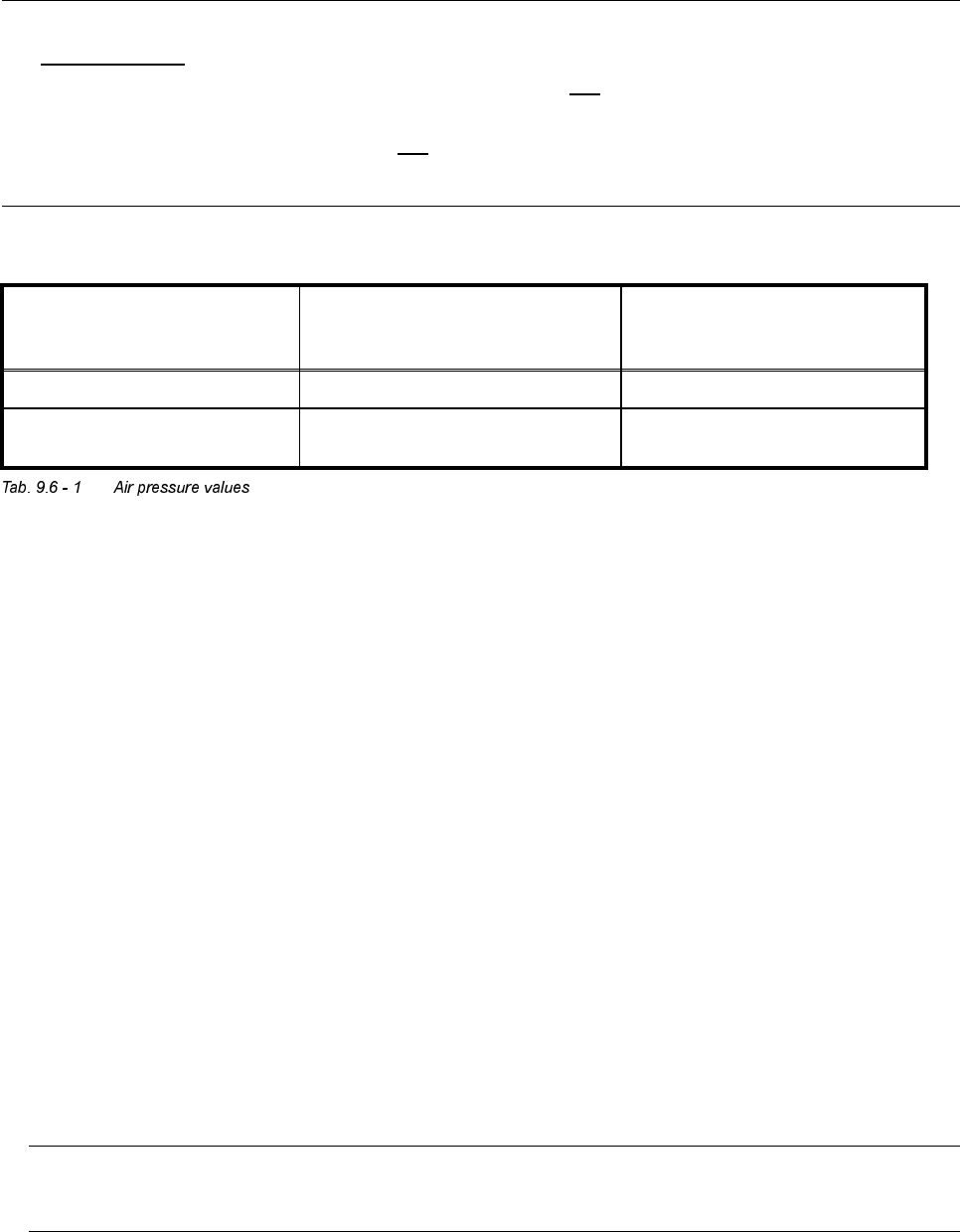
)RUFHGDLUSUHVVXUHYDOXHV
6HWXVLQJWKHFRPSUHVVHGDLUWHVW
LQJGHYLFH
0HDVXUHGDWWKHQR]]OH
'LVSOD\HGRQWKHPRQLWRU
,QSLFNXSSODFHPHQWFLUFXLW
RQO\
Pick-up / placement circuit: 150 mbar (100 – 200 mbar) e.g.: 250 mbar
Reject circuit: 250 mbar (200 – 300 mbar)
There is no sensor
in the reject circuit