182050 User manual.pdf - 第202页
semi automatic ',163(&7,21 237,216$)7 (5$1 ,163(& 7,21$/ $50 7.28 User Manual Software Ve rsion 07SP02 OPTIONS AFTER AN INSPECTION ALARM The machine st ops at t he first inspect ion alarm. When an insp…
semi automatic
',163(&7,21
6(7837,36
Software Version 07SP02 User Manual 7.27
SETUP TIPS
Setup Problem Guide
No inspection setup available Ensure that 2D Inspection is enabled in Set Prefs.
System not inspecting or inspec-
tion cycle not being carried out
The 2D option may be disabled or 2D inspect rate may equal 0.
Order of Inspection If a particular sequence of site inspection is required, the sites should be selected
as every cycle sites and setup in the sequence required.
Every cycle sites are inspected in the order that they were setup.
General sites are inspected in an order that depends on their position and their
inspection sequence cannot be set.
If at a later date a site is edited the sequence is affected.
Stencil and Board - Cleaning Before
Setup
Before 2D Inspection setup, ensure the stencil and board being used have been
thoroughly cleaned and are free of all paste deposits.
If either are not cleaned thoroughly any remaining smearing, partially blocked
apertures or paste on the board may cause an incorrect setup.
Site Area Accuracy Ensure that when setting site parameters (height, width etc.), the site graphic is
placed around the site to give clearance from the apertures and pads thus
preventing other areas being inspected.
Lighting Conditions If the inspection result is not as expected, it is possible that the site was learnt
under different lighting conditions.
This problem may be resolved by re-learning the site under new lighting
conditions, or by the use of paste scaling for paste present adjustment.
Site Quality The sites selected for inspection should be of good quality.
Sites should not have rounded or chamfered edges or uneven or excessive
tinning, this can lead to misleading results when attempting to learn sites.
Sites Being Lost Ensure that both board and stencil have been learnt.
After adjusting board or stencil site parameters always learn both, further editing
can be done at a later stage.
The number of pads must equal the number of apertures for a successful site.
Inspection Alarms too Frequent
and Unnecessary
This may be a symptom of limits being set too tight.
Relax the limits so that results of an acceptable print produce pass or warning, not
alarm, or use the global limit option or limit options to disable the particular limit
checking.
semi automatic
',163(&7,21
237,216$)7(5$1,163(&7,21$/$50
7.28 User Manual Software Version 07SP02
OPTIONS AFTER AN INSPECTION ALARM
The machine stops at the first inspection alarm. When an inspection alarm
occurs, several menu bar options become available.
The functional description for each option is as follows:
Accept Selecting this option clears the alarm panel and feeds the board out of the
machine, without inspecting further sites.
Inspect More Selecting this option clears the alarm panel and allows the inspection sequence
to continue, until it either completes inspection or raises another alarm.
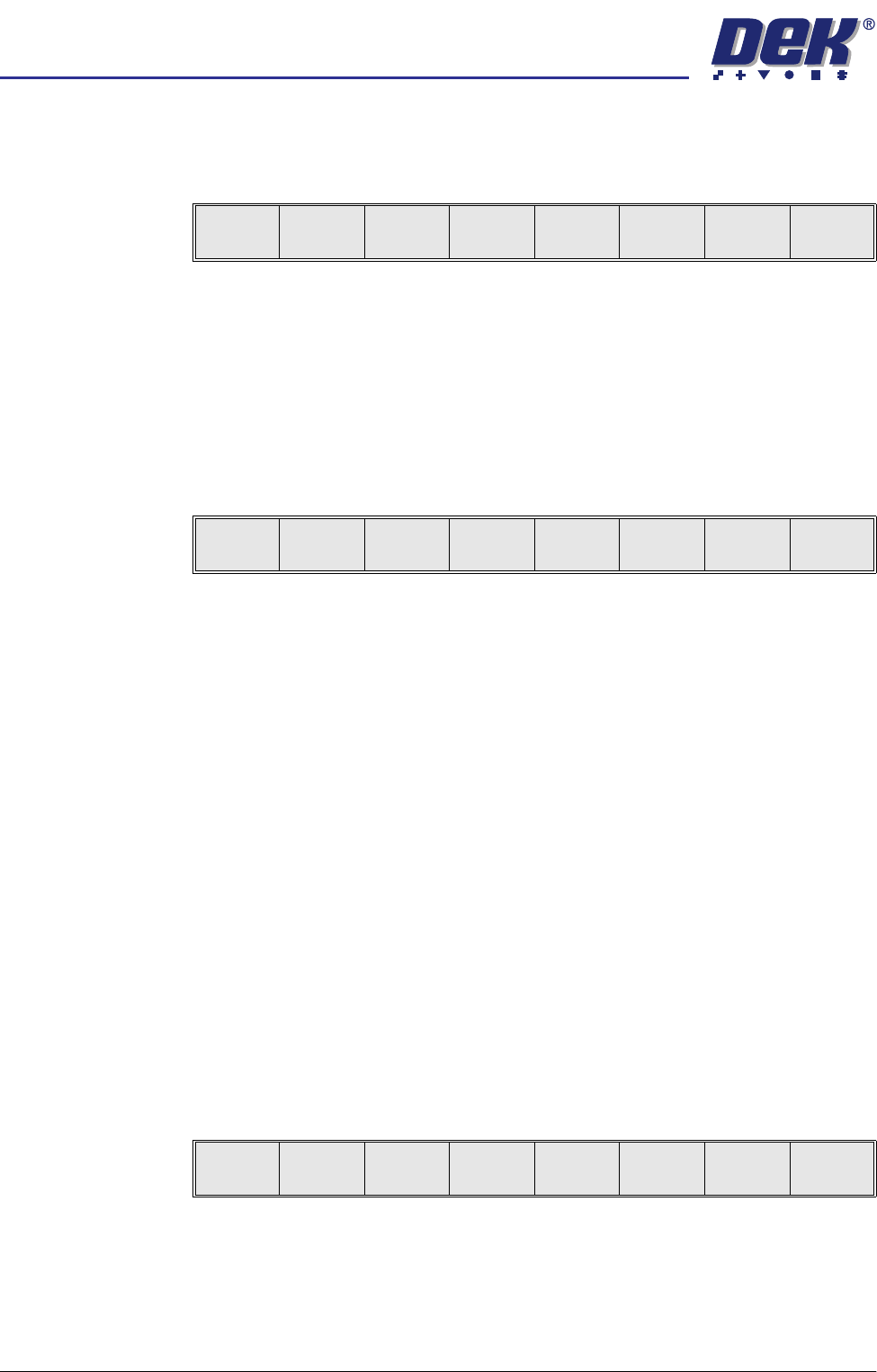
Recovery Action Selecting this option displays the following menu:
The user prompt text shows the following lines:
‘Clean Mode 1 : XXXX’
Where XXXX is the description of the clean mode setting, ie ‘WVWD’ for wet,
vac, wet, dry.
Paste Load Selecting this option initiates a paste load cycle, if a paste dispenser is fitted or
enables paste to be loaded manually.
Re-print Board Selecting this option clears the alarm panel, the board is re-printed and the
inspection sequence is started again from the beginning. All the existing alarm
information is cleared.
NOTE
The Re-print Board button is not available if the current board has already been
re-printed.
Adjust Selecting this option allows the adjustment of process parameters.
Inspect All Selecting this option clears the alarm panel, the inspection sequence is
restarted from the beginning. All the existing alarm information is cleared.
Adjust Inspect Selecting this option displays the following menu:
Edit Global Selecting this option opens the edit global parameters window, allowing param-
eters that are used throughout the inspection to be altered.
Edit Limits Selecting this option opens the limit sets window, allowing a set of limit param-
eters to be selected and altered.
Accept
Inspect
More
Recovery
Action
Adjust
Inspect
All
Adjust
inspect
Reject
Paste
Load
Clean
Mode 1
Re-print
Board
Exit
Edit
Global
Edit
Limits
New Pre-
images
Edit
Site
Inspect
Site
Exit

semi automatic
',163(&7,21
237,216$)7(5$1,163(&7,21$/$50
Software Version 07SP02 User Manual 7.29
New Pre-images Selecting this option initiates a pre-print inspection on the next print cycle to
capture the new pre-images. The message ‘New pre-images will be col-
lected next print cycle’ is displayed.
NOTE
The New Pre-image button is only available if pre-image is set to 1.
Edit Site Selecting this option opens the site parameters window, allowing adjustment of
the site specific parameters.
Inspect Site Selecting this option opens the inspection results window and displays the
following menu:
Selecting Next or Previous moves the highlight up and down the list of site
pads.
Selecting Auto Scale automatically adjusts the paste scaling value for the
current site, to cause the value of paste present, on the pad currently selected
in the inspection result list, to be reported as 100%. This is used where the site
pad causing the alarm is actually a good print.
Reject Selecting this option clears the alarm panel and the board is fed to the output
end of the rail system and held there.
Auto
Scale
Next Previous Exit