00197902-03_UM_X-Serie-S_EN.pdf - 第348页
6 Station extensions User manual SIPLACE X-Series 6.2 PCB barcode scanner From software version 710.0 Edition 12/2016 348 6.2 PCB barcode scanner 6.2.1 Description The PCB barcode reader is used to automatica lly record …
User manual SIPLACE X-Series 6 Station extensions
From software version 710.0 Edition 12/2016 6.1 Nozzle changer
347
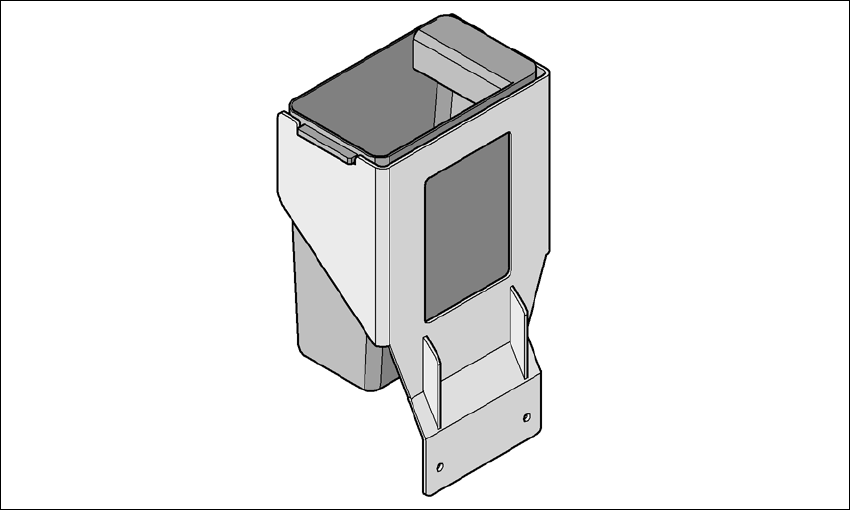
6.1.5.5 Component reject bin for the SIPLACE TwinStar
A component reject bin can be installed for the SIPLACE TwinStar. This is positioned next to the
stationary camera.
6
Fig. 6.1 - 27 Component reject bin for the SIPLACE TwinStar
6.1.5.6 Grippers and special nozzles
The SIPLACE machines can process components based on through hole technology and odd-
shaped (OSC) components, in addition to the standard SMT spectrum. ASM also continuously de-
velops special nozzles and grippers.
Special nozzles are available for all placement heads in order to process placement jobs with max-
imum speed, precision and flexibility. The use of automatic nozzle changers also reduces the
setup times that occur at a product change.
ASM can provide mechanical grippers for Pick&Place heads. If a component's surface is not suit-
able for sucking up with nozzles, then it can be picked up and placed with mechanical grippers.
There are two types of gripper and their functions can be divided into two groups:
– Grippers that grip the component at its outer edges and
– Grippers that grip the component at its inner edge.
Information on special nozzles and grippers is available from ASM. For the production of special
magazines and grippers, again contact ASM.

6 Station extensions User manual SIPLACE X-Series
6.2 PCB barcode scanner From software version 710.0 Edition 12/2016
348
6.2 PCB barcode scanner
6.2.1 Description
The PCB barcode reader is used to automatically record and decode barcodes on PCBs. The
PCB barcode scanners are installed on a special frame on the input side of the placement ma-
chine on the PCB conveyor. Depending on the position of the barcode strips, the barcode scanner
can be attached in a few simple steps so that the strips can be read parallel to or across the PCB
transport direction.
When using dual conveyors, four board barcode readers can be retrofitted. These can scan both
the top or bottom of the boards on both conveyor lanes.
There are two variants of the barcode scanner:
– 2D board code reader
This code reader processes barcodes and matrix codes. Matrix code is primarily used when
there is not enough space for barcode labels. 6
6.2.2 Technical data - 2D code reader
6
Dimensions (L x W x H) 55 mm x 42 mm x 22 mm
Weight 125 grams
Code types 2D Data Matrix ECC 0, 50, 80, 100, 140 and 200
Data Matrix ECC200
QR Code, MicroQR Code
Barcode length
Single conveyor
Dual conveyor, asynchronous
Dual conveyor, synchronous
Max. 40 characters
Max. 40 characters
Max. 40 characters
Data interface RS232, USB 2.0
Electrical connection 15-pin D-Sub HD connector
Operating voltage 5 V- to 24 V-

User manual SIPLACE X-Series 6 Station extensions
From software version 710.0 Edition 12/2016 6.3 Input conveyor and output conveyor extensions
349
6.3 Input conveyor and output conveyor extensions
Item no. 00519971.xx Input conveyor extension for single conveyor
Item no. 00519972.xx Input conveyor extension for dual conveyor
Item no. 00519973.xx Output conveyor extension for single conveyor
Item no. 00519974.xx Output conveyor extension for dual conveyor
6.3.1 Description
The input/output conveyor extensions can be fitted as board buffers between two machines. This
involves fitting an output conveyor extension to the output conveyor of the first placement machine
in the line and an input conveyor extension to the input conveyor of the following placement ma-
chine. This intermediate space serves as a buffer to prevent any waiting time during board trans-
port. The input/output conveyor extensions can also be fitted to the beginning and end of a line.
6
CAUTION
Improved ease of operation for X-Series machines and access to emergency stop button
Always fit an input conveyor extension or an output conveyor extension if the X-Se-
ries placement machine is in the same line as an X-Series machine.