CMV12000_DS000603_6-00.pdf - 第39页
Document Feedback CMV12000 Functional Description Datasheet • PUBLIC DS000603 • v6 - 00 • 2023 -Sep- 22 84 │ 38 7.4.2 Frame Timing The frame rate of the CMV12000 is defined by two main factors. ● Exposure time ● Read-out…
Document Feedback
CMV12000
Functional Description
Datasheet • PUBLIC
DS000603 • v6-00 • 2023-Sep-22
84 │ 37
Reg. Name
Address
Bits
Default
Description
Exp_time
71
72
[15:0]
[7:0]
1536
Sets the exposure time in Internal Exposure Mode
using the formula below.
The formula to calculate the actual exposure time in internal exposure mode from the programmed
registers is given by:
Equation 1:
The minimal exposure times when running at 600 MHz in internal mode will therefore be:
Figure 40:
Minimum Exposure Times in Internal Exposure Mode
When using external exposure mode, the actual exposure time will be given by:
Equation 2:
The time between the T_EXP and FRAME_REQ pulses will be clocked to a multiple of
(LVDS_CLK_P/N_period * #bits).
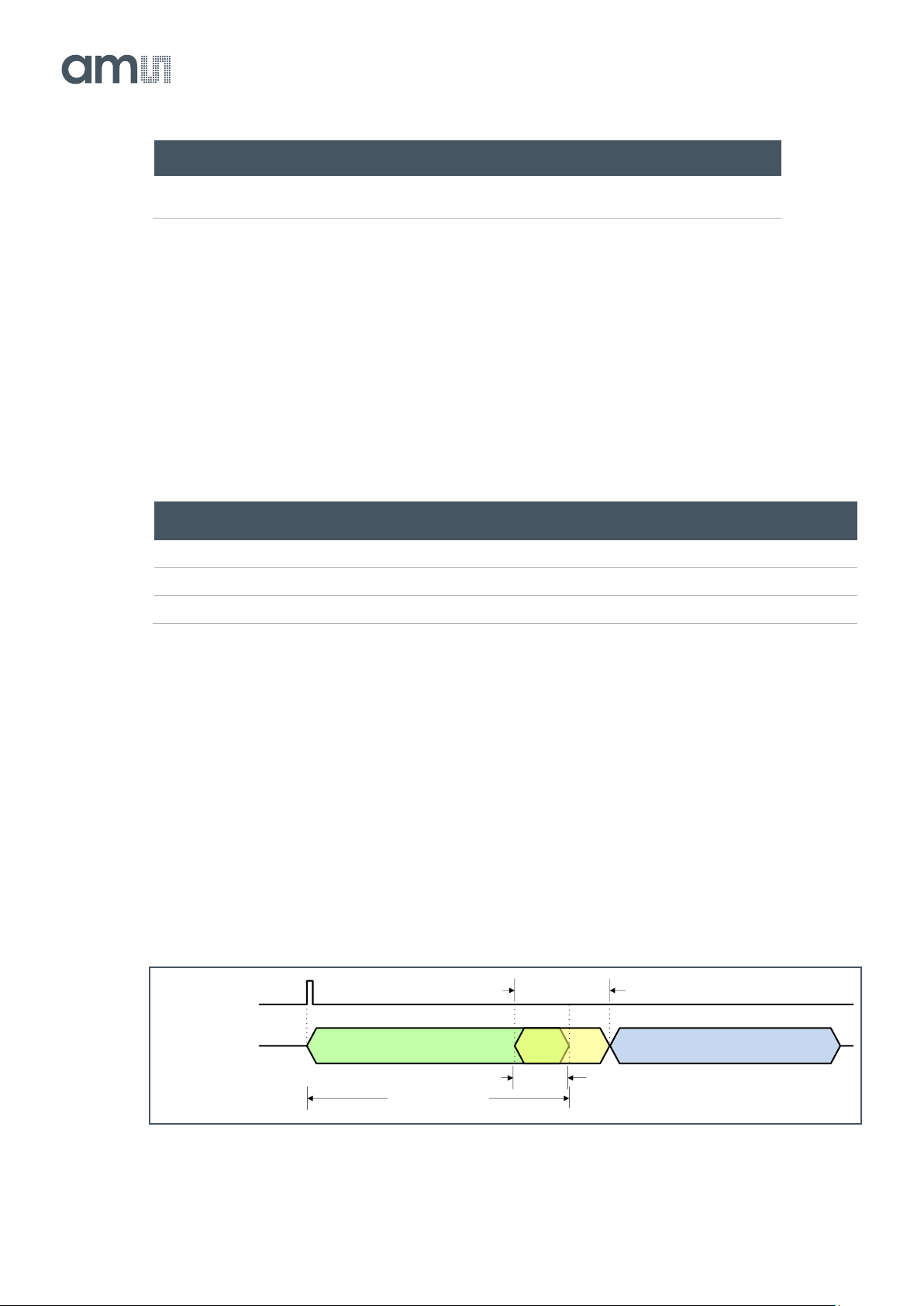
For both modes there is an overlap of the exposure during the FOT (= the (34 * reg82[7:0]) part).
Figure 41:
Exposure FOT Overlap
Bit Mode
Min. Exposure Time [µs]
8
15.4
10
15.3
12
20.4
Frame_REQ
Frame_cycle
Exposure time FOT
Actual exposure time
(reg82[15:8] + 2) * (reg85 + 1) * clk_per
Read-out time
(34 * reg82[7:0]) * clk_per

Document Feedback
CMV12000
Functional Description
Datasheet • PUBLIC
DS000603 • v6-00 • 2023-Sep-22
84 │ 38
7.4.2 Frame Timing
The frame rate of the CMV12000 is defined by two main factors.
● Exposure time
● Read-out time
FOT (Frame Overhead Time) will only have an influence when very few rows are read out.
For ease of use we will assume that the exposure time is equal to or shorter than the read-out time. By
assuming the frame rate is completely defined by the read-out time (because the exposure time
happens in parallel with the read-out time). The read-out time (and thus the frame rate) is defined by:
● Clock speed: 600 MHz maximum
● ADC mode: 8, 10 or 12-bit
● Number of lines read-out (windowing, subsampling or binning)
● Number of LVDS data outputs used: 64 maximum
This means that if any of the parameters above are changed, it will have an impact on the frame rate
of the sensor.
All timings can be expressed in line times:
Equation 3:
The total read-out time is composed of the FOT and the image readout time. The image readout time
is dependent of the total number of read out lines (#readout lines), sides used and the line time.
Equation 4:
Equation 5:
The number of lines read out will depend on the mode:
● Normal mode: #readout lines = Number_lines_tot
● X&Y-Subsampling: #readout lines = Number_lines_tot/2
● Binning: #readout lines = Number_lines_tot/4
Number_lines_tot is the value of register 1.
When running at 600 MHz in 10-bit mode with 64 output channels, register 82[15:8] is 12 and register
85 is 128. This will result in a line time of 2.15 µs, FOT of 30.1 µs and an image read-out time of
3.3024 ms for the full pixel array.

Document Feedback
CMV12000
Functional Description
Datasheet • PUBLIC
DS000603 • v6-00 • 2023-Sep-22
84 │ 39
The total frame time will be 3.3024 ms + 0.0301 ms = 3.3325 ms, which results in a frame rate of
300 fps.
If the exposure time is longer than the readout time the frame rate will depend on the exposure time.
Below you can see an overview of the frame rate in fps for a full resolution image and 64 outputs with
a 600 MHz LVDS input clock.
Figure 42:
Frame Rates vs Modes
Bit Mode
Normal
X&Y-Subs.
Binning
8
333
401
251
10
300
533
267
12
132
267
267
As binning is done in the readout circuit, the four binned pixels have to be sampled, causing a longer
readout time needed and a drop in frame rate. When using fewer outputs, the frame rate will improve
when using binning.
Number of Frames
When using internal exposure mode, the number of frames taken at each frame request can be
programmed. In external exposure mode, only one frame is taken each time or you can use
continuous mode.
Figure 43:
Number of Frames Setting
Reg. Name
Address
Bits
Default
Description
Number_frames
80
[15:0]
1
1 to 65535
7.4.3 High Dynamic Range Modes
The sensor has different ways to achieve high optical dynamic range in the grabbed image.
● Interleaved read-out: The odd and even columns have a different exposure time
● Multiple slope: Partial reset of the photodiode, within an exposure time, to reset the saturated
pixels
All the HDR modes mentioned above can be used in both the internal and external exposure time
modes.