M3plus_OperationManual_e.pdf - 第142页
4 - 7 4 Using the adv anced functions 2. Parts parameters 2.2 Using "Parts Group No." Use "Parts Group No." on the [Parts]-[Option] tab when components must be mounted in a specific order, for example…
4 -6
4
Using the advanced functions
2. Parts parameters
4
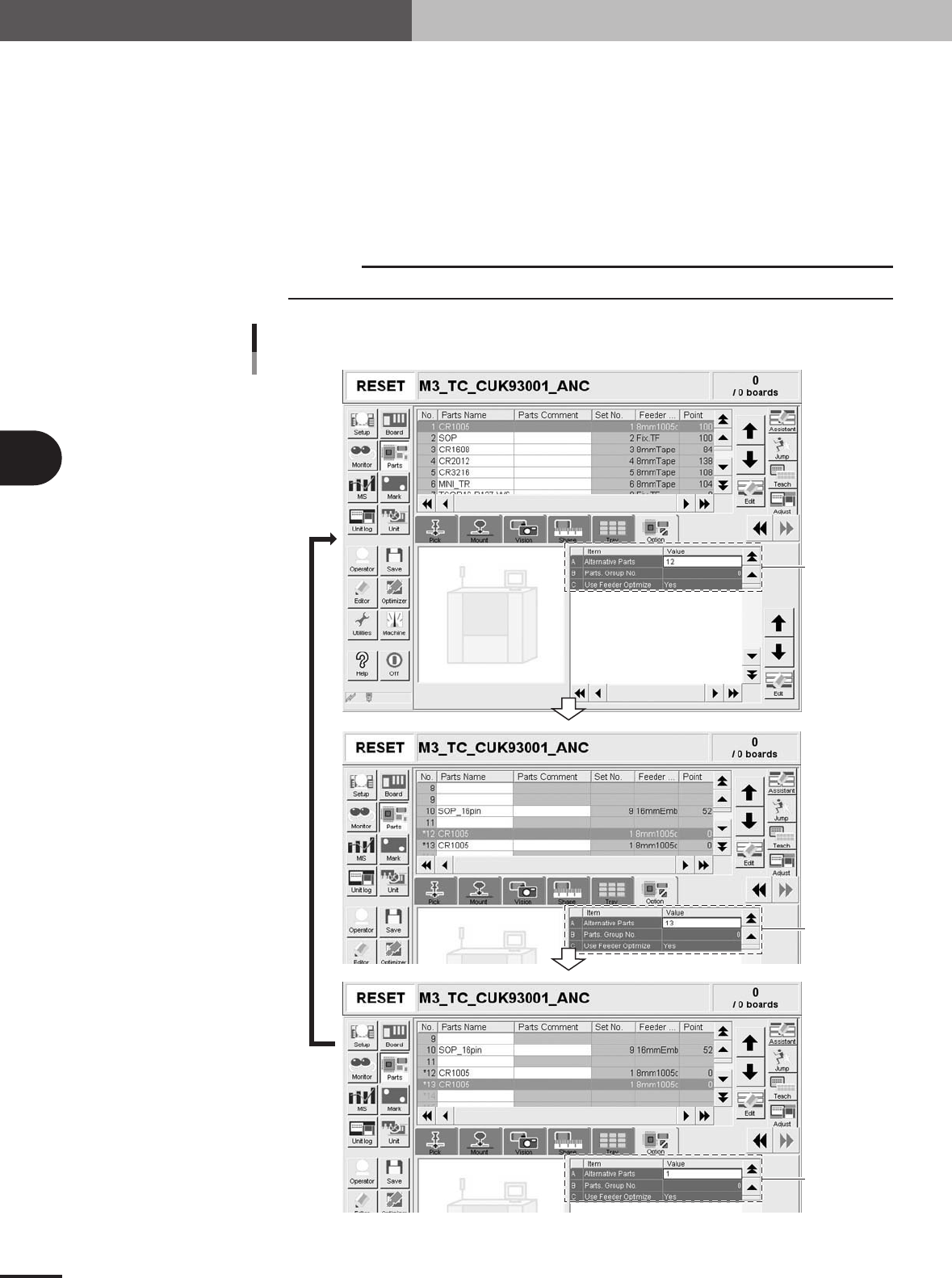
Specify the alternative component numbers.
When data No. 12 and No. 13 in the data list are used as alternative components for
data No. 1, make the settings as follows.
1.Select data No. 1 and set the "Alternative Parts" parameter to "12".
2.Select data No. 12 and set the "Alternative Parts" parameter to "13".
3.Select data No. 13 and set the "Alternative Parts" parameter to "1".
The settings above mean that the alternative component for No. 1 is No. 12, that
for No. 12 is No. 13, and that for No. 13 is No. 1, just like making a loop as an
alternative component group.
c
CAUTION
Data No. for alternative components must make a loop.
Set to "12".
Set to "13".
Set to "1".
Alternative component number settings
27477-5E-20
4 -7
4
Using the advanced functions
2. Parts parameters
2.2 Using "Parts Group No."
Use "Parts Group No." on the [Parts]-[Option] tab when components must be mounted in
a specific order, for example in the following cases.
1. Short (low profile) components should be mounted before mounting tall components to prevent the
nozzles from interfering with mounted components.
2. Components should be mounted on a component (chip on chip, etc.).
Components can be grouped by a number specified in the "Parts Group No." parameter.
When data optimization is executed after setting the "Parts Group No." parameter, the
mount sequence is determined so that a component group of the smallest number will be
mounted first. For example, when all components are classified into group 1 and group 2.
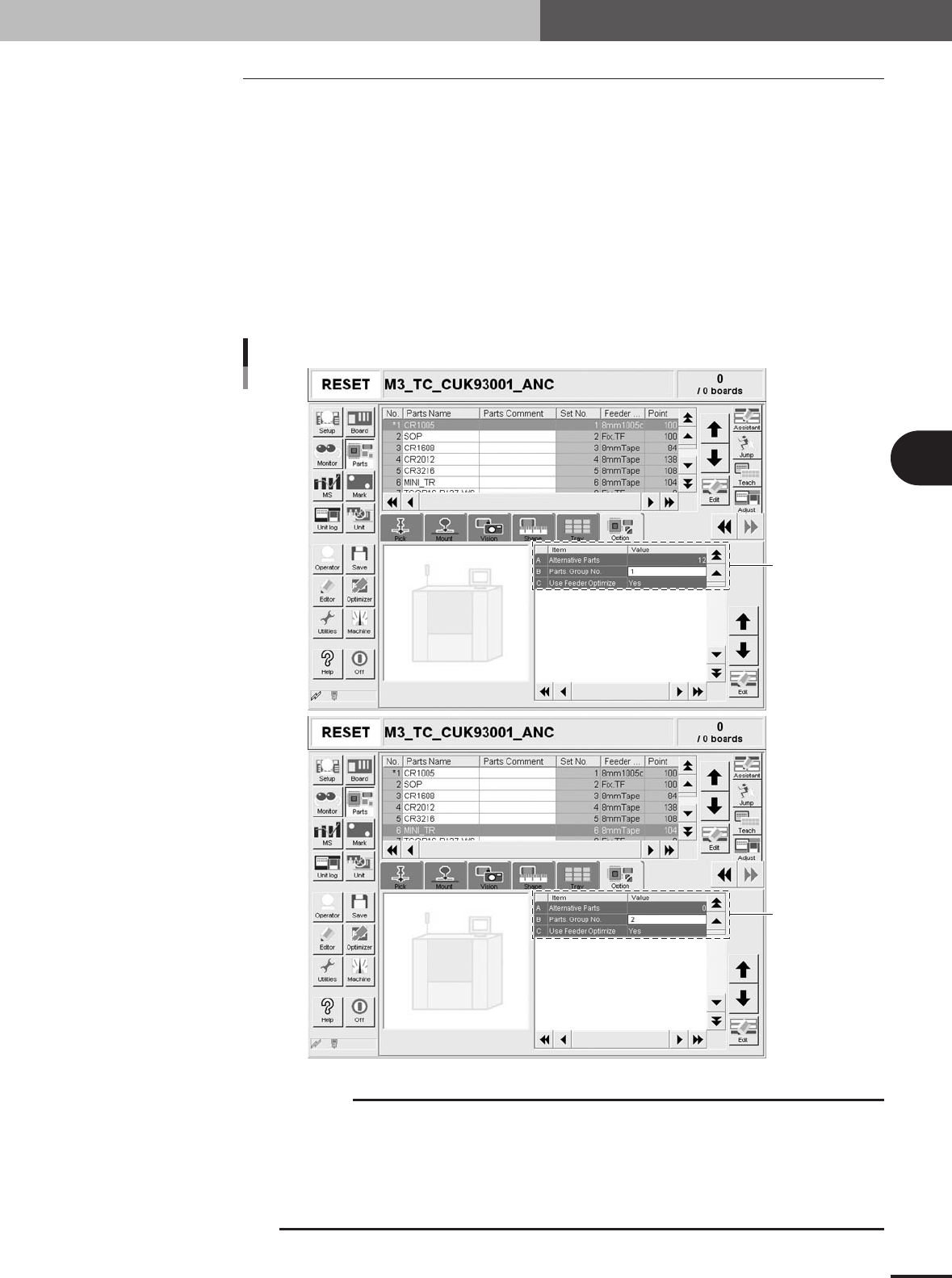
Components of group 2 are mounted after components of group 1 have been mounted. (In
the example below, component No. 6 (set to group 2) is mounted after other components
(set to group 1) have been mounted.
Set to "1" to mount
components first.
Set to "2" to mount
components after
group 1.
Setting "Parts Group No."
27478-5E-20
c
CAUTION
Numbers specified in the "Parts Group No." parameter determines the order of mounting
components, but this order is enabled only after executing data optimization. Always execute
data optimization to enable the "Parts Group No." parameter settings.
All components must be classified into any group, so a number of 1 or larger must be given to
the "Parts Group No." parameter of all components. For example, if you want to mount a kind of
components after other components have been mounted, set that kind of components to group
2 and all other components to group 1.
4
Using the advanced functions
4-8
3. Mark parameters
3.1 Pattern matching
Pattern matching is a function for correcting PCB dimensional or reference hole errors,
positioning errors occurring from the PCB clamping mechanism, or local distortion of the
PCB. To use this function, the image of a particular PCB pattern must be registered as
the template. Errors or distortion are corrected by comparing the template you registered
with an actual pattern being recognized. Pattern matching is useful when the fiducial
function cannot be used, for example, if the PCB has no fiducial marks or the mark does
not match any recommended marks.
n
NOTE
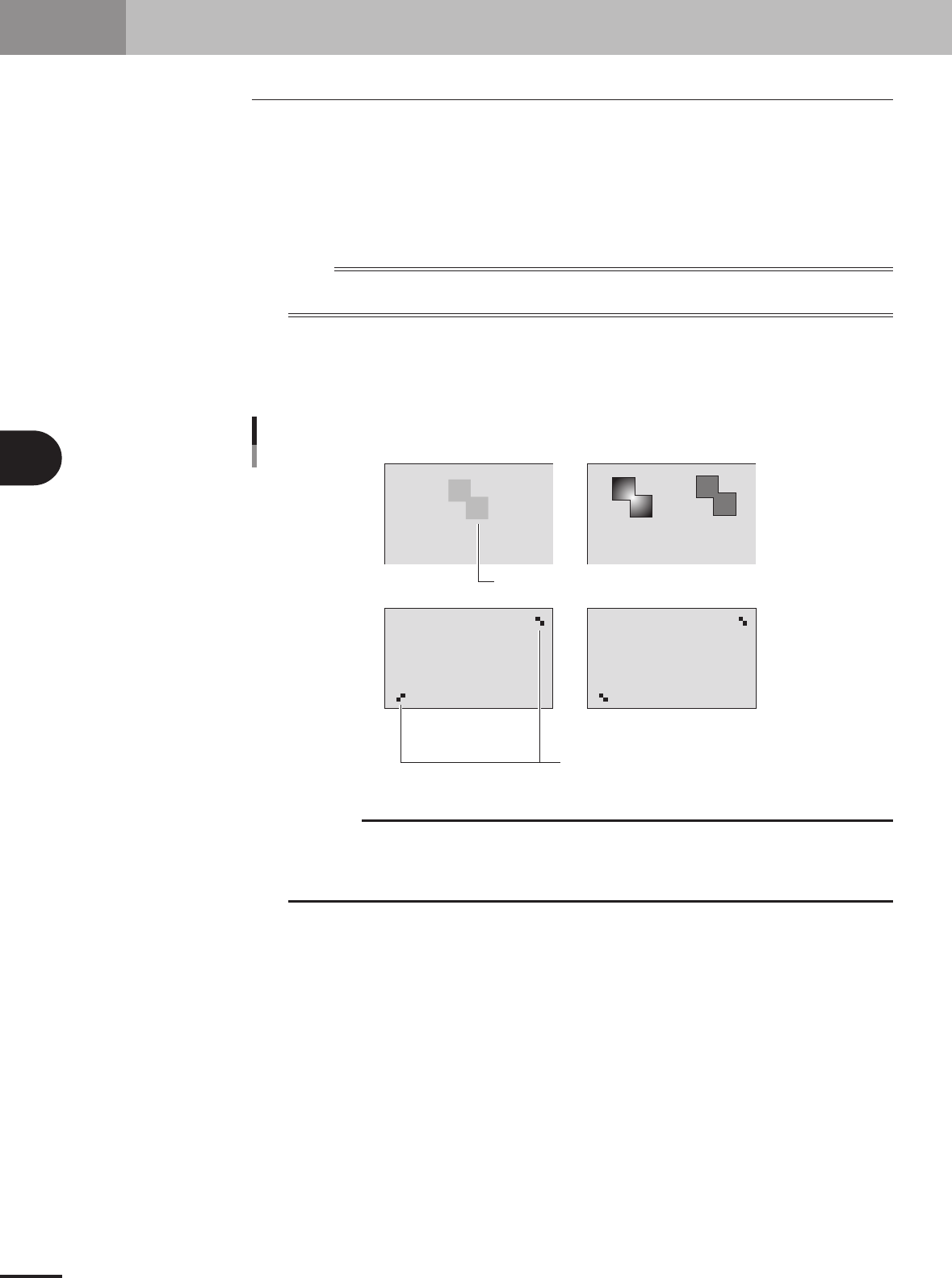
Any pattern can be used, but the pattern image should be smaller than about 1/4th of the monitor and must meet
the following conditions.
Pattern conditions
• Each pattern clearly contrasts with the PCB. (It is okay if the outline of each pattern is definite.)
•A pair of patterns are diagonally opposing on the PCB.
NG
NG
OK
PCB
PCB
OK OK
Low contrast
Not the same direction
Pattern conditions
23442-5E-20
c
CAUTION
Pattern matching requires a longer recognition time than normal mark recognition and its
accuracy may drops slightly when compared to cases using round or square marks. It is not
necessary to use pattern matching for marks which can be correctly recognized with "Algorithm
Type" set to "Normal".