M3plus_OperationManual_e.pdf - 第87页
3 Creating the PCB data 3- 22 4. Creating the component information This section explains how to create component data. Component data has various parameters for each of the component names registered as illustrated belo…
3 -21
3
Creating the PCB data
3. Creating the PCB information
3. 4-point fiducial function
The "4-point fiducial" function is used to enhance the mounting position accuracy by recognizing 4
fiducial marks provided on a PCB. This function is effective in the following cases.
• PCBs with 4 or more fiducial marks which meet the conditions
• Large PCBs
• PCBs made of materials which tend to expand, flex or warp.
(paper phenol, paper, glass epoxy, other flexible materials)
The 4-point fiducial data settings are basically the same as those for point fiducial and local
fiducial marks. However, because the 4-point fiducial function requires 4 XY coordinate points,
you must use two data lines ("4Local-M" and "4Local-S") on the Offset tab screen in order to
register one set of 4-point fiducial marks.
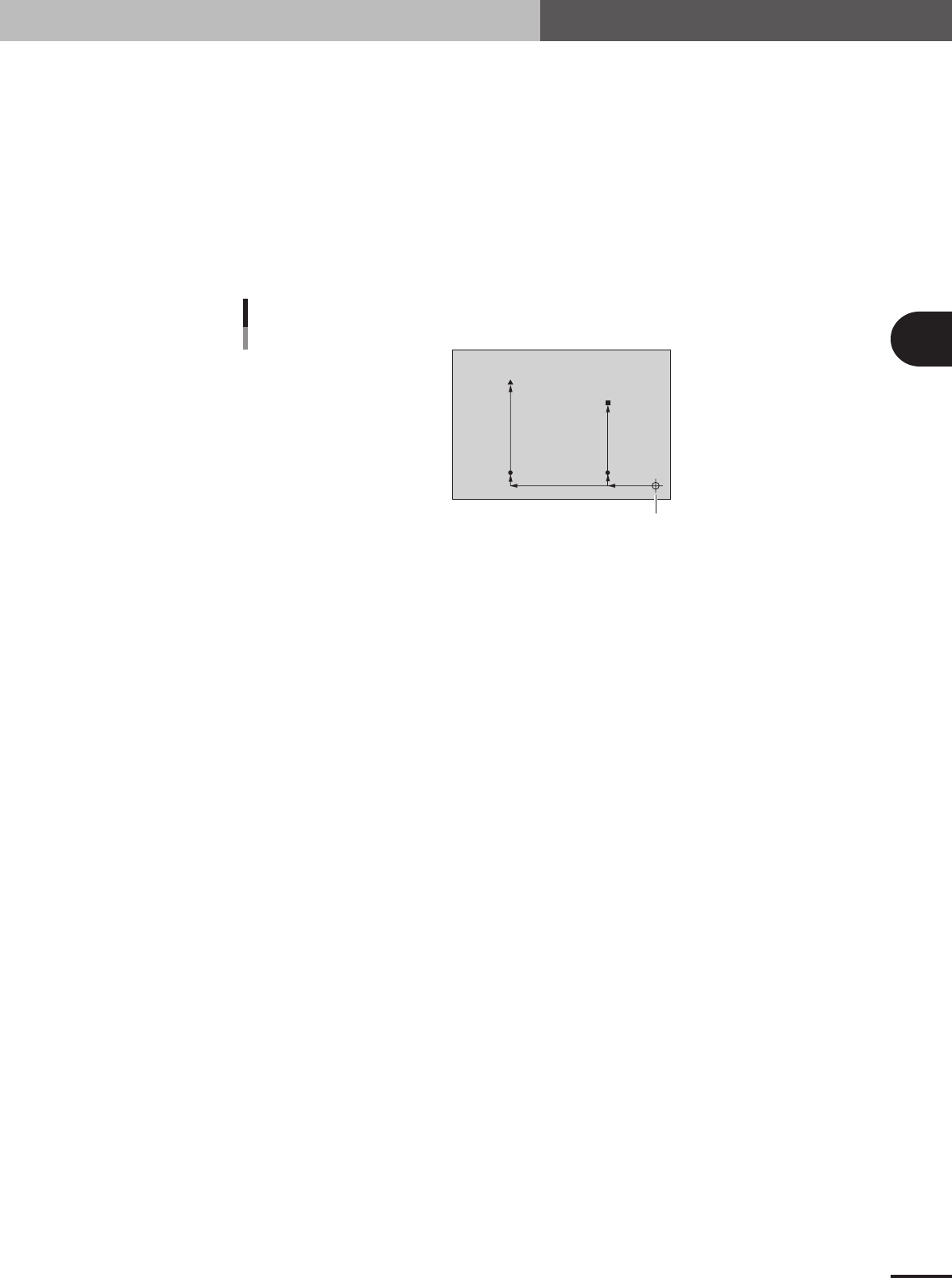
4-point fiducial marks
(-50, 10)
(-200, 10)
(-50, 150)
(0, 0)
(-200, 200)
Mark 3
PCB origin
Mark 2
Mark 4
Mark 1
23413-5E-20
3
Creating the PCB data
3-22
4. Creating the component information
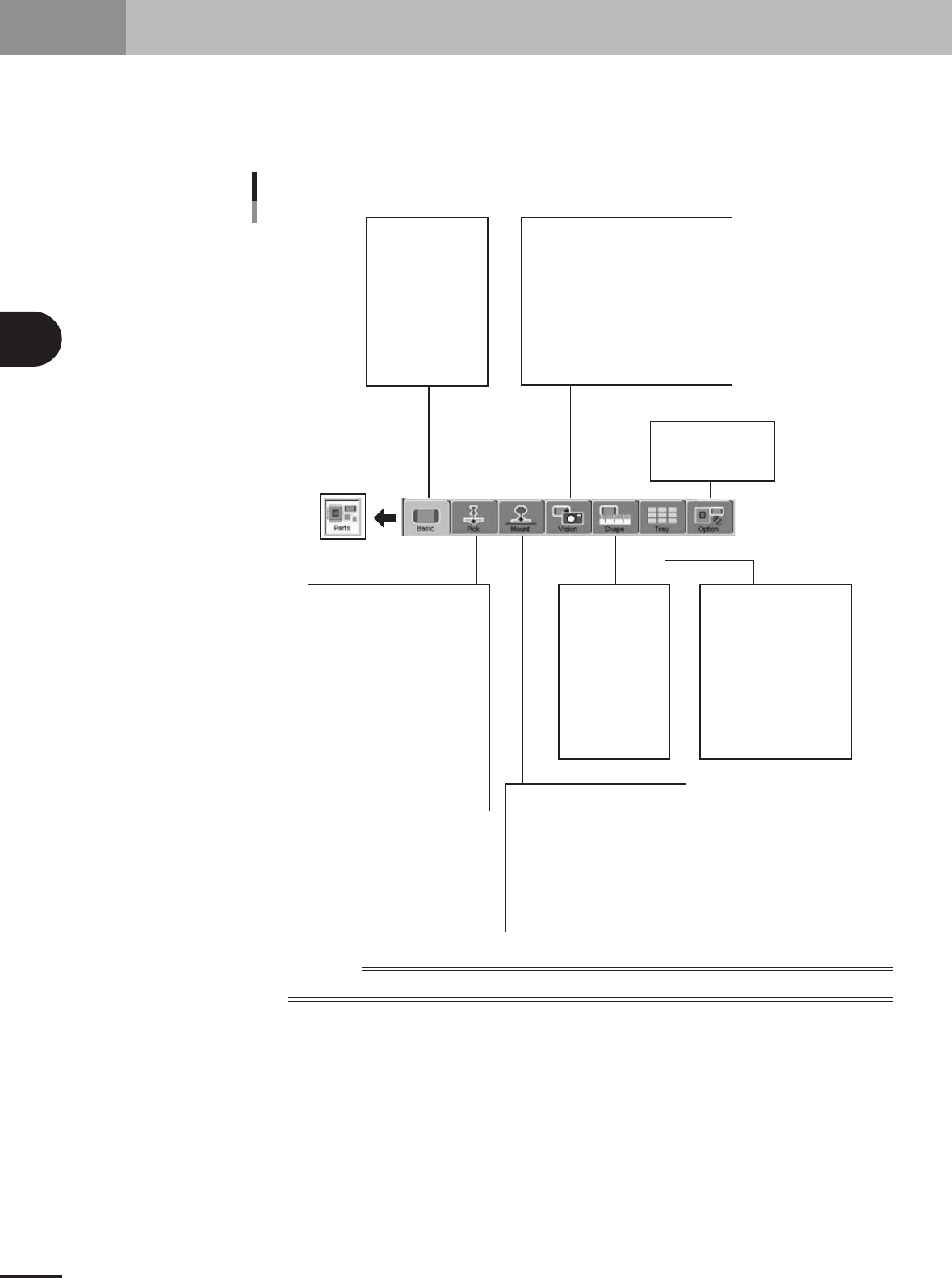
This section explains how to create component data. Component data has various parameters for each
of the component names registered as illustrated below. To set these parameters, it is convenient to
copy sample data of a component with a similar shape from the database and then edit only the
different parameters.
Component name
Comment
Component information parameter
Alignment Group
Alignment Type
Required Nozzle
Package
Feeder Type
Dump Way
Retry Times
Conveyor X Speed
Database Number
(Library Name)
Feeder Set No.
Position Definition
Y (mm)
Pick Angle
Pick Height
Pick Timer sec
Pick Speed
XY Speed
Pick&Mount Vacuum Check
Pick Vacuum
Pick Start
Pick Action
Pick Tango
Mount Height
Mount Timer
Mount Speed
XY Speed
Pick&Mount Vacuum Check
Mount Vacuum
Mount Action
Mount Tango
(Alignment Group)
(Alignment Type)
Body Size XY
Body Size Z
Ruler Offset
Ruler Width
Lead Number
Lead Width
ReflectLL
etc.
(Package)
(Feeder Type)
Comp Amount
Tray Amount XY
Count Out Stop
etc.
Alignment Module Fore, Back
Light Main, Coax, Side
Lighting Level
Auto Threshold
Comp. Threshold
Comp. Tolerance
Search Area
Datum Angle
Comp. Intensity
Multi MACS
Alternative Parts
Parts Group No.
Use Feeder Optimize
23416-5E-20
Reference
Parameters displayed somewhat differ depending on the selected component type and package style.
3 -23
4. Creating the component information
3
Creating the PCB data
4.1 Creating procedure
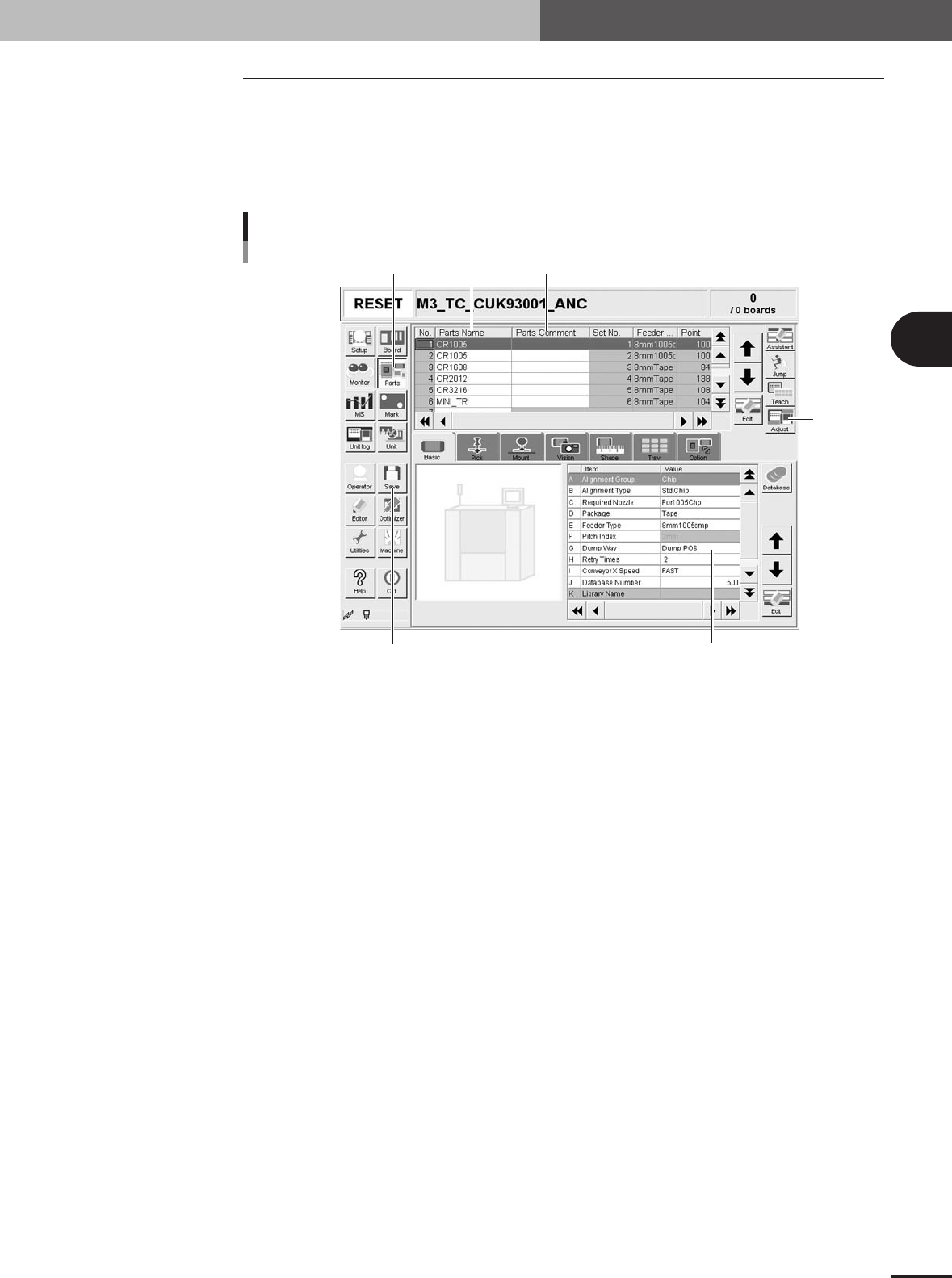
After selecting the PCB name, press the [Parts] button in the main menu button area to
open the component information screen. Enter the component name and comment in the
data No. list on the upper part of the screen, and set the parameters in the right lower list,
as explained below.
1
Press the [Parts] button to open the component information screen.
Step 1 Step 2 Step 3
Step5
Step 4
Step 7
Component information screen
27411-5E-20
2
Enter the component name in the Part Name column.
Enter the name printed on the tape reel or on the component itself within 20 alphanu-
meric characters. A space cannot be included in the name.
3
Enter a comment.
Type any desired comment in the Parts Comment column as necessary. You can omit
entering comments here.
4
Set the parameters.
While selecting the [Basic], [Pick], [Mount], [Vision], [Shape] tabs and so forth, set the
necessary parameters in the right lower list.
5
Adjust the parameters in the Parts Adjust mode.
Press the [Adjust] button to open the Parts Adjust screen that allows you to adjust or
check the parameters of the selected component. (For more details, see "4.9 Parts
Adjust mode" in this chapter.)
6
Repeat the above steps for other components.
Repeat the same procedure from step 2 to register all components to be mounted on
the PCB.
7
Save the data.
Press the [Save] button to store the data.