Tracker-2800-2800S.pdf - 第47页
47 Applications The Tracker 2800 can locate defecti ve capacitors in or out of circuit. The r anges cover 100 pF to 15,000 F. When analyzin g a capacitor's signature, adjust the Tracker 2800 's R S and F …
46
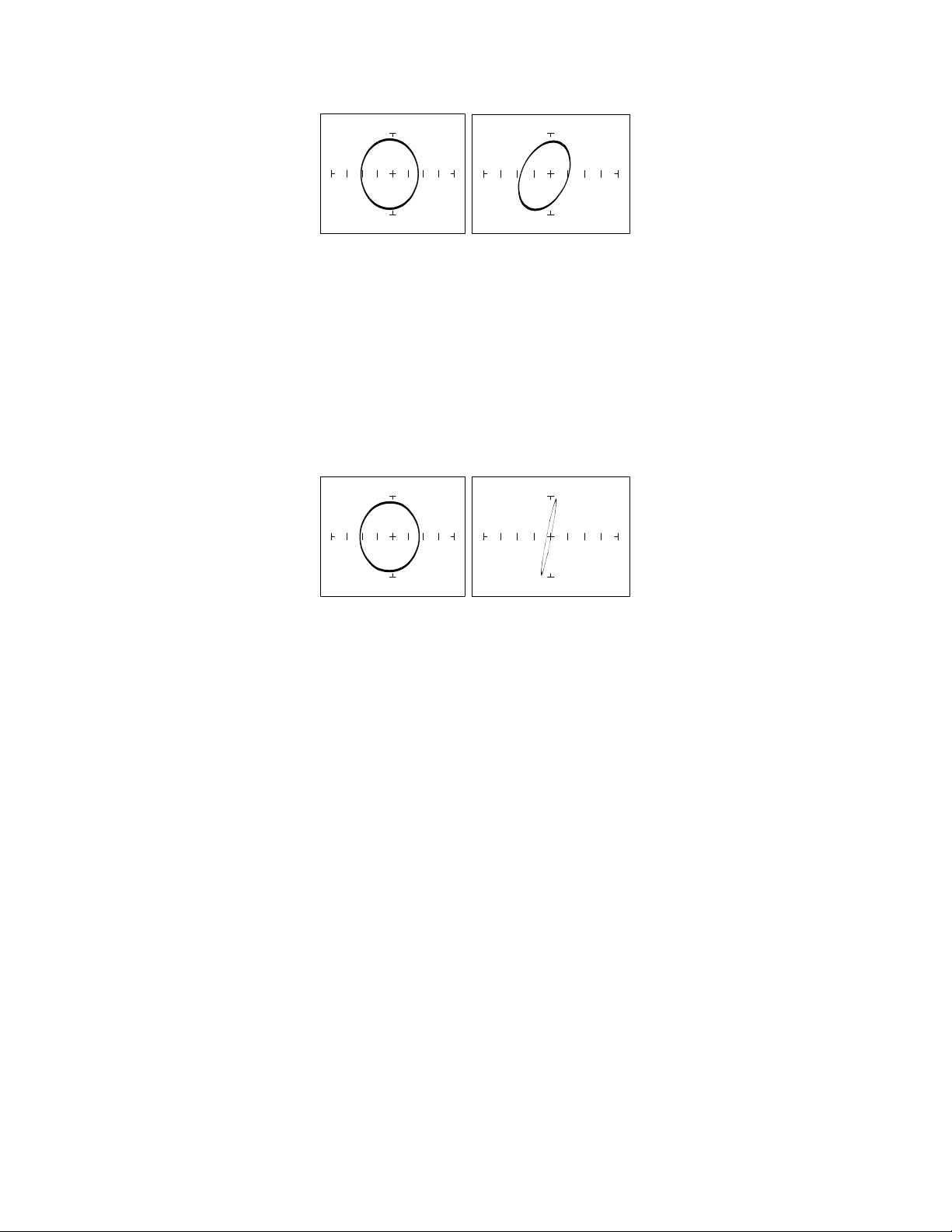
Normal Capacitor Leaky Capacitor
Figure 3-15. Signatures of A 100 F Capacitor with Dielectric Leakage.
This example only simulates the leakage flaw by adding a 100 resistor in parallel to a 100 F
capacitor. It shows the signature change from a normal circular ellipse pattern to a sloped and
depressed vertical pattern. The signature of a real capacitive leakage would be quite similar to this
example.
Another example of capacitive leakage is shown for a 10 F capacitor.
Normal Capacitor Leaky Capacitor
Figure 3-16. Signatures of a 10 F Capacitor with Dielectric Leakage at 10V, 500, 60Hz
Again, this example only simulates the leakage flaw by adding a 68 resistor in parallel to a 10 F
capacitor. It shows the signature change from a normal circular ellipse pattern to a sloped and
depressed vertical pattern. The signature of a real capacitive leakage would be quite similar to this
example.
As you can see from the two previous examples, adding resistance in parallel to a capacitor distorts the
normal signature with a diagonal bend to it. This is our first look at a composite signature, the kind of
signature the Tracker 2800 displays when there are several components connected together in a circuit.
Review
Capacitors have elliptical signatures due to the current and voltage phase shift.
As the test signal's frequency increases, the capacitor's signature becomes more vertical due to
decreasing X
C
of the component.
Capacitors with leakage flaws have their ellipses tilted diagonally due to an internal resistance in
parallel with the capacitance.

47
Applications
The Tracker 2800 can locate defective capacitors in or out of circuit. The ranges cover 100 pF to
15,000 F.
When analyzing a capacitor's signature, adjust the Tracker 2800's R
S
and F
S
for the most
pronounced ellipse.
The test signal frequency F
S,
can be changed to enhance a composite signature by emphasizing or
de-emphasizing the capacitance.
Besides resistance, faulty capacitor signatures often exhibit other irregularities such as non-
symmetry, broken or distorted ellipse and saw-toothed shapes that can be seen in the signature
display.
48
3-3. INDUCTORS
Inductors, like capacitors, have elliptical analog signatures and respond to Tracker 2800's test signal
non-linearly. Also like capacitors, an inductor's reactance (resistance to an AC test signal) is dependent
on the test signal's frequency. Because of the way they are constructed using wire with some amount of
resistance in it, it is hard to find a pure inductance. An inductor's analog signature will usually be an
elliptical pattern with some slope or tilt to it due to the resistance of the coil wire.
Inductive Signatures
The goal of this section is to explore some inductive signatures and to help you understand how
inductor signatures are related to:
The inductance (L µH) of the circuit under test
The frequency (F
S
) of the test signal
The voltage (V
S
) of the test signal
The internal resistance (R
S
) of the Tracker 2800
Plug the red test microprobe in the Channel A jack, and the black test clip lead in the Common jack.
Do the following to display the analog signature of an inductor:
1. Select 50, 10V and 60Hz range (LOW Range)
2. Place or clip each test lead on the opposite ends of an inductor and observe the signature in the
Tracker 2800 signature display.
Signatures of Different Inductor Values
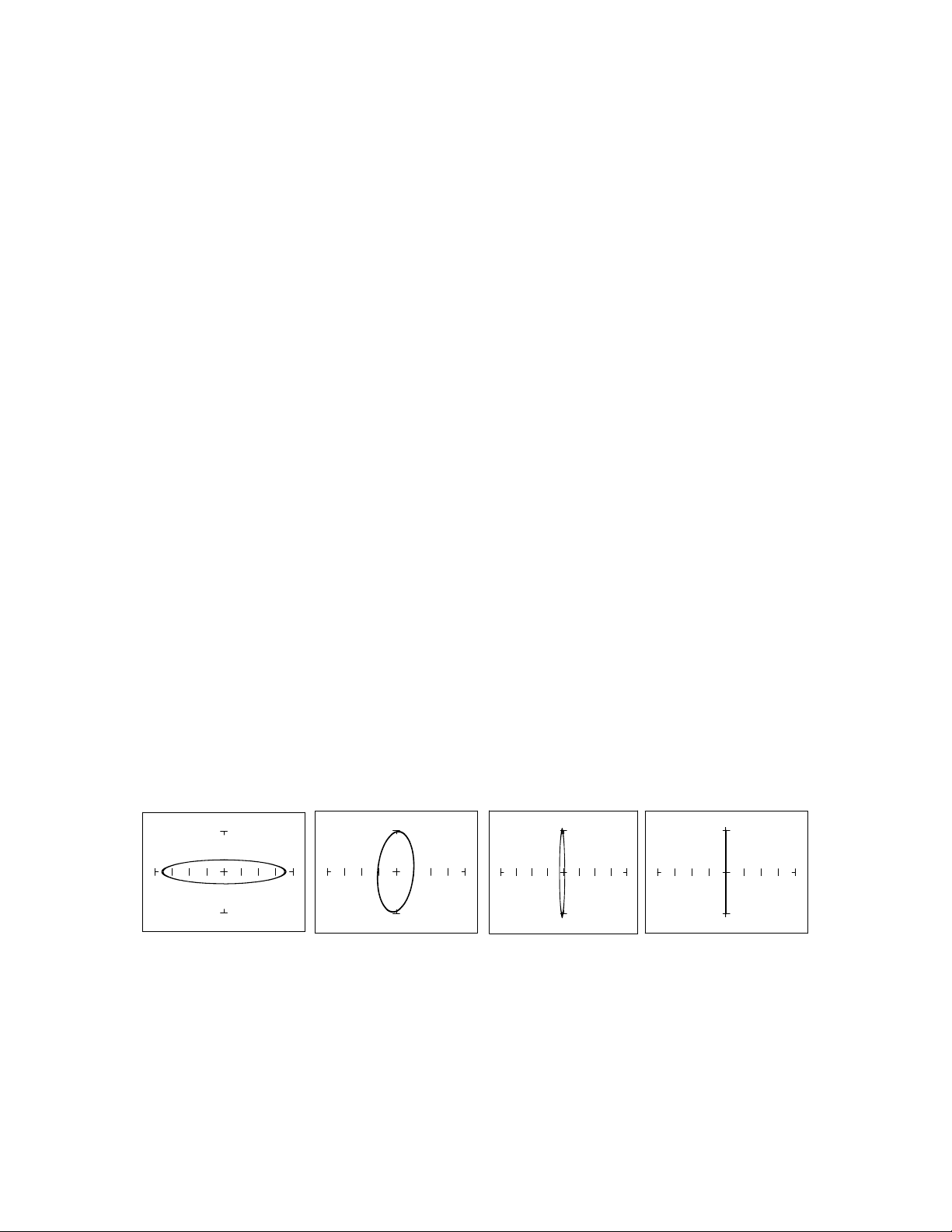
The figure below shows analog signatures for four different value inductors, 12,000 µH, 1200 µH, 120
µH and 12 µH. Select 10V, 50, 2KHz.
12,000 µH 1,200 µH 120 µH 12 µH
Figure 3-17. Signatures of 4 Inductors at 10 V, 50, 2KHz.
Note that as the inductance values decrease, each signature changes from a horizontal elliptical pattern
to a vertical elliptical pattern. In ASA, a large value inductor has a signature that looks similar to an
open circuit. And likewise, a small value inductor has a signature that's similar to a short circuit.