Tracker-2800-2800S.pdf - 第85页
85 5-3. LOW VOLTAGE The low voltage family of logic that o ffers lower dynamic power consumptio n, lower operating voltages, higher output drive, faster AC speed, lo wer noise and better d ynamic thresholds than HC CMOS.…

84
The IC signatures resemble zener diodes.
There are many causes for IC failures and the Tracker 2800 can display its "health" as resistive
leakage, an open or a short.
Functionally identical pins on a single IC out-of-circuit will display the same signature.
The most common point for reference is ground, but V
CC
or another point might give a more
informative signature.
Different analog IC families exhibit different characteristic signatures.
Applications
Testing for faulty IC’s is one of the more common uses for the Tracker. A technician can compare IC’s
in or out of circuit.
85
5-3. LOW VOLTAGE
The low voltage family of logic that offers lower dynamic power consumption, lower operating
voltages, higher output drive, faster AC speed, lower noise and better dynamic thresholds than HC
CMOS. These features make this family attractive for low power applications such as battery operated
portable applications (that is, laptop computers, pagers, phones, etc.).
In order to achieve this improved level of performance, the manufacturers of this LV (low voltage)
family of logic ICs have redesigned the internal structure of the device. Some manufacturers have
changed the input structure by eliminating the input protection diode to V
CC
. Similarly, the design of
the output structure also has changed by eliminating the output protection diode to V
CC
and replacing it
with a N-Channel pull-up transistor. As a result of these changes, the analog signatures of the LV logic
family are different from the conventional HC logic family.
Do the following to view signatures of low voltage logic:
1. Select the 3V, 10K and 60Hz.
2. Place or clip the black test lead from the Tracker 2800's Common jack to the IC's ground pin. For
this example, the ground pin of the 74LVQ245 is pin 10.
3. Use the red test lead from the Tracker 2800's Channel A jack and probe each pin of the IC. For this
example, pins 2 to 9 and 11 to 18 are all buffer circuits so they will have identical signatures.
(Note: This is only for ICs out of circuit.)
4. Use the red test lead from the Signal jack and probe the enable input pins. For this example, the
enable pins of the 74LVQ245 are pin 1 and 19 and will have the same signatures. (Note: This is
only for ICs out of circuit.)
5. Use the red test lead from the Tracker 2800's Signal jack and probe the power supply V
CC
input
pin. For this example, the V
CC
pin of the 74LVQ245 is pin 20.
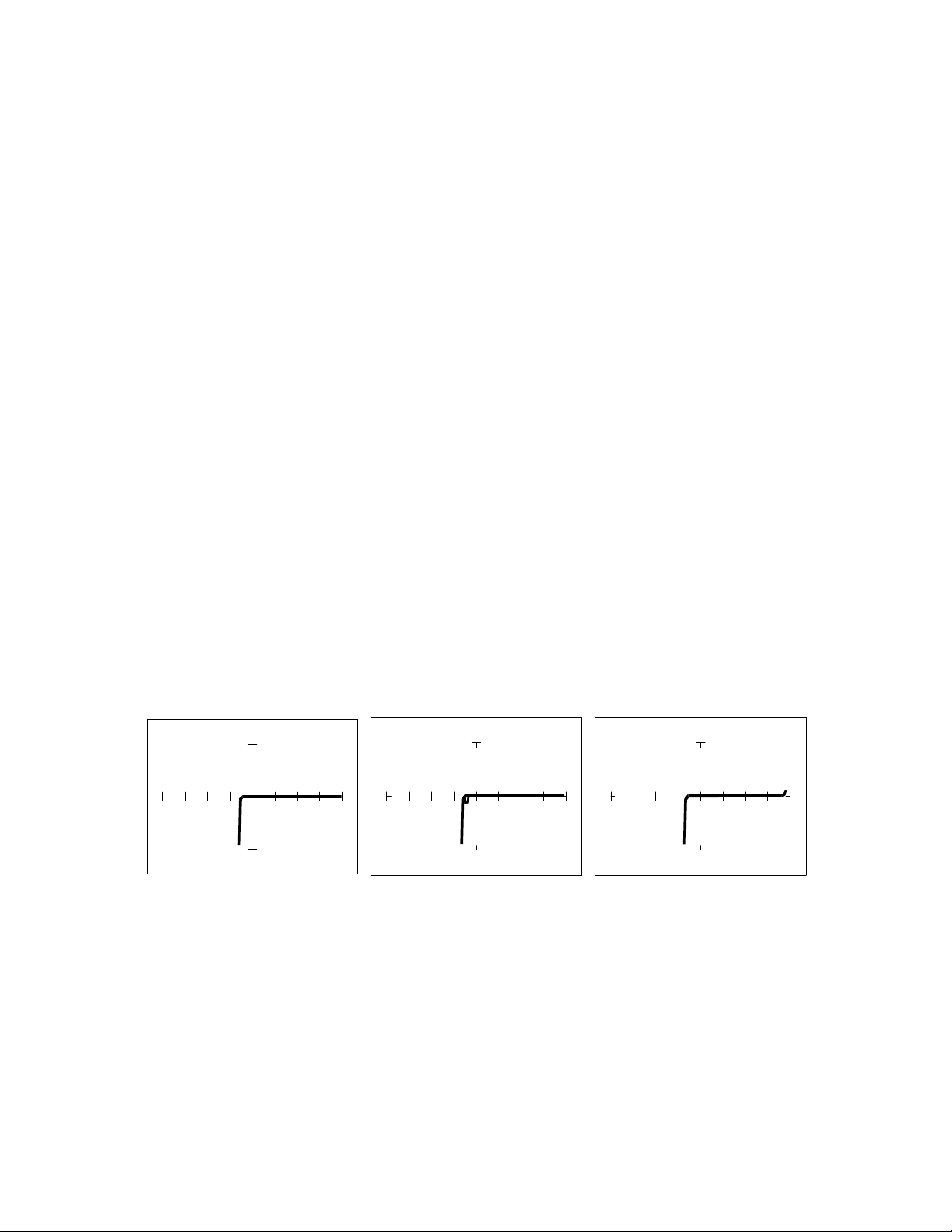
Buffer pins Enable pins V
CC
Power pin
3V, 10K, 60Hz, Ground Pin to Test Common
Figure 5-15. Signatures of a Low Voltage IC (74LVQ45 Type).
The ranges used above enhance the resistive fault signatures that are commonly found when
troubleshooting this logic family. The test signal voltage V
S
is lower than the TTL range groups to
ensure that most descriptive signature is displayed. A higher V
S
may result is a signature going toward
a short with would mask out flaws. The short signature can be attributed by the LV family's lower
voltage characteristics.

86
Compare these signatures with the CMOS logic family and other discrete components such as
transistors and diodes. Note that these signatures have some common similarities with the other
components' analog signature we have seen already.
Review
Integrated circuits are complex devices that are built using basic electronic components.
The IC signatures resemble regular and zener diode signatures.
There are many causes for IC failures and the Tracker 2800 can display its "health" as resistive
leakage, an open or a short.
Functionally identical pins on a single IC out-of-circuit will display the same signature.
The most common point for reference is ground, but V
CC
or another point might give a more
informative signature.
Applications
Testing for faulty IC’s is one of the more common uses for the Tracker. A technician can compare IC’s
in or out of circuit.