SIPLACE Line Computer UNIX.pdf - 第43页
User Manual Line Computer UNIX 2 General Information on Using the Program Software Version 502.xx 10/2000 Issue 2.1 Basics 41 I t I I 2.1.1.1 W orking With the Mouse The mo use is used to move the m ouse cursor around th…
2 General Information on Using the Program User Manual Line Computer UNIX
2.1 Basics Software Version 502.xx 10/2000 Issue
40
I
t I I
● Enter the user name and the password specified in the user account (see chapt. 3, Fig. 3.2.2) in
the appropriate editing fields.
● Click on OK.
The login dialog box closes. The user has now logged onto the LC system and can start the indi-
vidual applications provided his privileges include the access to the respective applications
(function group).
NOTE
The access rights (see chapt. 3, page 3 - 102) of each user are defined in the user accounts.
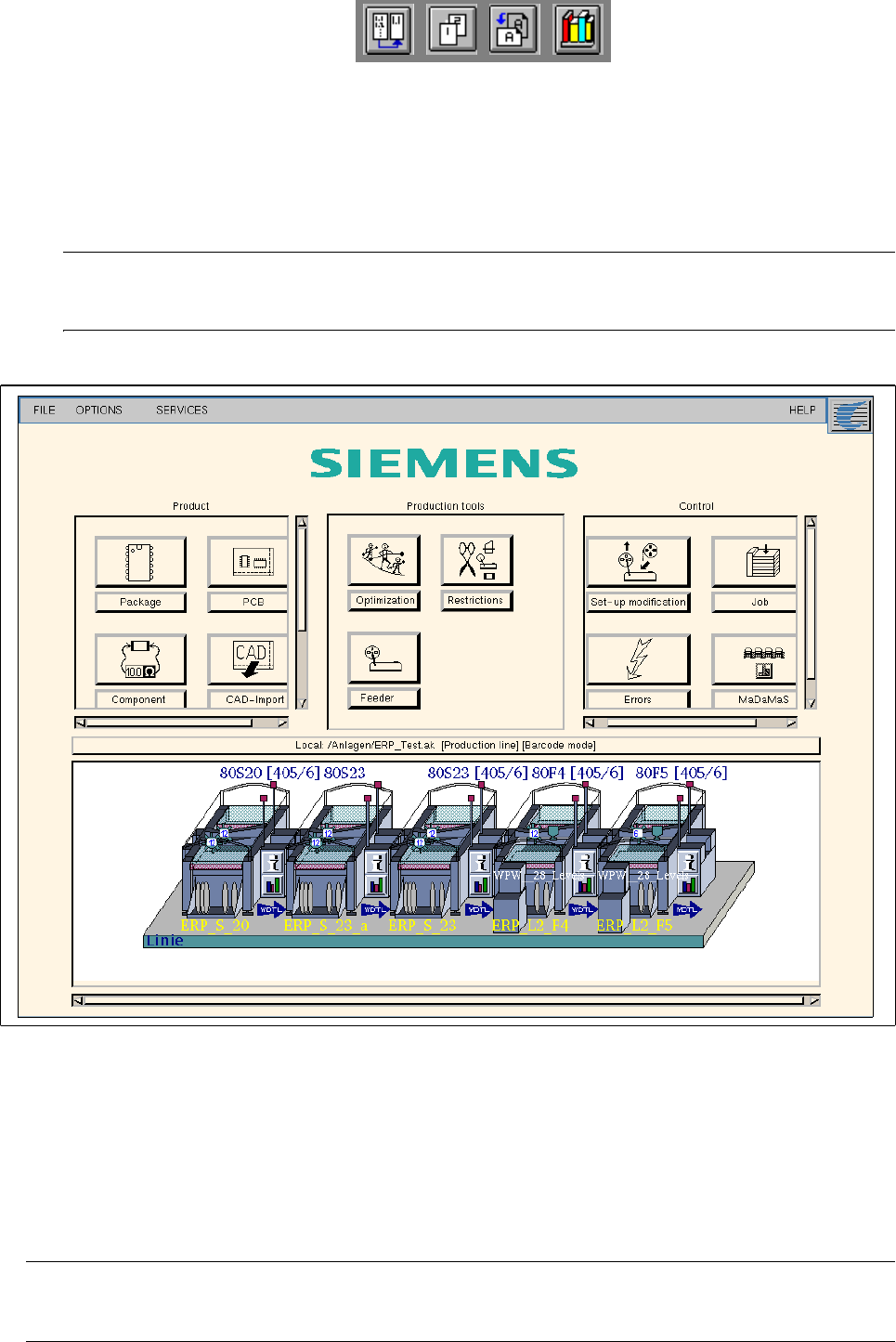
Fig. 2.1.1 "Desktop" (Programming Mode)
The "Desktop" fills the entire screen and is the backdrop on which all windows, icons and menus are positioned.
It is organized like a desk on which the working documents are distributed which can be arranged as desired.
The job you are currently working on is arranged centrally on the screen and positioned at the top. All elements
are activated or selected by means of the mouse.
NOTE
A detailed description of the structure and function of the desktop is contained in chapt. 3 of this manual.
User Manual Line Computer UNIX 2 General Information on Using the Program
Software Version 502.xx 10/2000 Issue 2.1 Basics
41
I
t I I
2.1.1.1 Working With the Mouse
The mouse is used to move the mouse cursor around the screen. The individual elements are selected or
executed by pressing the appropriate mouse button.
- The mouse has three mouse buttons. To operate the Line Computer program mainly the left button is
used. The right mouse button serves to select several entries or icons whereas the middle button is
pressed when entries are to be copied.
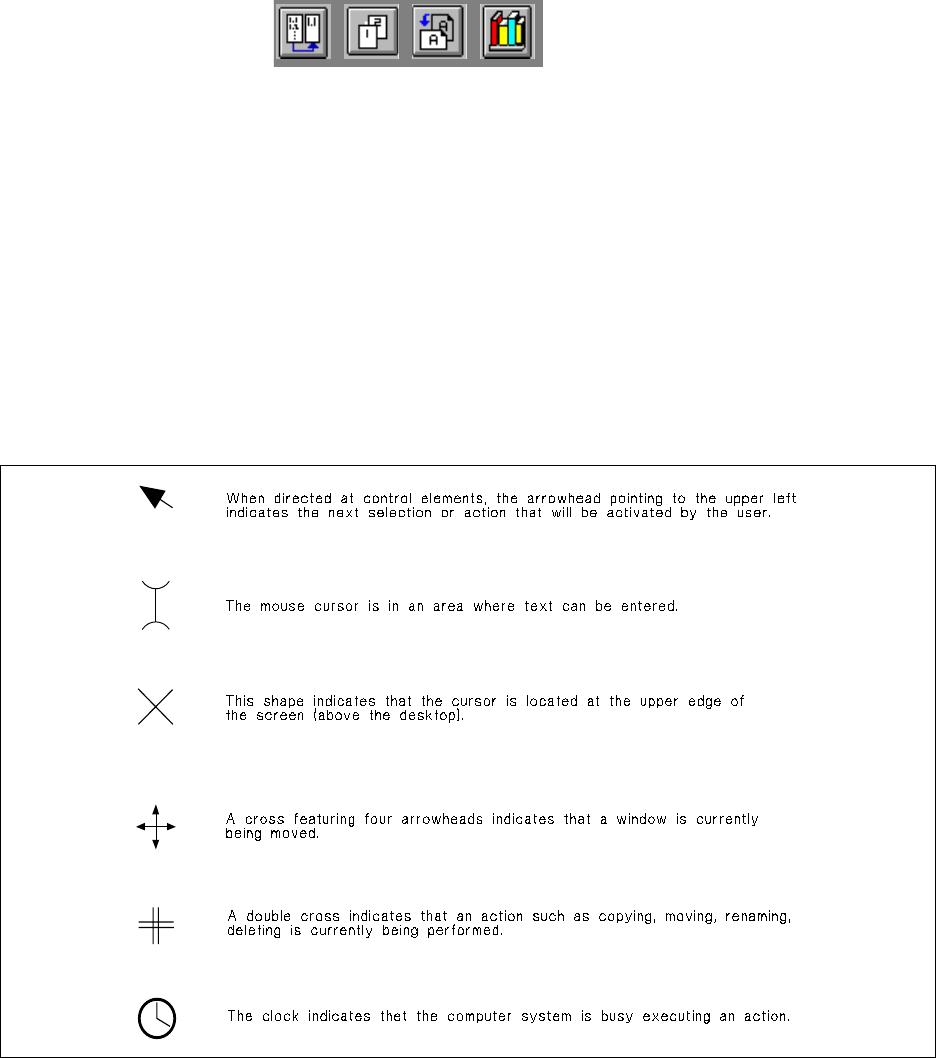
- The cursor’s shape depends on its location on the screen. The shape of the mouse cursor indicates
what kind of function is being executed.
In the following, the mouse cursor shapes most frequently used are shown.
Fig. 2.1.2 Mouse Cursor Shapes
Selecting object (clicking on object):
To be able to perform actions in an object it must first be selected .
● Using the mouse, position the mouse cursor over the specified object (no mouse button to be
pressed).
● Click left mouse button (press and release button one time). The object is selected and displayed
in reverse video.
● (Perform desired action).
2 General Information on Using the Program User Manual Line Computer UNIX
2.1 Basics Software Version 502.xx 10/2000 Issue
42
I
t I I
Triggering immediate action
If a specific action has been assigned to double-clicking (e.g. copying, see Chapt. 4), it can be executed
by double-clicking on the desired icon.
● Select object.
● Double-click left mouse button (press and release button twice in quick succession).
● Specified action for the selected object is immediately executed.
Entering text
In some windows text must be entered from the keyboard. In most of the cases, the cursor will jump to the
appropriate location. In some windows, however, the cursor must be positioned.
● Using the mouse move mouse pointer to the desired location inside the window (e.g. editing
field).
● Click left mouse button. Mouse pointer is positioned at the input position.
● Enter the text from the keyboard.
Copying text (entries)
In some windows entries can be copied within the same window or to a different window that may be open,
using the mouse.
● Hold down the left mouse button and move the mouse cursor over the entries to be copied (exactly
to the end of the last character) and then release the mouse button. The respective characters
darken.
● Position cursor to the insertion point and click middle mouse button one time.
The copied entries are now displayed.
2.1.1.2 Icons (meaningful symbols)
Icons are small visual representations of files, directories, programs and functions on the screen. An icon
consists of a symbol and a name.
There are three different types of icons:
- Application program icons (see Fig. 2.1.1)
- File and directory icons (see Fig. 2.2.2)
- Icons for the different functions available in an application program (e.g. for the command "Create").
Icons of application programs as well as file or directory icons consist of a symbol and a name. Icons representing
functions contain only the symbol of the particuar function.