KE-2030使用说明书.pdf - 第502页
7 − 8 Select the desired f ile, t hen click t he <Open> button. Y ou have reg istered additional nozzle informat ion to the system at this point. W hen y ou click t he <Cancel> button, any data is not regist …
7 − 7
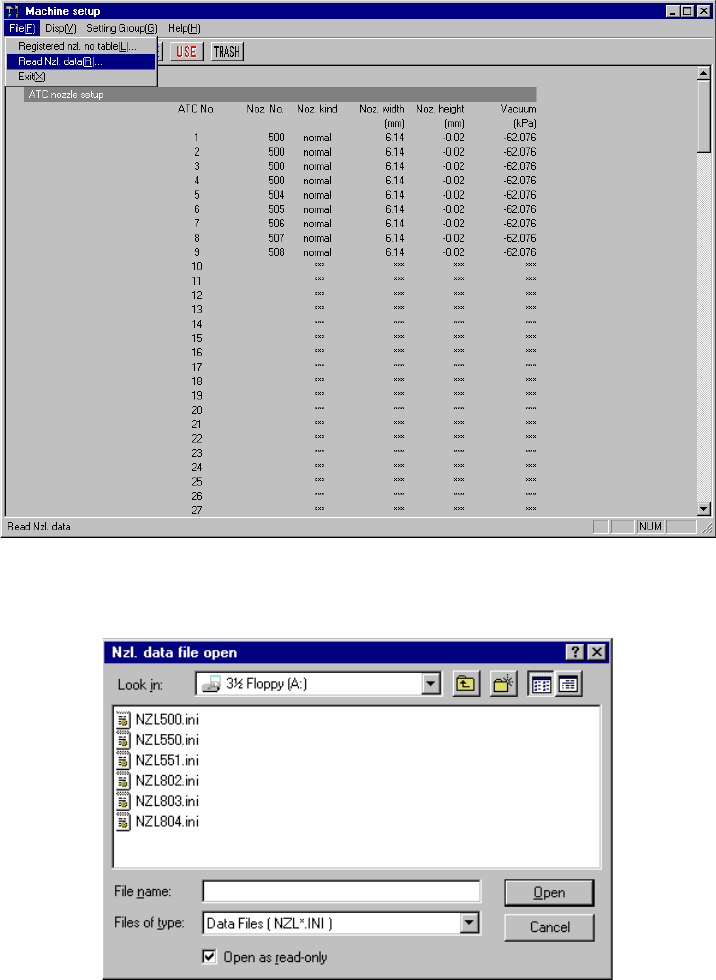
7.2.1.2 Read Nzl. data
When you select the [Read Nzl. data] command from the “File” menu that is invoked
form the menu bar, the “Nzl. data file open” dialog box (see Figure 7.2.1.2.2)
appears on the screen.
◇ This function adds nozzle information on customized nozzles to the system.
− Additional nozzle information is provided from a floppy disk.
− The format of an additional nozzle information file is “NZL*.INI”, that is, an
INI file format, where * is a three-digit nozzle number.
◇ When you select this menu command, insert the floppy disk on which additional
nozzle information is stored in advance.
Figure 7.2.1.2.1 “Read Nzl. data” menu command
(Screen example when a KE-2020 is used)
Figure 7.2.1.2.2 “Nzl. data file open” dialog box
7 − 8
Select the desired file, then click the <Open> button.
You have registered additional nozzle information to the system at this point.
When you click the <Cancel> button, any data is not registered.
You can check the added nozzle number with the “Registered nzl. no table” menu
command, which is described under Section 7.2.1.1.
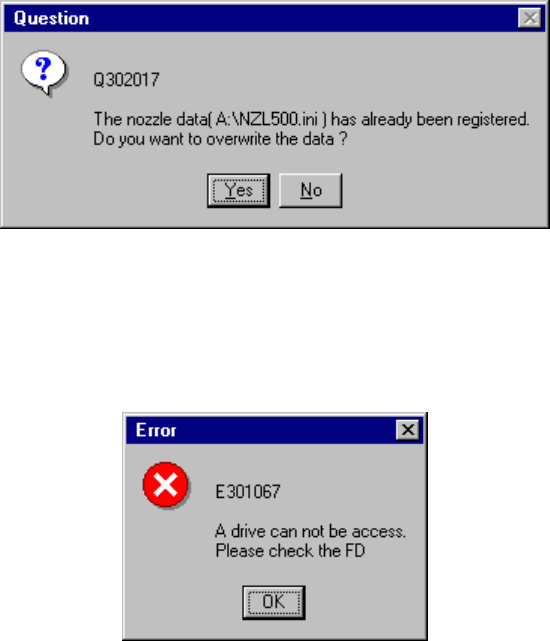
If the specified nozzle information is already registered, the dialog box that asks you
whether to overwrite the existing nozzle information (see Figure 7.2.1.2.3). When
you select “Yes”, the system updates the existing data with the specified nozzle
information that is stored on a floppy disk.
Figure 7.2.1.2.3 Nozzle information update confirmation dialog box
If no floppy disk is inserted into the drive or if any data is not read due to a failure of
the inserted floppy disk, the system displays the error dialog box (see Figure
7.2.1.2.4) on the screen. Check the floppy disk drive or contents of the floppy disk.
Figure 7.2.1.2.4 Floppy disk access error dialog box
7 − 9
7.2.1.3 Exit
Select [File] on the menu bar, then [Exiting Application], or click the close button (X)
at the upper right corner of the dialog box. The system quits the Machine Setup
menu.
7.2.1.3.1 Saving the settings
Although push buttons <OK>, and <Cancel> and <Apply> are available with each
setup group dialog box, pressing the <OK> or <Apply> button will not save the
data onto the hard disk.
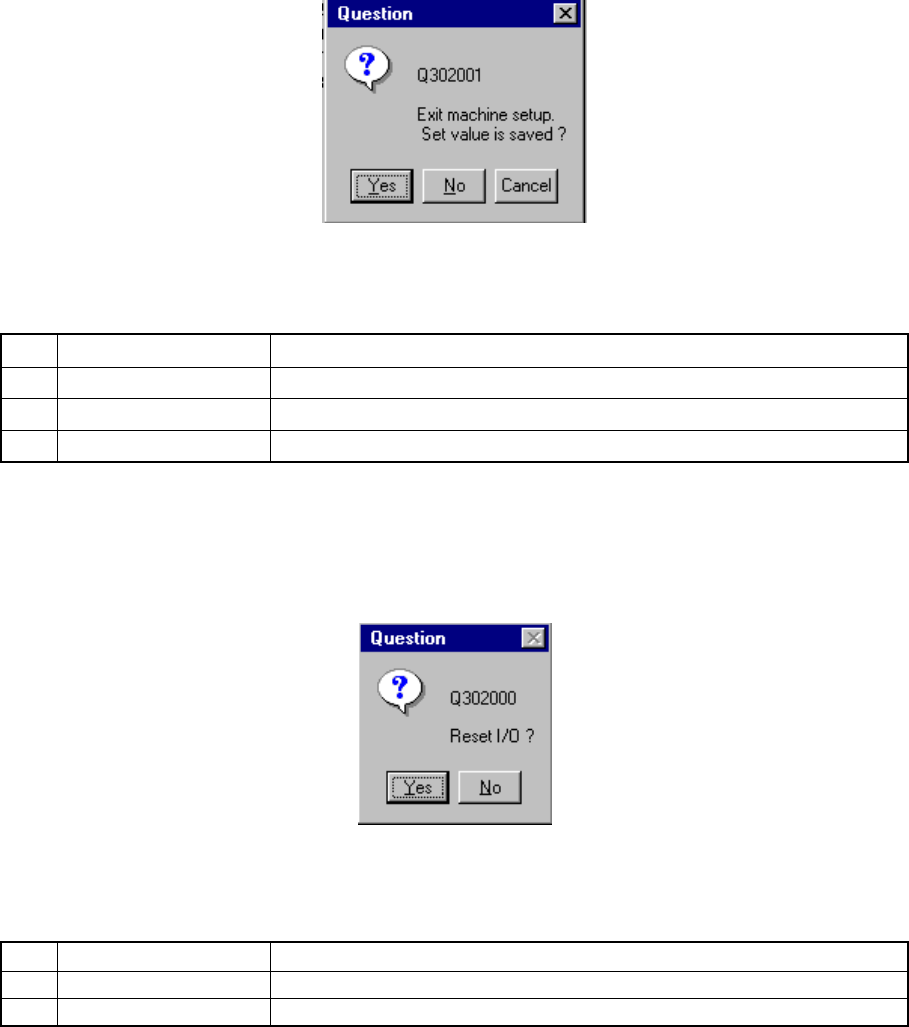
When you change the setting(s) on each Setup group dialog box, a dialog box
appears asking you whether to save the setting(s) or not (see Figure 7.2.1.3.1.5).
When you click the <Yes> button, the setting(s) is (are) saved onto the hard disk.
Figure 7.2.1.3.1.5 Save confirmation screen
Table 7.2.1.3.1.1 Save confirmation buttons
No. Button Action
1 Yes Saves the setting data onto the hard disk.
2 No Cancels the setting data.
3 Cancel Cancels the Exiting Application command.
7.2.1.3.2 Setting the safe direction of each I/O
After you select the [Exiting Application] command, the dialog box shown in Figure
7.2.1.3.2.1 appears on the screen.
Figure 7.2.1.3.2.1 “Reset I/O” dialog box
Table 7.2.1.3.2.1 Buttons for setting the safe direction of each I/O
No. Button Action
1 Yes Sets each I/O safe direction, then quits the Machine Setup menu.
2 No Quits the Machine Setup menu without setting each I/O safe direction.