00900194-01_SM_ASM ProcessLens_Dual-lane_EN.pdf - 第11页
1 Introduction 1.3 Other instructions Service Manual ASM ProcessLens Dual-lane 09/2018 11 1.3 Other instructions 1.3.1 Environmentally-friendly disposal of materials and components Our products are manufactured using onl…

1 Introduction
1.2 Lock out and tag out procedure
10 Service Manual ASM ProcessLens Dual-lane 09/2018
1.2.4 Responsibility and obligations
●
It shall be the responsibility of the maintenance and service personnel to make sure this pro-
cedure is adhered to.
●
It shall be the responsibility of the maintenance and service personnel’s immediate supervisor
to instruct his personnel on this procedure.
●
It shall be the responsibility of the Safety Officer with assistance from the Safety Committee,
Health Service Department, and the various managers and Vice-presidents to administer the
lock out/tag out procedure.
1.2.5 Training
●
Staff training:
– The safety regulations require training for every individual. Of course, not every employee
is exposed to the same degree of danger or is involved with lock out/tag out as others are.
So extensive training is not necessary for everyone.
– To determine how much training to provide for each worker, the employees are divided into
three groups. Each group has its own level of training.
●
Authorized employees:
– These workers actually install the locks and tags and do the preventive maintenance or
service work. So they must know the most about controlled energy. First, they must be
able to recognize all energy sources and measure the amount of energy. Authorized em-
ployees must look for energy sources out of the realm of the obvious. These energy
sources include electrical, mechanical, hydraulic, pneumatic, chemical, thermal and gravit-
ational. Once these workers can recognize all energy sources they must be taught how to
isolate, control, and release the energy without any risk.
●
Affected employees
– These are workers who operate the machinery or equipment that may be de-energized.
Other employees who may be affected include those who work in an area that contain
equipment that may be locked/tagged out. These employees have to be instructed about
the nature of the energy control program. They must know why lock out/tag out is import-
ant, what tags and locks look like and why they must not remove tags or locks.
●
All others
– As the name implies, any employee who is not affected or authorized fits into this category.
These employees include office personal, managers, and upper management. Although
they do not have a direct relationship to the machinery being locked or tagged, they have
to receive some training.
– To evaluate the lock out/tag out procedure, the safety department will conduct periodic in-
spections. As part of the inspection the safety department will document that all facets of
the procedure are followed. The safety department will follow up with formal classroom re-
view or retraining of the lock out/tag out procedure.
1.2.6 Review
This procedure will be reviewed and amended as required, and at least once a year.
1 Introduction
1.3 Other instructions
Service Manual ASM ProcessLens Dual-lane 09/2018 11
1.3 Other instructions
1.3.1 Environmentally-friendly disposal of materials and components
Our products are manufactured using only materials and parts that can be easily separated and
disposed of in an environmentally-friendly way.
NOTICE
Observe the applicable regulations
The company operating the system has sole responsibility for the proper, environmentally-
friendly disposal of machines, working materials, consumable materials and wear parts.
► Please observe your national statutory provisions for waste disposal and environ-
mental protection.
1.3.2 Use of original accessories and spare parts
Only use original spare parts and authorized accessories. The use of other parts will affect safety
and will invalidate the liability for any consequential damage.
1.3.3 Information about this service manual
WARNING
Additional qualifications required
The service work described in this manual may only be performed by specially trained ser-
vice technicians, with appropriate qualifications and expertise.
If you should have any questions during the service work, please contact the SIPLACE customer
hotline directly or send an e-mail to hotline.siplace@asmpt.com.
1.3.4 ESD guidelines
1.3.4.1 What does ESD mean?
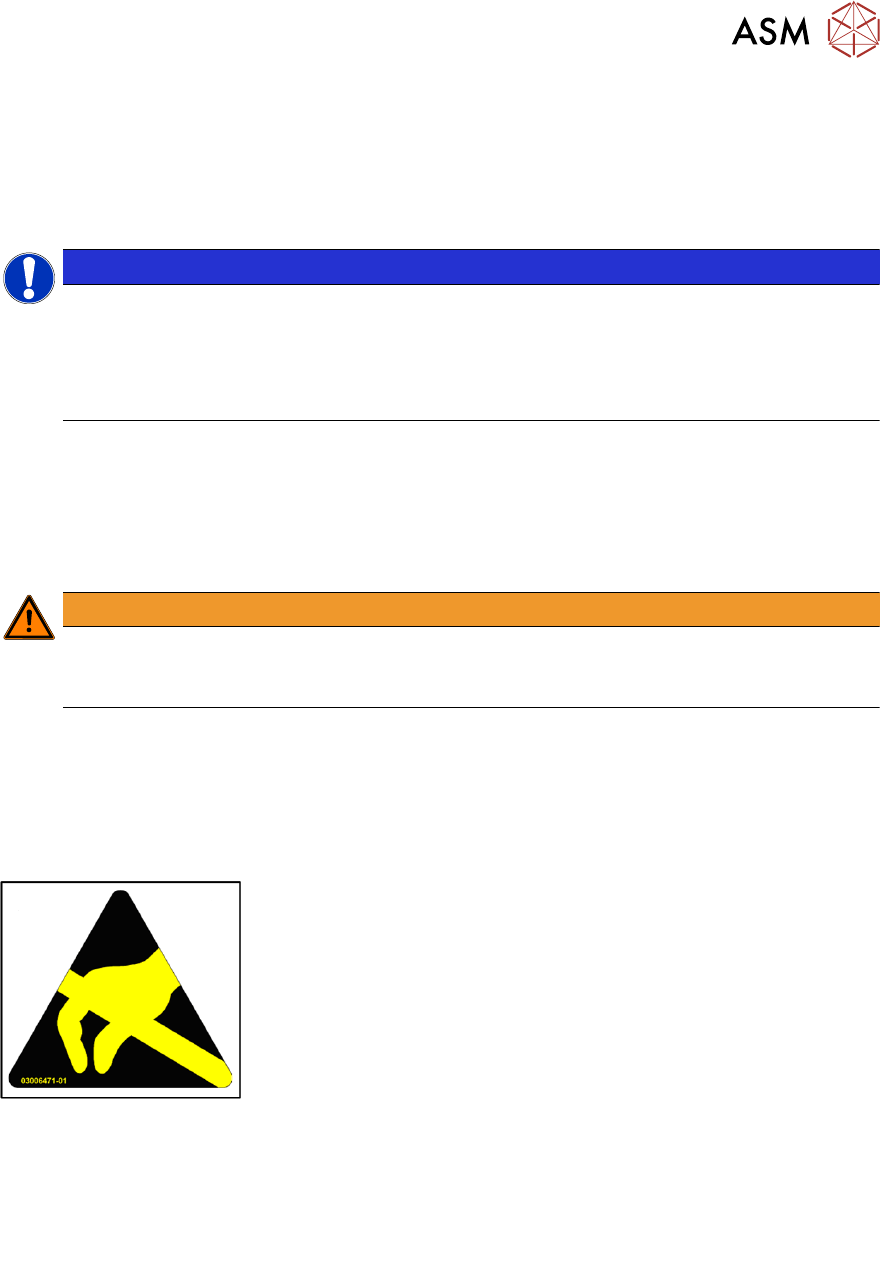
Fig.2: ESD label
Almost all of the modules in use today are equipped with highly integ-
rated Metal-Oxide-Semiconductor (MOS) blocks and components.
The manufacturing techniques used mean that these electronic com-
ponents are extremely sensitive to overvoltage and thus to electro-
static discharge.
The abbreviation for such modules is "ESD" (Electrostatic Sensitive
Device). "ESD" is used internationally. The following symbol on cab-
inet rating plates, racks or packaging indicates that components
which are sensitive to electrostatic discharge have been used and
thus that the modules concerned are also touch-sensitive.
ESDs can be destroyed by voltages and power levels that are far below the level that can be per-
ceived by humans. Such voltages occur if a person touches a component or module without
earthing themselves. Components that are exposed to such overvoltages do not generally appear
to be defective immediately - incorrect behavior starts after the component or module has been in
operation for some time.
1.3.4.2 Important measures to protect against static charging
► Most plastics can easily become charged and must therefore be kept away from at-risk com-
ponents.
► Always ensure that people, the workplace and packaging are safely earthed when handling
electrostatic sensitive components.

1 Introduction
1.3 Other instructions
12 Service Manual ASM ProcessLens Dual-lane 09/2018
1.3.4.3 Handling ESD modules
Do not touch electronic modules unless it is absolutely essential to do so in order to carry out other
work. If it is necessary, make sure that you do not touch the pins or printed conductors when you
pick up flat modules.
Do not touch components unless:
●
you are constantly earthed by an ESD wrist strap or
●
You are wearing ESD shoes or ESD shoe earthing strips on an ESD floor.
Always discharge yourself before you touch an electronic module. To do this, simply touch a con-
ductive and earthed object immediately before you touch the module (such as unpainted parts of a
switch cabinet, a water pipe, etc.).
Do not allow modules with chargeable and highly insulating materials to touch one another, e.g.
plastic films, insulating table surfaces or items of clothing made from synthetic fibers.
Always place the modules on a conductive surface (table with an ESD coating, conductive ESD
foam, ESD bag or container).
Do not move the assemblies near to data view devices, monitors or television units. Keep a min-
imum distance of 10 cm to monitors.
1.3.4.4 Measurements and modifications to ESD modules
Do not take measurements on the modules unless the following conditions are fulfilled:
●
The measuring device is earthed (e.g. via PE conductors) or
●
You discharge the measuring head just before taking measurements with a potential-free
measuring device (e.g. by touching an unpainted metal part of the controller casing).
► Always use an earthed soldering iron if you carry out any soldering work.
1.3.4.5 Dispatching ESD modules
► Always store modules and components in conductive packaging (e.g. metallized plastic bags
or metal sleeves) and dispatch them in conductive packaging.
► If the packaging is not conductive, place the modules in a conductive envelope before pack-
aging. Use conductive expanded rubber, ESD bags, domestic aluminum foil or paper, for ex-
ample. NEVER use plastic bags or film.
► If the module has integral batteries, ensure that the conductive packaging does not touch or
short circuit the battery terminals and, if necessary, first cover the terminals with insulating
tape or material.
1.3.5 Validity of document
This document contains service work instructions for the ASM ProcessLens machine.
The manual focuses on describing mechanical service work.
Please refer to the circuit diagram folder for any electrical checks.
1.3.6 Release history
Release Changes
12/2016 First edition
09/2018 New conveyor