80S-15贴片机.pdf - 第230页
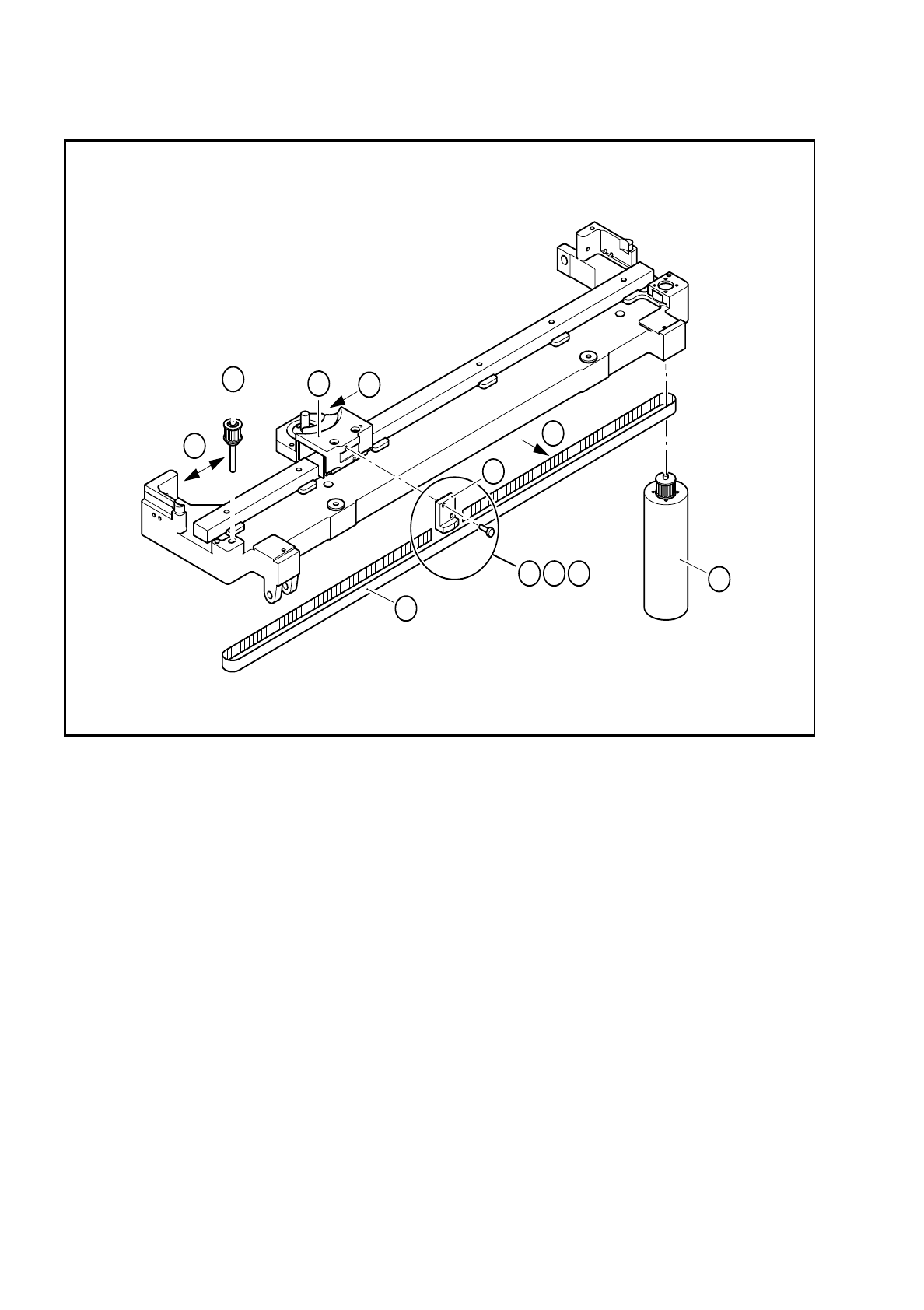
7 Components Table S IPLACE 80 S/F/G Servic e Manual Edition 04/97 7 - 48 Fig. 7.6.5 Replacing and tensioning the endless t oothed belt 1 C lamping c onnector 2 D rive motor 3 C utter w heel carr iage 4 D eflect ion pu l…

SIPLACE 80 S/F/G Service Manual 7 Components Table
Edition 04/97
7 - 47
NOTE
The exact adjustment is carried out with the aid of the belt tension measuring device.
●
Bring the empty tape cutting unit into a stable position, and then position the belt tension measuring device
at the empty tape cutting unit corresponding to the measurement point in Fig. 7.6.4.
●
Measure the belt tension when the carriage is on the left and when it is on the right:
–
Halfway along the belt you must measure 40 - 45Hz.
●
If necessary, correct the toothed belt tension by moving the corresponding tension piece.
●
Finally make sure that the screws are firmly tightened up at the tension pieces.
●
If applicable, go straight on to check the endless toothed belt (see next section).
●
Fit the empty tape cutting unit into the machine as described in section 7.6.6, subsection "Reinstalling and
adjusting the empty tape cutting unit",.
●
Carry out the "Concluding work" including a function check (see section 7.6.15 on page 7 - 55).
7.6.11 Checking, Replacing and Tensioning the Endless Toothed Belt
If the endless toothed belt is damaged or incorrectly tensioned, this can - similarly to the cut toothed belt - be
the cause of the motor being switched out, premature wear or tapes not being cut.
●
To remove the empty tape cutting unit follow precisely the same procedure as for the cut toothed belt
described above, from the first point.
●
Undo the screws fastening the clamping connector to the cutter wheel carriage (2 socket-head cap screws
M4, see Fig. 7.6.5.) and lift the defective cut toothed belt upwards and off the synchronizing disks.
●
Fit the new endless toothed belt: A, B, C in Fig. 7.6.5. Make sure that the welded join of the toothed belt is
positioned centrally in the clamping connection.
●
Bring the empty tape cutting unit into a stable position, and move the cutter wheel carriage to its left end
position.
●
Measure the belt tension in the middle of the toothed belt using the belt tension measuring device:
–
The toothed belt tension must amount to 30 - 35Hz.
●
If this is not the case, correct the position of the lefthand synchronizing disk axle within the slot accordingly.
To do this, slacken off the hexagonal nuts at the lower end of the axle (underside of the support).
●
Finally, make sure that the synchronizing disks mounting is firmly seated.
●
Fit the empty tape cutting unit back into the machine as described in section 7.6.6, subsection "Reinstalling
and adjusting the empty tape cutting unit".
●
After this carry out the "Concluding work" including checking functioning (see section 7.6.15 on
page 7 - 55).
7 Components Table SIPLACE 80 S/F/G Service Manual
Edition 04/97
7 - 48
Fig. 7.6.5 Replacing and tensioning the endless toothed belt
1 Clamping connector
2 Drive motor
3 Cutter wheel carriage
4 Deflection pulley
5 Endless toothed belt
A Insert the endless toothed belt
B Check whether the toothing of the clamping connector has engaged with the toothing of the endless
toothed belt.
C Screw in the clamping connector without pinching the toothed belt.
D Measure the belt tension in the middle of the toothed belt, setpoint value 30-35 Hz.
E To measure the belt tension move the cutter wheel carriage to its left end position.
F Correct the belt tension, if necessary, by moving the deflection pulley.
,,
4
F
E
3
5
2
1
D
A B C

SIPLACE 80 S/F/G Service Manual 7 Components Table
Edition 04/97
7 - 49
7.6.12 Swivel Mechanism
–
If the pressure rod is not pressed strongly enough against the spring bows or the empty tape during the
cutting process (see Fig. 7.6.8), the tapes may slip over one another during cutting (tape jam, poor cuts).
–
If the pressure rod does not swing out far enough when the tape cycles on, the tapes may not slide down
the empty tape channel which will also lead to a tape jam.
A fault in the swivel movement can indicate a fault in the 5.6 bar compressed air branch, in the solenoid valve,
in the compressed air cylinder, or incorrect adjustment of the restrictor valves or fatigued tension springs.
–
Detailed information on the electrical and pneumatic systems and on the functional sequence will be found
under "Overview" in section 7.1.4 "Empty Tape Cutting Device".
7.6.12.1 Checking the Swivel Movement
●
Please observe the DANGER notes in section 7.6.2 on page 7 - 34, concerning working with the SITEST
program
(danger of physical injury!)
.
●
Select "Abort placement" and load the SITEST program.
●
If necessary, have on hand the detailed functional sequence described in section 7.1.4 "Empty Tape Cut-
ting Device".
●
Select "BE table"
→
"Single function"
→
"Tape cutter".
●
At the same time check by eye the empty tapes and the swivel movement of the pressure rod.
–
If the pressure rod does not swing far enough in or out, check the compressed air branch as described
below.
–
If the pressure rod swings in too slowly or bounces as it swings in or out, adjust the supply or exhaust
air restrictor valve (see "Concluding work").
7.6.12.2 Checking the Compressed Air Branch
●
Remove the compressed air unit cover from the machine base (undo 2 special socket-head cap screws
M3).
●
Check the threaded hose connections at the solenoid valve of the tape cutting unit (see Fig. 7.6.7) and at
the compressed air unit (see Fig. 7.6.6) for leaks.
●
If these screwed connections are okay, proceed as follows:
DANGER
QQQ
Switch the machine off at the main switch and disconnect it from the power supply.
NOTE
OOO
Switch the compressed air supply line at the shut-off valve of the compressed air unit (see Fig. 7.6.6).
●
Check the compressed air hose between the compressed air unit and the solenoid valve:
–
If the compressed air hose pinched, replace it. Replace all of the cable lacings.