M8_ServiceManual_e.pdf - 第90页
4 Electrical Section 4-22 The detail of 7 segm ents LED indications is shown in t he below table. Diagnostic Code Meaning Diagnostic Code Meaning 02h Verify processor mode 41h Initialize extended memo ry for RomPilot 03h…
4 Electrical Section
4-21
Motion Port
Port No. Drive No. DI/DO Control Motor
Access AMP
Drive 1 - Control X1 Axis Motor X1 Axis AMP
X60
Drive 2 - Control X2 Axis Motor X2 Axis AMP
Drive 3 - Control Y Axis Motor Y Axis AMP
X61
Drive 4 - Control W Axis Motor W Axis AMP
Drive 5 6/8 Control Z and T Axes Motors (Front Unit) Z/T AMP ( 1
~
4 )
X62
Drive 6 4/8 Control Z and T Axes Motors (Rear Unit) Z/T AMP ( 5
~
8 )
Drive 7 - CTF (F), Control Z Axis Motor CTF (F) Z AMP
X63
Drive 8 - CTF (F), Control Y Axis Motor CTF (F) Y AMP
Drive 9 - CTF (R), Control Z Axis Motor CTF (R) Z AMP
X64
Drive10 - CTF (R), Control Y Axis Motor CTF (R) Y AMP
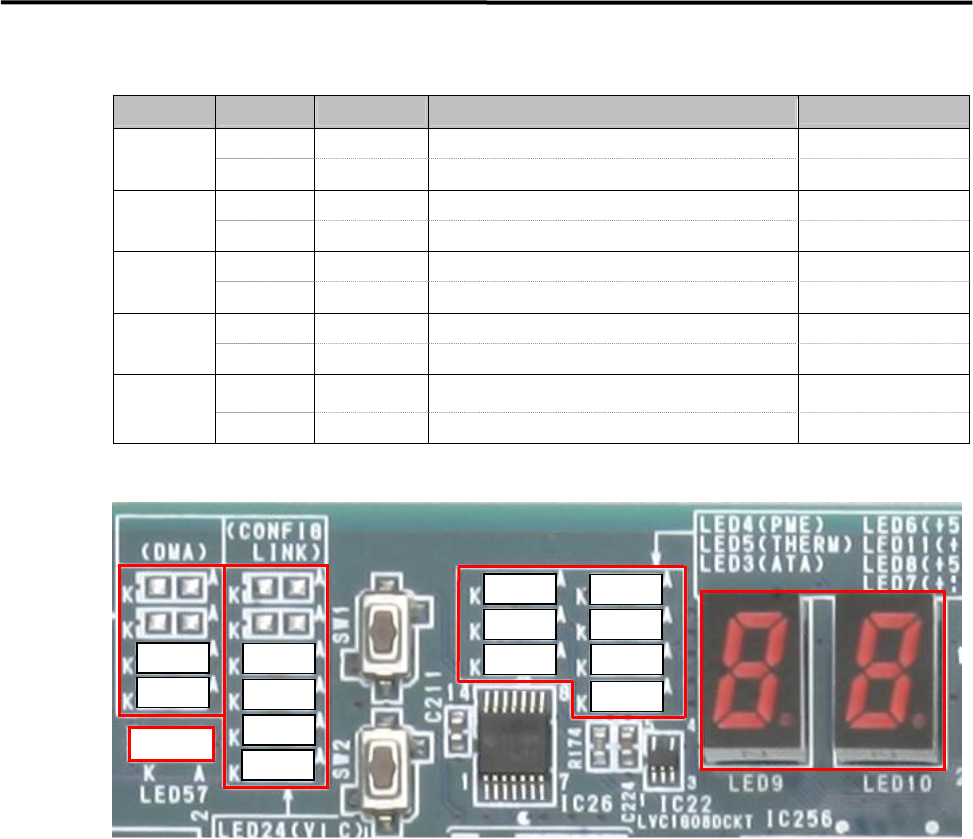
Operation Check LED
① DMA Transfer LED ; Transferring → Yellow
LED21 ; Vision Stage A Vision Data Transfer
LED27 ; Motion Axis Data Transfer
② Initialization Completion LED ; After initialization → Yellow
LED20 ; Vision Stage A
LED26 ; Motion
LED51 ; Serial I/O
LED54 ; Encoder, Trigger, Laser I/F
③ CPU Operation Check LED
LED 4 ; Red Color → Power Saving Mode
LED 5 ; Red Color → CPU Module Temperature Abnormal
LED 3 ; Yellow Color → Accessing HDD
④ ATX Power Supply Voltage LED ; Normal → Green
LED 6 ; +5V Standby
LED11; +3.3V
LED 8 ; +5V
LED 7 ; +12V
⑤ 7Segments LED
“c0” sign will be indicated after Windows has booted up normally.
Usually, the indication will be changing ,『2A』⇒・・・・・⇒『60』⇒・・・・・⇒『c0』.
The detail of other indications is shown in the next page.
LED57
③
④
②
①
⑤
LED27
LED21
LED54
LED51
LED26
LED20
LED 7
LED 8LED 3
LED 5
LED 4
LED11
LED 6

4 Electrical Section
4-22
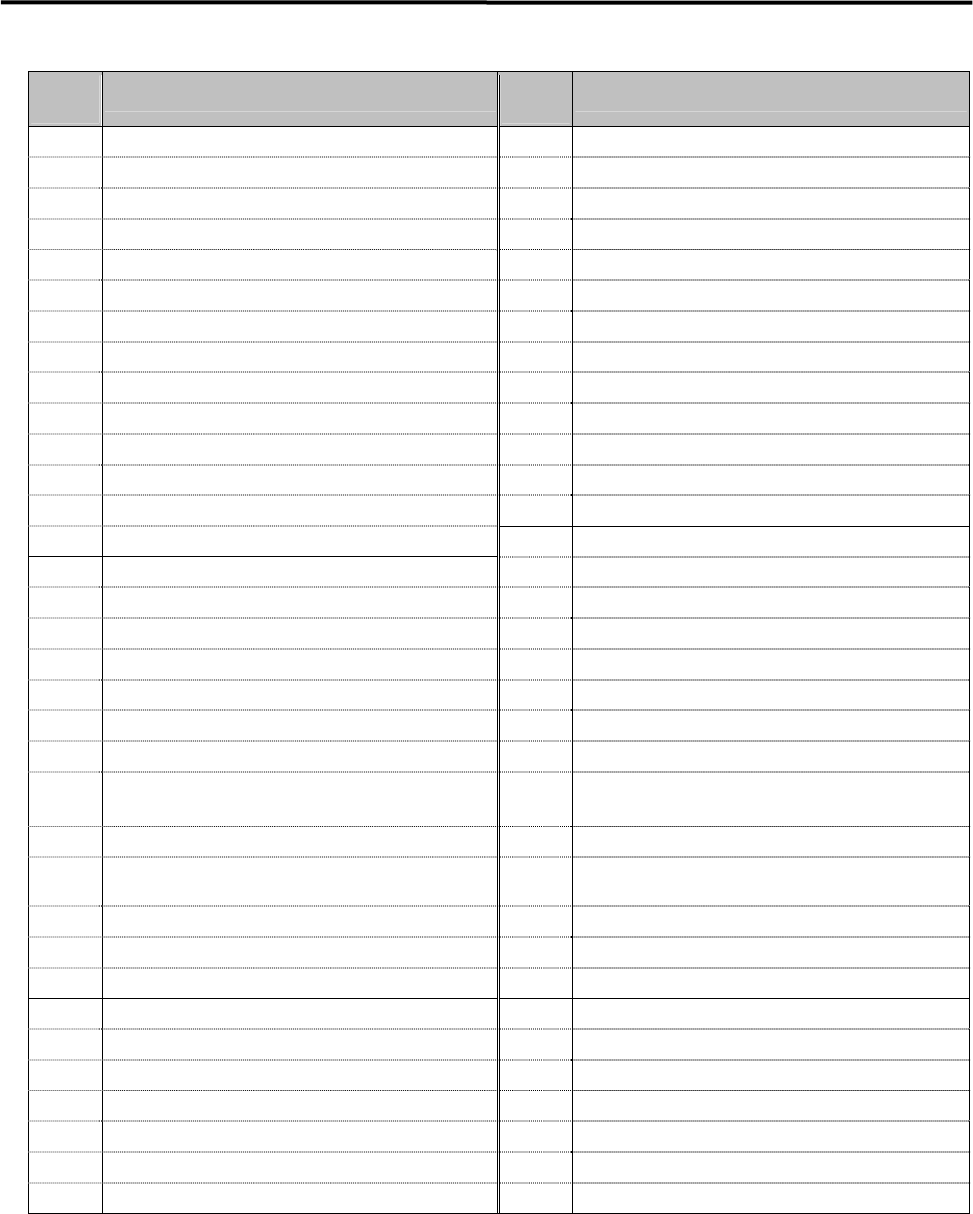
The detail of 7 segments LED indications is shown in the below table.
Diagnostic
Code
Meaning
Diagnostic
Code
Meaning
02h Verify processor mode 41h Initialize extended memory for RomPilot
03h Disable Non-Maskable Interrupt (NMI) 42h Initialize interrupt vectors
04h Get CPU type 45h POST device initialization
06h Initialize system hardware 46h Check ROM copyright notice
07h Disable shadow and execute code from the ROM. 47h Initialize I2O support
08h Initialize chipset with initial POST values 48h Check video configuration against CMOS
09h Set IN POST flag 49h Initialize PCI bus and devices
0Ah Initialize CPU registers 4Ah Initialize all video adapters in system
0Bh Enable CPU cache 4Bh QuietBoot start
0Ch Initialize caches to initial POST values 4Ch Shadow video BIOS ROM
0Eh Initialize I/O components 4Eh Display BIOS copyright notice
0Fh Initialize the local bus IDE 4Fh Initialize MultiBoot
10h Initialize Power Management 50h Display CPU type and speed
11h Load alternate registers with initial POST values 51h Initialize EISA board
12h Restore CPU control word during warm boot 52h Test keyboard
13h Initialize PCI Bus Mastering devices 54h Set key click if enabled
14h Initialize keyboard controller 55h Enable USB devices
16h BIOS ROM checksum 58h Test for unexpected interrupts
17h Initialize cache before memory autosize 59h Initialize POST display service
18h 8254 timer initialization 5Ah Display prompt "Press F2 to enter SETUP"
1Ah 8237 DMA controller initialization 5Bh Disable CPU cache
1Ch Reset Programmable Interrupt Controller 5Ch Test RAM between 512 and 640 KB
20h Test DRAM refresh 60h Test extended memory
22h Test 8742 Keyboard Controller 62h Test extended memory address lines
24h Set ES segment register to 4 GB 64h Jump to UserPatch1
28h Autosize DRAM 66h Configure advanced cache registers
29h Initialize POST Memory Manager 67h Initialize Multi Processor APIC
2Ah Clear 512 KB base RAM 68h Enable external and CPU caches
2Ch RAM failure on address line xxxx 69h Setup System Management Mode (SMM) area
2Eh RAM failure on data bits xxxx of low byte of memory
bus
6Ah
Display external L2 cache size
2Fh Enable cache before system BIOS shadow 6Bh Load custom defaults
32h Calculate CPU speed 6Ch Display shadow-area message
33h Initialize POST Dispatch Manager 6Eh Display possible high address for UMB recovery
34h Test CMOS RAM and RTC 70h Display error messages
36h Initialize shut down victor for warm start 72h Check for configuration errors
38h Shadow system BIOS ROM 76h Check for keyboard errors
3Ah Autosize cache 7Ch Set up hardware interrupt vectors for 08-0F and 70-77
3Ch Advanced configuration of chipset registers 7Dh Initialize Intelligent System Monitoring
3Dh Load alternate registers with CMOS values 7Eh Initialize coprocessor if present
4 Electrical Section
4-23
Diagnostic
Code
Meaning
Diagnostic
Code
Meaning
80h Disable onboard Super I/O ports and IRQs B0h Check for errors
81h Late POST device initialization B1h Inform RomPilot about the end of POST.
82h Detect and install external RS232 ports B2h POST done - prepare to boot operating system
83h Configure non-MCD IDE controllers B4h One short beep before boot
84h Detect existence of parallel ports B5h Terminate QuietBoot
85h Checking for PnP ISA devices B6h Check password
86h Re-initialize onboard I/O ports B7h Initialize ACPI-BIOS
87h Configure Motherboard Configurable Devices B9h Clear Screen
88h Initialize BIOS Data Area BAh Initialize SMBIOS
89h Enable Non-Maskable Interrupts (NMIs) BCh Clear parity checkers
8Ah Initialize Extended BIOS Data Area BDh Display MultiBoot menu
8Bh Test and initialize PS/2 mouse BEh Clear screen
8Ch Initialize floppy controller BFh Check virus and backup reminders
8Fh Determine number of ATA drives C0h Try to boot with INT 19
90h Initialize hard-disk controllers C1h Initialize POST Error Manager (PEM)
91h Initialize local-bus hard-disk controllers C2h Initialize error logging
92h Jump to UserPatch2 C3h Initialize error display function
93h Build MPTABLE for multi-processor boards C4h Initialize system error handler
95h Install CD ROM for boot C5h PnP dual CMOS
96h Clear huge ES segment register C6h Initialize note dock
97h Fixup Multi Processor table C7h Initialize note dock rate
98h Search for option ROMs. One long, two short beeps on
checksum failure
C8h
Force check
99h Check for SMART Drive C9h Extended checksum
9Ch
Set up Power Management
CBh
Redirect Int 13h to Memory Technologies Devices
such as ROM, RAM,PCMCIA, and serial disk
9Dh Initialize security engine CCh Redirect Int 10h to enable remote serial video
9Eh Enable hardware interrupts CDh Redirect Int 15h to enable remote keyboard
9Fh Determine number of ATA and SCSI drives CEh Initialize digitizer and display message
A0h Test Real Time Clock interrupt D2h Unknown interrupt
A2h Check key lock E0h Check memory mounting
A4h Initialize Typematic rate
A8h Erase F2 prompt
AAh Scan for F2 key stroke
ACh Enter SETUP
AEh Clear Boot flag