MIL- STD-883F 2004 TEST METHOD STANDARD MICROCIRCUITS.pdf - 第305页
MIL-STD-883F METHOD 2017.8 18 June 2004 15 Class H Class K b. The number of c ontinuous str ands along t he mesh is less than 50 per cent of lengthwis e st rands t hrough each sect ion. ( see Figur e 2017-8a). c. Les s t…
MIL-STD-883F
METHOD 2017.8
18 June 2004
14
Class H Class K
f. Bonding tool impression less than 1.0 mil from the die edge (see Figure 2017-6).
g. Effective bonded area less than 50 percent of that which would be possible for an exactly aligned beam (see
Figure 2017-6).
h. Any tears in the beam lead between the bond junction nearest the die body and the die or in the bonded area of
the beam lead within a distance equal to 50 percent the beam lead width (see Figure 2017-7).
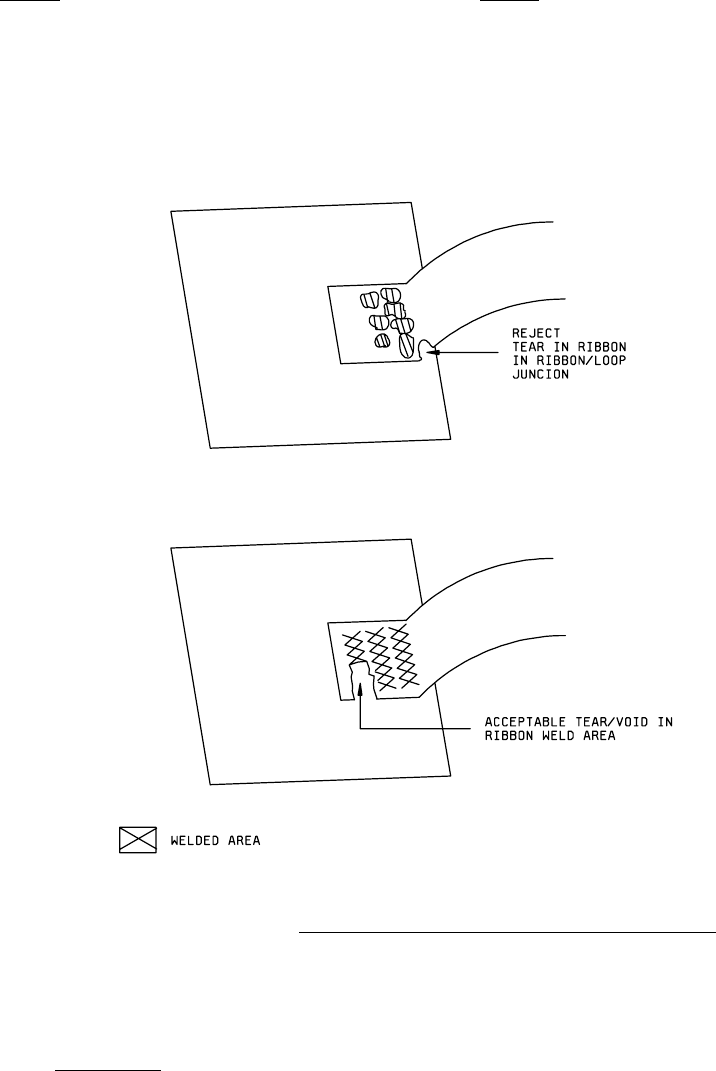
FIGURE 2017-7. Acceptable/rejectable tears or voids in ribbon weld area
.
i. An absence of visible separation between the bond and the edge of the passivation layer (see Figure 2017-6).
j. An absence of visible separation between a beam lead and non-electrically common metallization. This criteria applies
for both glassivated and unglassivated metallization.
3.1.5.6 Mesh bonding
. No device shall be acceptable that exhibits the following:
a. Less than 50 percent of the bond is on substrate metallization.
MIL-STD-883F
METHOD 2017.8
18 June 2004
15
Class H Class K
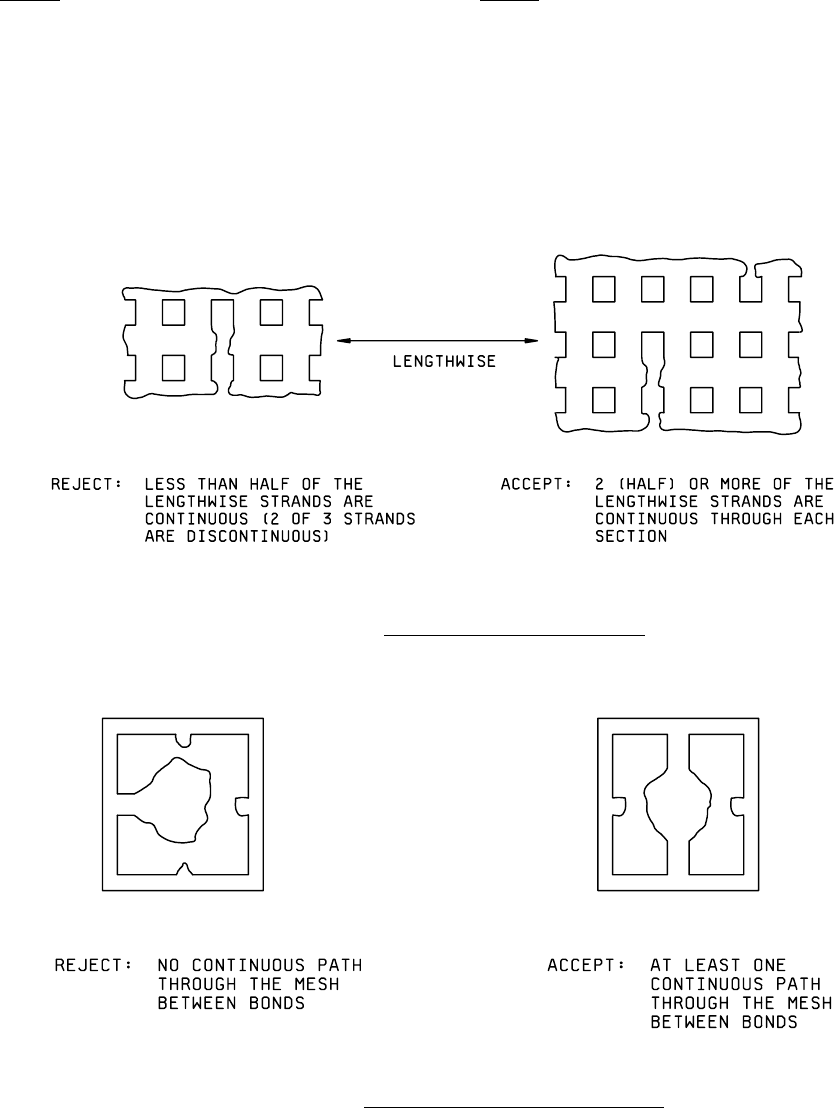
b. The number of continuous strands along the mesh is less than 50 percent of lengthwise strands through each
section. (see Figure 2017-8a).
c. Less than one continuous Less than two continuous conducting
conducting path(s) through a path(s) through a bond (see Figure
bond (see Figure 2017-8b). 2017-8b).
FIGURE 2017-8a. Criteria for strands along the mesh
.
FIGURE 2017-8b. Criteria for continuous conducting paths
.

MIL-STD-883F
METHOD 2017.8
18 June 2004
16
Class H Class K
3.1.5.7 Ribbon bonds
. No device shall be acceptable that exhibits the following:
a. Any tears in the ribbon at the junction between the ribbon loop and bond/weld.
b. Bonds which do not exhibit 100 percent bond/weld impression(s) across the width of the ribbon overlapping
underlying metallization.
NOTE: Gaps between welds on the ribbon caused by the natural footprint of a weld tip (i.e., split tip, etc.) are acceptable
provided the total of all gaps do not exceed 25 percent of the ribbon width.
c. Effective bonded area less than 50 percent of that which would be possible for an exactly aligned ribbon.
d. Bond tails longer than one ribbon width or 10.0 mils, whichever is less, or bridging adjacent metallization.
e. The unbonded end of a ribbon bond tuning stub longer than one ribbon width of 10.0 mils, whichever is less, that is
not secured by polymer adhesive.
3.1.5.8 General
. No device shall be acceptable that exhibits:
a. Bonds on the die where less Monometallic bonds on the die where less
than 50 percent of the bond than 50 percent of the bond is within
is within the unglassivated the unglassivated bonding site.
bonding site. Bimetallic bonds on the die where less
than 75 percent of the bond is within
the unglassivated bonding site.
b. Bonds on the package post or substrate that are not completely within the bonding site.
NOTE: For cases where the substrate bonding site is smaller than 1.5 times the minimum bond size, bonds on the
substrate where less than 50 percent of the bond is within the bonding site.
c. Bonds placed so that the wire exiting from a bond crosses over another bond, except by design, in which case the
clearance shall be 2.0 wire diameters minimum (common bonds are excluded from this criteria).
d. An absence of a visible line of separation between non-electrically common bonds.
e. An absence of a visible line of separation between a bond and non-electrically common metallization. This criteria
applies to both glassivated and unglassivated metallization.
f. Wire bond tails that extend over or make contact with any noncommon, unglassivated active metal.
g. Wire bond tails that exceed two wire diameters in length at the bonding pad or four wire diameters in length at the
package post.
h. Bonds on element attach media or on contaminated or foreign material.
i. Any lifted or peeling bond.
j. Intermetallic formation extending completely around the metallic interface of any bond between dissimilar metals.