MIL- STD-883F 2004 TEST METHOD STANDARD MICROCIRCUITS.pdf - 第371页
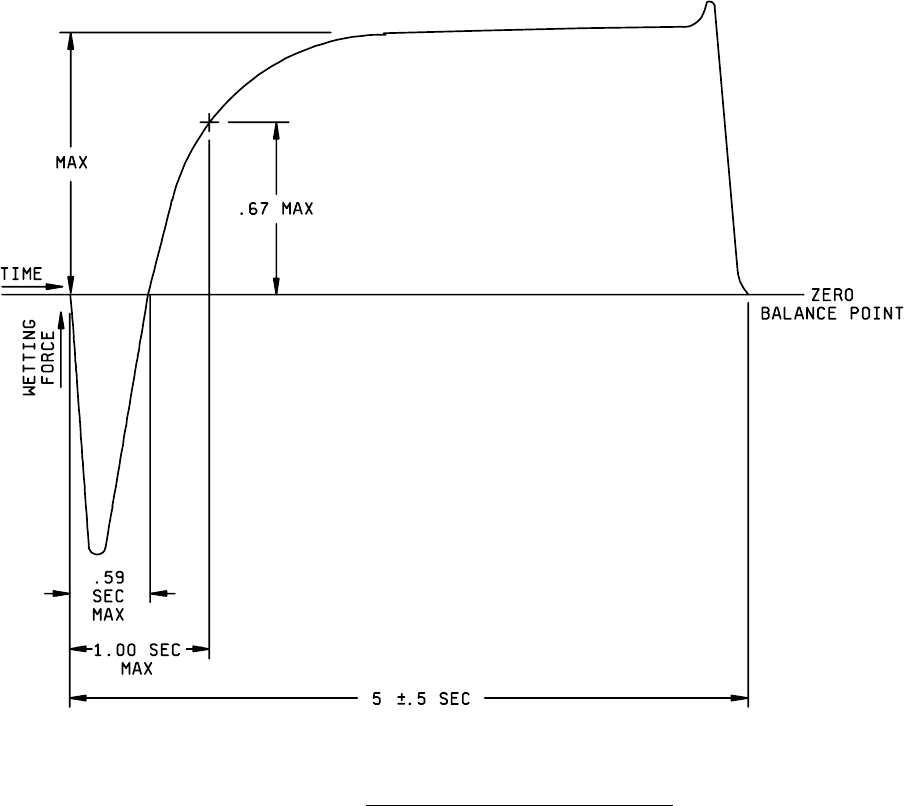
MIL-STD-883F METHOD 2022.2 29 May 1987 3 FIGURE 2022-1. W ett ing balanc e curve eval uation c riter ia .
MIL-STD-883F
METHOD 2022.2
29 May 1987
2
3.2 Aging. Prior to the application of the flux and subsequent solder dips, all specimens assigned to this test shall be
subjected to aging by exposure of the surfaces to be tested to steam in the container specified in 2.3. The specimens shall
be suspended so that no portion of the specimen is less than 1.5 inches (38.10 mm) above the boiling distilled or deionized
water with the cover specified in 2.3 in place for 4 to 8 hours. In effect while the manufacturer may accept on the basis of 4
hours aging, the customer/user shall be able to reject on the basis of results after 8 hours aging. Means of suspension shall
be a nonmetallic holder. If necessary, additional hot distilled water may be gradually added in small quantities so that the
water will continue to boil and the temperature will remain essentially constant.
3.3 Application of flux
. Flux, type R shall be used (see 2.4.1). Terminations shall be immersed in the flux, which is at
room ambient temperature, to the minimum depth necessary to cover the surface to be tested. Unless otherwise specified
in the applicable acquisition document, terminations shall be immersed to 0.16 inch (4 mm) from end of lead. The surface to
be tested shall be immersed in the flux for a period of from 5 to 10 seconds.
3.4 Solder dip
. The dross and burned flux shall be skimmed from the surface of the molten solder specified in 2.4.2. The
molten solder shall be maintained at a uniform temperature of 245 ±5°C. The surface of the molten solder shall be skimmed
again just prior to immersing the terminations in the solder. The part shall be attached to a dipping device (see 2.2) and the
flux-covered terminations immersed once in the molten solder to the same depth specified in 3.3. The immersion and
emersion rates shall be 1 ±.25 inches (25.40 ±6.35 mm) per second and the dwell time in the solder bath shall be 5 ±0.5
seconds.
3.5 Evaluation of resultant meniscograph curves from testing of microelectronic leads
. The criteria for acceptable
solderability during the evaluation of the recordings are:
a. That the recorded signal trace crosses the zero balance point at or before 0.59 seconds of test time.
b. That the recorded signal trace reaches two-thirds of its maximum value in 1 second or less of test time (see figure
2022-1).
4. SUMMARY
. The following details must be specified in the applicable acquisition document:
a. The number of terminations of each part to be tested (see 3).
b. Special preparation of the terminations, if applicable (see 3.1).
c. Depth of immersion if other than 0.16 inch (4 mm) (see 3.3).
d. Solder dip if other than specified in 3.4.
e. Evaluation of meniscograph curves if other than specified in 3.5.
f. Solder composition, flux, and temperature if other than those specified in 2.4 and 3.4.
g. Number of cycles, if other than one. Where more than one cycle is specified to test the resistance of the device to
heat as encountered in multiple solderings, the examinations and measurements required shall be made at the end
of the first cycle and again at the end of the total number of cycles applied. Failure of the device on any
examination and measurement at either the one-cycle or the end-point shall constitute failure to meet this
requirement.
MIL-STD-883F
METHOD 2022.2
29 May 1987
3
FIGURE 2022-1. Wetting balance curve evaluation criteria
.
MIL-STD-883F
METHOD 2022.2
29 May 1987
4
This page intentionally left blank