MIL- STD-883F 2004 TEST METHOD STANDARD MICROCIRCUITS.pdf - 第629页
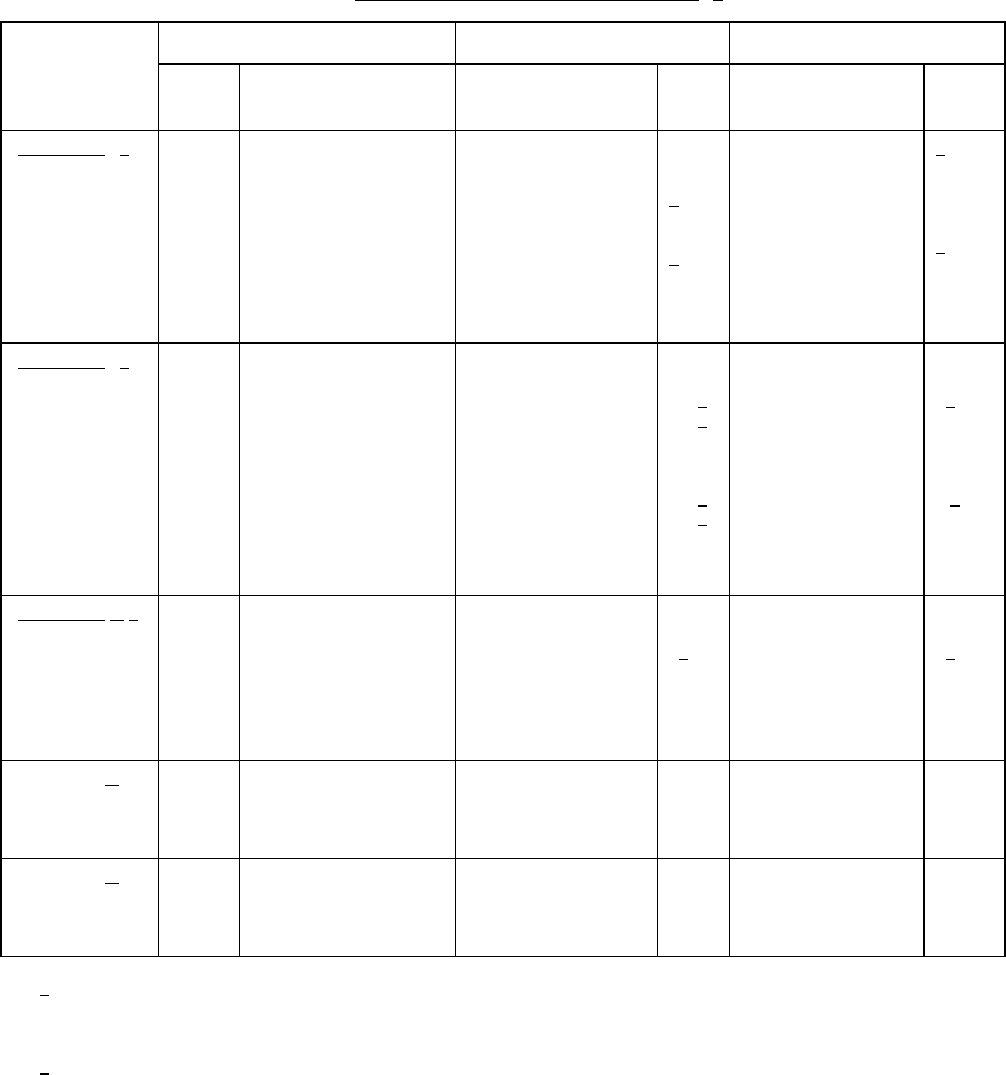
MIL-STD-883F METHOD 5005.14 18 June 2004 13 TABLE V. Group E ( radiati on hardness ass urance t ests ) . 1/ Test MIL- STD-883 Class le vel S Class le vel B Method Conditi on Quantit y/ accept number Notes Quantit y/ acce…
MIL-STD-883F
METHOD 5005.14
18 June 2004
12
TABLE IV. Group D (package related tests) (for class levels B and S) - Continued.
3
/ The sample size number of 45, C = 0 for lead integrity shall be based on the number of leads or terminals tested
and shall be taken from a minimum of 3 devices. All devices required for the lead integrity test shall pass the seal
test if applicable (see 4
/) in order to meet the requirements of subgroup 2. For leaded chip carrier packages, use
condition B1. For pin grid array leads and rigid leads, use method 2028. For leadless chip carrier packages only,
use test condition D and a sample size number of 15 (C = 0) based on the number of pads tested taken from 3
devices minimum.
4
/ Seal test (subgroup 2b) need be performed only on packages having leads exiting through a glass seal.
5
/ Devices used in subgroup 3, "Thermal and Moisture Resistance" may be used in subgroup 4, "Mechanical".
6
/ Lead bend stress initial conditioning is not required for leadless chip carrier packages. For fine pitch packages
(≤ 25 mil pitch) using a nonconductive tie bar, preconditioning shall be required on 3 devices only prior to the
moisture resistance test with no subsequent electrical test required on these 3 devices. The remaining 12 devices
from the sample of 15 devices do not require preconditioning but shall be subjected to the required endpoint
electrical tests.
7
/ After completion of the required visual examinations and prior to submittal to method 1014 seal tests, the devices
may have the corrosion by-products removed by using a bristle brush.
8
/ At the manufacturer's option, end-point electrical parameters may be performed after moisture resistance and
prior to seal test.
9
/ Visual examination shall be in accordance with method 1010 or 1011.
10
/ Test three devices; if one fails, test two additional devices with no failures. At the manufacturer's option, if the
initial test sample (i.e., 3 or 5 devices) fails a second complete sample may be tested at an alternate laboratory
that has been issued suitability by the qualifying activity. If this sample passes the lot shall be accepted provided
the devices and data from both submissions is submitted to the qualifying activity along with 5 additional devices
from the same lot. If sample size (accept number) of 5(1) is used to pass the lot, the manufacturer shall evaluate
his product to determine the reason for the failure and whether the lot is at risk.
11
/ The adhesion of lead finish test shall not apply for leadless chip carrier packages.
12
/ Sample size number based on number of leads.
13
/ Lid torque test shall apply only to packages which use a glass-frit-seal to lead frame, lead or package body (i.e.,
wherever frit seal establishes hermeticity or package integrity).
MIL-STD-883F
METHOD 5005.14
18 June 2004
13
TABLE V. Group E (radiation hardness assurance tests). 1/
Test
MIL-STD-883 Class level S Class level B
Method
Condition
Quantity/
accept
number
Notes
Quantity/
accept
number
Notes
Subgroup 1 2/
Neutron
irradiation
a. Qualification
b. QCI
Endpoint
electrical
parameters
1017
25°C
As specified in
accordance with
device specification
(a) 2(0) devices/wafer
11(0) devices/wafer lot
(b) 2(0) devices/wafer
11(0) devices/wafer lot
3
/
3
/
(a) 2(0) device/wafer
5(0) devices/wafer lot
11(0) devices/
inspection lot
(b) 2(0) devices/wafer
5(0) devices/wafer lot
11(0) devices/
inspection lot
4/
4
/
Subgroup 2 5/
Steady-state
total dose
irradiation
a. Qualification
b. QCI
Endpoint
electrical
parameters
1019
25°C
Maximum supply voltage
As specified in
accordance with
device specification
(a) 4(0) devices/wafer
2(0) devices/ wafer
22(0) devices/wafer lot
(b) 4(0) devices/wafer
2(0) devices/wafer
22(0) devices/wafer lot
(a) 6
/
8
/
(b) 6
/
8
/
(a) 2(0) devices/wafer
5(0) devices/wafer lot
22(0) devices/
inspection
(b) 2(0) devices/wafer
5(0) devices/wafer lot
22(0) devices/
inspection lot
7
/
7
/
Subgroup 3 2/ 9/
Transient
ionizing
irradiation
Endpoint
electrical
parameters
1021
Digital
1023
Linear
25°C
As specified in
accordance with
device specification
2(0) devices/wafer
11(0)
devices/wafer lot
3
/
2(0) devices/wafer
11(0)
devices/
inspection lot
4
/
Subgroup 4 2/
Radiation latch-
up
1020
As specified in the device
specification
As specified in the
device specification
As specified in the
device specification
Subgroup 5 2/
Single event
effects
ASTM
F-1192
As specified in the device
specification
4(0) deviceswafer
1
/ Parts used for one subgroup test may not be used for other subgroups but may be used for higher levels in the same
subgroup. Total exposure shall not be considered cumulative unless testing is performed within the time limits of the
test method. Group E tests may be performed prior to device screening (see 3.5.3).
2/ This test is to be conducted only when specified in the purchase order or contract.
3
/ In accordance with wafer lot. If one part fails, seven additional parts may be added to the test sample with no
additional failures allowed, 18(1).

MIL-STD-883F
METHOD 5005.14
18 June 2004
14
TABLE V. Group E (radiation hardness assurance tests) - Continued. 1/
4
/ In accordance with inspection lot. If one part fails, seven additional parts may be added to the test sample with no
additional failures allowed, 18(1).
5
/ Class level B devices shall be inspected using either the class level B quantity/accept number criteria as specified, or
by using the class level S criteria on each wafer.
6
/ In accordance with wafer for device types with less than or equal to 4,000 equivalent transistors/chip selected from
the wafer. The manufacturer shall define and document sampling procedures.
7
/ In accordance with inspection lot. If one part fails, 16 additional parts may be added to the test sample with no
additional failures allowed, 38(1).
8
/ In accordance with wafer for device types with greater than 4,000 equivalent transistors/chip selected from the wafer.
The manufacturer shall define and document sampling procedures.
9
/ Upset testing during qualification on first QCI shall be conducted when specified in purchase order or contract. When
specified, the same microcircuits may be tested in more than one subgroup.
3.5.2 Alternate group B inspection for class level B
. At the manufacturer's option, (class level B only), group B inspection
shall be performed on any inspection lot of each qualified package type and lead finish from each different week of sealing.
Different inspection lots may be used for each subgroup. After this alternate group B inspection is successfully completed,
all other device types manufactured on the same assembly line using the same package type and lead finish sealed in the
same week may be accepted without further group B testing. A manufacturer shall not accept inspection lots containing
devices of a particular package type and lead finish until after the successful completion of group B testing for that package
type and lead finish for each week of seal.
3.5.2.1 Nonconformance for the alternate group B inspection
. When a failure has occurred in group B using the alternate
group B procedure, samples from three additional inspection lots of the same package type, lead finish, and week of seal as
the failed package shall be tested to the failed subgroup(s). If all three inspection lots pass, then all devices manufactured
on the same assembly line using the same package type and lead finish and sealed in the same week may be accepted for
group B inspection. If one or more of the three additional inspection lot fail, then no inspection lot containing devices
manufactured on the same assembly line using the same package type and lead finish sealed in the same week shall be
accepted for group B inspection until each inspection lot has been subjected to and passed the failed subgroup(s).
3.5.3 Group E samples
. At the manufacturer's option (but subject to the criteria defined by 3.5.3.1, 3.5.3.2, and 3.5.3.3),
group E samples need not be subjected to all the screening tests of method 5004, but shall be assembled in a group D
qualified package and, as a minimum, pass group A, subgroups 1 and 7, electrical tests at 25°C prior to irradiation.
3.5.3.1 Group E tests shall be performed on samples that have been exposed to burn-in or
3.5.3.2 as an alternative, the requirement of 3.5.3.1 can be waived if previous testing has shown that burn-in produces
negligible changes in the device total dose response or
3.5.3.3 as an alternative, the Group E tests can be performed on samples which have not received burn-in if the results of
the Group E tests are corrected for the changes in total dose response which would have been caused by burn-in. This
correction shall be carried out in a manner acceptable to the parties to the test.
3.6 Disposition of samples
. Disposition of sample devices used in groups A, B, C, D, and E testing shall be in
accordance with the applicable device specification.
3.7 Substitution of test methods and sequence
.
3.7.1 Accelerated qualification or quality conformance testing for class level B
. When the accelerated temperature/time
test conditions of condition F of method 1005 are used for any operating life or steady state reverse bias subgroups on a
given sample for purposes of qualification or quality conformance inspection, the accelerated temperature/time test
conditions shall be used for all of those named subgroups. When these accelerated test conditions are used for burn-in
screening test (test condition F of method 1015) or stabilization bake (any test temperature above the specified maximum
rated junction temperature for devices with aluminum/ gold metallurgical systems) for any inspection lot, it shall be
mandatory that they also be used for the operating life, and steady-state reverse bias tests of method 5005, as applicable, or
qualification or quality conformance inspection. Qualification and quality conformance inspection may be performed using
accelerated conditions on inspection lots that have been screened using normal test conditions.